
Spain vs Belgium Prediction Market: What Polymarket Odds Say About the World Cup Quarterfinal


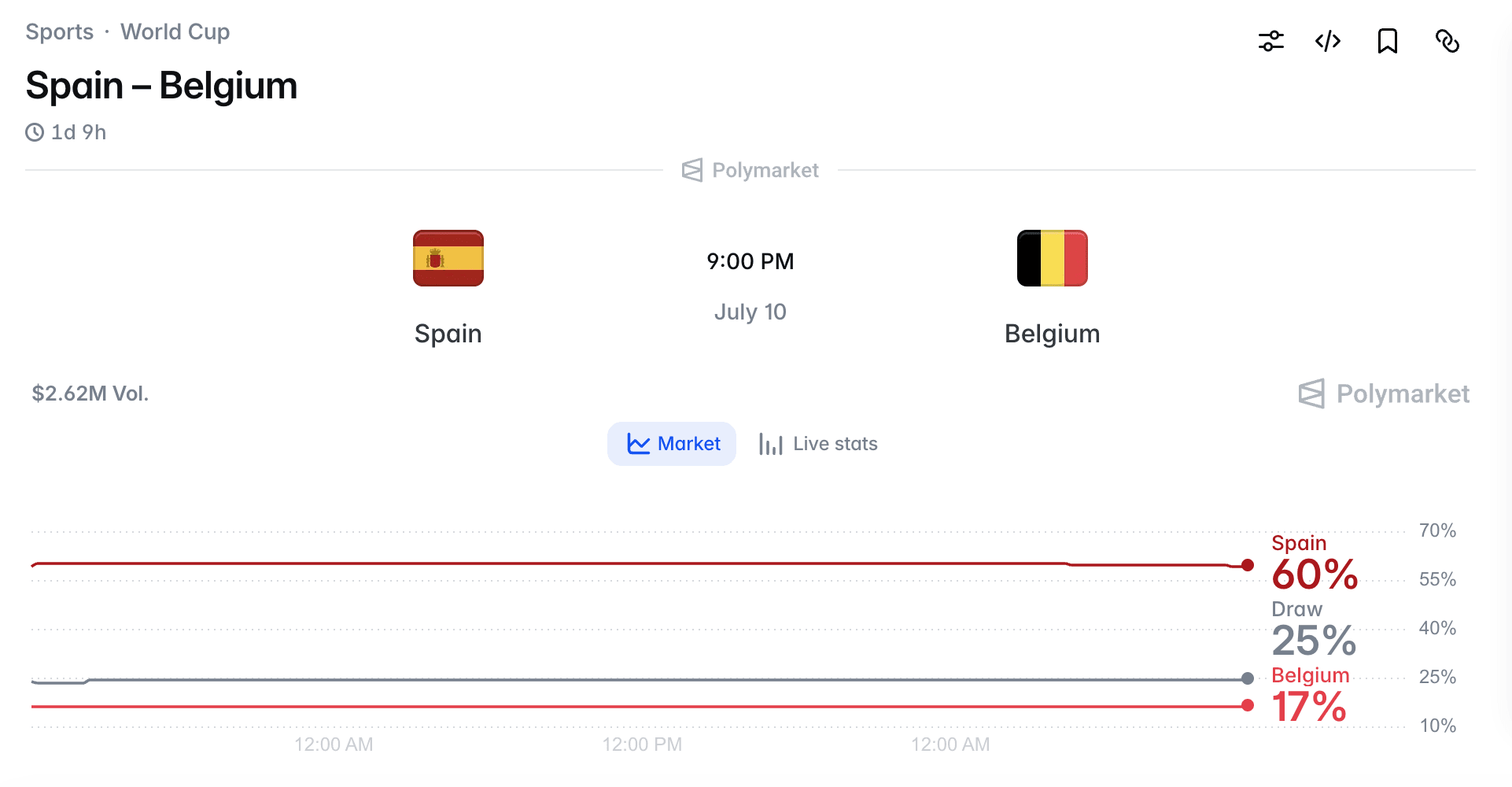
Spain vs Belgium prediction market odds have settled into one of the clearest signals of the 2026 World Cup quarterfinals. The Spain vs Belgium prediction market on Polymarket currently gives Spain a 60% chance of winning, Belgium a 17% chance, and a draw 25% probability heading into Friday's quarterfinal in Los Angeles. Understanding what the Spain vs Belgium prediction market is actually telling you, and what it might be missing, is more useful than simply accepting the numbers as a verdict on how the match will unfold.
Prediction markets have become the most watched real time probability tool for the 2026 World Cup, and this quarterfinal has produced one of the clearest directional signals of the knockout round. Those numbers reflect the collective judgment of traders putting real money behind their views. Understanding what the numbers mean, why they sit where they do, and where the market might be wrong is the most useful thing any reader can do before kickoff on Friday.
What the Polymarket Odds Actually Mean
A 60% probability for Spain does not mean Spain will definitely win. It means that across all the times Polymarket assigns 60% to a match outcome, that outcome occurs approximately 60% of the time when the market is well calibrated.
Belgium at 17% is not being written off entirely. It means the market believes Belgium wins roughly one in six times this exact match is played. That is a meaningful underdog probability, not a rounding error. History is full of World Cup matches where the 17% team went home celebrating.
The 25% draw probability is notable for a knockout match where draws lead to extra time and potentially penalties. A quarter of the probability sits on an outcome that neither team is explicitly playing for, which reflects how evenly matched the market believes the 90 minutes will be even if it ultimately favors Spain significantly.
Why Spain Is at 60%
The Spain probability is not arbitrary. It reflects a combination of factors that traders have collectively priced into the market.
Spain has been the most defensively dominant team of the tournament. Five matches played, zero goals conceded. Not one. That is the longest clean sheet run in World Cup history and it reflects a structural defensive organization under coach Luis de la Fuente that has frustrated every attacking unit it has faced. Portugal's Cristiano Ronaldo managed two shots on target in the round of 16, which was reportedly the most any team had managed before the half in any of Spain's games. That defensive record is not luck at this stage of the tournament.
The attacking side of Spain's game has been equally efficient. Lamine Yamal, still a teenager, has been one of the players of the tournament. Alvaro Morata provides the physical presence in attack. The midfield control that Spanish football has historically built its identity on remains intact even as the squad has evolved.
Spain also eliminated Portugal in the round of 16, which means they have already beaten the one team that prediction markets might otherwise have rated above them in this half of the bracket. Arriving in the quarterfinal with that result behind them adds a psychological dimension that the pure probability cannot fully capture.
Why Belgium Is at 17%
Belgium's 17% probability reflects a tournament journey that has been dramatic rather than dominant, and a match against the one opponent they might least want to face.
The Red Devils came through their group by the skin of their teeth. Two draws against Egypt and Iran, including a period with ten men, before a decisive win over New Zealand. They then came from two goals down against Senegal in the round of 16 with Romelu Lukaku saving the day in the closing minutes. Their round of 16 against the United States was more convincing, a commanding result, but the inconsistency of their earlier performances lingers in how traders assess their ceiling.
Kevin De Bruyne, Belgium's most influential player, was on the bench against the United States for the first time in 38 games under coach Rudi Garcia. Whether that was rotation ahead of a harder match or a signal about his physical condition is a question the prediction market cannot answer precisely, but traders are pricing it.
The historical record between the two teams adds another layer. Spain knocked Belgium out at the previous World Cup, and the tactical matchup between Spain's pressing, possession-based system and Belgium's transition-oriented attack is one that tends to favor Spain when both teams are performing at their recent levels.

What the 25% Draw Probability Is Telling You
The draw probability in a knockout match is not a prediction that the match ends level after 90 minutes and the teams shake hands. In World Cup knockout football, a draw after 90 minutes leads to extra time and potentially a penalty shootout.
A 25% draw probability means the market believes there is a one-in-four chance that 90 minutes is insufficient to separate the teams. That is actually a relatively high probability for a match where one team is a 60% favorite, and it reflects something specific about how the market sees this match playing out.
Spain's defensive organization makes them difficult to break down, but Belgium's ability to play on the counter through Doku, Lukaku, and the pace they carry in transition means they are capable of making the game tight even if they cannot dominate possession. A tight game where Spain control the ball and Belgium threaten on the break is exactly the kind of match that ends 0-0 or 1-1 and goes to extra time.
Belgium's tournament history in knockout matches is also relevant here. They are a team that has repeatedly taken matches deep before finding a way through or, in some cases, being eliminated in circumstances that were not predicted. The 25% draw probability reflects that historical pattern as much as it reflects pure tactical analysis.
What Prediction Markets Miss
Polymarket's 60-17-25 split is the most current publicly available probability estimate for this match, and it aggregates more information than any single analyst can produce. But there are specific things prediction markets cannot capture that experienced football observers would incorporate into their assessment.
Team news on the day of the match is the most significant factor. If Kevin De Bruyne's fitness is not at full capacity or if Spain have any concerns about key defenders, that information does not fully enter the market until it becomes public knowledge. Prediction markets update in real time when news breaks, but the hours before a match can involve privately held injury information that the market cannot price.
Tactical specifics that are only revealed in the match itself cannot be pre-priced. How Spain sets up defensively against Belgium's specific wide threats, whether De Bruyne plays and in what role, and which team's game plan better suits the conditions in Los Angeles on the day are all variables that become clear only once the match is underway.
Referee decisions, set piece execution, and the kind of genuine randomness that makes football compelling all sit outside what prediction markets can capture. A 60% probability means Spain wins this match roughly three times in five, which also means Belgium wins or the match draws roughly two times in five. That space for surprise is not a failure of the prediction market. It is an honest acknowledgment of football's fundamental unpredictability.
How to Use These Odds
For readers who are thinking about using prediction markets around this match, a few practical points apply.
The 60% probability for Spain is already fairly well established and reflects what most serious football analysis would conclude about this matchup. The informational edge in betting markets comes from identifying where the market is wrong, not from confirming what it already believes. If you have specific knowledge or analysis that suggests Belgium is undervalued at 17%, that is where the value sits. If your analysis broadly agrees with the market, the odds are unlikely to offer meaningful value.
The draw market at 25% is worth specific attention for anyone who watches Spain regularly. Spain's tendency to control matches without necessarily producing many clear chances means draws in their matches are structurally more likely than the typical tournament favorite's games. Whether 25% appropriately reflects that tendency or whether it should be higher is a judgment that requires watching this Spanish team through the tournament rather than just looking at the odds.
For readers following the World Cup, WEEX is running the WEEX Cup: Dice Rush campaign through July 20, combining trading tasks with football match predictions and a 1,000,000 USDT prize pool.
Conclusion
Polymarket's 60-17-25 split for Spain vs Belgium is a well-reasoned collective probability estimate that reflects Spain's defensive dominance, Belgium's inconsistency, and the genuine possibility that 90 minutes is insufficient to separate two teams with significantly different but potentially compatible tactical profiles.
Spain at 60% is the favorite for reasons the tournament record supports clearly. Belgium at 17% is an underdog but not an impossible one, and their ability to come from behind has been demonstrated repeatedly in this tournament. The 25% draw probability is the market's honest acknowledgment that Spain's control does not automatically translate into goals, and Belgium's transitional threat could keep this match tighter than the prematch probability suggests.
Friday's quarterfinal in Los Angeles is one of the most anticipated matches of the tournament. The prediction market has given you its best estimate of how it ends. What happens on the pitch will either confirm or confound that estimate, which is exactly what makes following these markets alongside the actual football so compelling.
FAQ
1. What does Polymarket say about Spain vs Belgium?
Polymarket currently gives Spain a 60% chance of winning, Belgium a 17% chance, and a draw including extra time and penalties a 25% probability. These odds reflect Spain's unbeaten defensive record and dominant tournament performance against Belgium's inconsistent but occasionally dangerous campaign.
2. Why is Belgium only at 17% despite reaching the quarterfinals?
Belgium's tournament journey has been marked by narrow escapes, two draws in the group stage and a late comeback against Senegal, contrasting with Spain's dominant clean sheet run through five matches. The market is also reflecting the historical tactical advantage Spain's possession-based system tends to have over Belgium's counter-attacking style.
3. What does the 25% draw probability mean in a knockout match?
In World Cup knockout football, a draw after 90 minutes leads to extra time and potentially penalties. The 25% probability reflects the market's view that there is a one-in-four chance neither team separates in regular time, which is plausible given Spain's defensive solidity and Belgium's ability to frustrate opponents.
4. How accurate are Polymarket World Cup predictions?
Prediction markets are well-calibrated across large samples, meaning their probability estimates reflect actual outcome frequencies closely. Polymarket claims over 94% accuracy in calibration terms across all markets. Individual match predictions carry genuine uncertainty, and a 60% favorite loses roughly two in five times over a large enough sample.
5. When and where is Spain vs Belgium played?
Spain vs Belgium is played on Friday July 10 at SoFi Stadium in Los Angeles, California, with kickoff at 3pm Eastern Time.
Disclaimer
For informational purposes only. Not financial advice. Any activities, rewards, campaigns, or promotions mentioned do not constitute an offer, solicitation, or recommendation to buy, sell, or trade crypto assets. Crypto assets are highly volatile and may lose value. WEEX services, products, or campaigns may not be available in all regions. Users are responsible for complying with applicable local laws before participating.
You may also like

Norway vs England Prediction Market: Haaland vs Bellingham in the World Cup Semifinal
olymarket gives England a 53% chance of beating Norway in Saturday's World Cup quarterfinal in Miami, with a draw at 27% and Norway at 23%. The gap between the two favorites is the narrowest of any quarterfinal at this tournament. This guide examines what those numbers say about the Haaland versus Bellingham matchup and what the prediction market might be underpricing.
Argentina vs Switzerland Prediction Market: Can Messi Lead Argentina to the Final?
Polymarket gives Argentina a 57% chance of winning in 90 minutes against Switzerland, with a draw at 28% and Switzerland at 17%. Argentina escaped a two-goal deficit against Egypt in the round of 16. Switzerland have not been beaten in 90 minutes all tournament. This guide examines what those numbers reveal about Saturday's quarterfinal in Kansas City and what they leave unanswered.
What Does It Mean to Short Bitcoin? A Beginner’s Guide
Shorting is the opposite of buying. Instead of hoping Bitcoin goes up, you take a bitcoin short to…
How to Join GROVE Airdrop and Unlock 50,000 USDT Rewards
The GROVE airdrop marks Grove Finance’s token debut on WEEX with a clear, rules-based campaign that rewards deposits,…
What is Cash Cat (CASHCAT) Coin? Everything You Need to Know Before Trading CASHCAT/USDT
This article explains what Cash Cat (CASHCAT) is, how it works on Robinhood Chain, what drives demand, how…
Can CASHCAT Reach $0.15 in 2026? Cash Cat Price Prediction
KEY TAKEAWAYS CASHCAT trades around $0.09585 today based on live market dashboards such as CoinMarketCap and CoinGecko, with…
Cash Cat (CASHCAT) Price Prediction (July 2026): Forecast, Technical Levels, and Market Outlook
Cash Cat (CASHCAT) has been in the spotlight after Robinhood CEO Vlad Tenev followed the project’s account, amplifying…
SK Hynix vs Micron: Which AI Memory Stock Offers Better Value in 2026?
SK Hynix vs Micron: Which AI memory stock is the better buy in 2026? Compare HBM leadership, valuation, and risks. Trade SKHYNIX and MU on WEEX with perpetual futures.
Apple Stock Is About to Overtake Nvidia as the World's Most Valuable Company
Apple stock and Nvidia are separated by roughly $200 billion in market capitalization, the smallest gap between the two since Nvidia first overtook Apple to claim the top spot. Apple stock has gained significantly in recent sessions while Nvidia has faced pressure. This guide examines what closing that gap would mean, what is driving it, and whether Apple stock reclaiming the top position changes anything fundamental for investors.
Apple Stock Price Prediction 2026–2027: Can AAPL Reach $400?
Apple stock is trading around $312, close to its all time high of $317. Getting to $400 by end of 2027 means roughly 28% appreciation from current levels. This guide examines what the path to $400 actually requires and what the realistic range of outcomes looks like over the next eighteen months.
Apple Stock and the $30 Billion Broadcom Chip Deal: What It Means for AAPL Investors
Apple stock rose after announcing an expanded chip supply partnership with Broadcom extending through 2031. The deal covers custom ASIC chips and represents one of the largest supply commitments Apple has made with a single partner. This guide examines what the Broadcom deal actually means for Apple stock and why the market reacted the way it did.
Amazon Stock and the Anthropic IPO: Why It Could Change Everything for AMZN
Anthropic is expected to go public before end of 2026 at a valuation that could make Amazon's stake worth hundreds of billions. Amazon stock has already gained roughly 91% this year. The Anthropic IPO adds a separate catalyst on top of the core AWS and advertising story. This guide examines what that catalyst actually means and why it matters more than most Amazon coverage acknowledges.
SK Hynix Nasdaq Listing 2026: What Investors Need to Know About SKHY Stock
SK Hynix stock analysis 2026: Is SKHY a good investment after the Nasdaq debut? Learn how to trade SKHYNIX/USDT on WEEX.
Is Amazon Stock a Buy After a 91% Rally and a $25 Billion Bond Sale?
Amazon stock has gained roughly 91% over the past year and is trading around $245. The company just announced a $25 billion bond sale to fund AI infrastructure, its largest debt offering in recent history. This guide focuses on the buy-or-wait decision at current levels rather than repeating what the business does.
Amazon Stock Price Prediction 2026–2030: Can AMZN Reach $500?
Amazon stock is trading around $245, up roughly 91% over the past year. Getting to $500 by 2030 requires approximately doubling from current levels over four years. This guide examines what that path requires across the three independent business drivers that will determine where Amazon stock trades by the end of the decade.
SK Hynix Stock Forecast 2026: Is SKHYNIX a Good Investment in July 2026?
SK Hynix stock analysis 2026: HBM demand, earnings growth, and risks explained. Should you invest in SKHYNIX? Read our full forecast and trading guide.
CDOF Crypto Review 2026: Is the Chinese Digital Oil Fund Token a Good Investment in July?
What is CDOF crypto? Learn about the Chinese Digital Oil Fund token on Solana, its market performance, potential risks, and whether it's worth buying in July 2026.
Sensex Nifty Stock Market Crash: What Trump's Iran Remark Did to Indian Markets
The Sensex Nifty stock market fell sharply on July 8 after Donald Trump declared the US Iran interim agreement was over. Indian markets suffered their steepest single-day fall since March as crude oil surged and global risk sentiment collapsed. This guide explains what happened, why India felt the pain more than most, and what investors should watch next.
Norway vs England Prediction Market: Haaland vs Bellingham in the World Cup Semifinal
olymarket gives England a 53% chance of beating Norway in Saturday's World Cup quarterfinal in Miami, with a draw at 27% and Norway at 23%. The gap between the two favorites is the narrowest of any quarterfinal at this tournament. This guide examines what those numbers say about the Haaland versus Bellingham matchup and what the prediction market might be underpricing.
Argentina vs Switzerland Prediction Market: Can Messi Lead Argentina to the Final?
Polymarket gives Argentina a 57% chance of winning in 90 minutes against Switzerland, with a draw at 28% and Switzerland at 17%. Argentina escaped a two-goal deficit against Egypt in the round of 16. Switzerland have not been beaten in 90 minutes all tournament. This guide examines what those numbers reveal about Saturday's quarterfinal in Kansas City and what they leave unanswered.
What Does It Mean to Short Bitcoin? A Beginner’s Guide
Shorting is the opposite of buying. Instead of hoping Bitcoin goes up, you take a bitcoin short to…
How to Join GROVE Airdrop and Unlock 50,000 USDT Rewards
The GROVE airdrop marks Grove Finance’s token debut on WEEX with a clear, rules-based campaign that rewards deposits,…
What is Cash Cat (CASHCAT) Coin? Everything You Need to Know Before Trading CASHCAT/USDT
This article explains what Cash Cat (CASHCAT) is, how it works on Robinhood Chain, what drives demand, how…
Can CASHCAT Reach $0.15 in 2026? Cash Cat Price Prediction
KEY TAKEAWAYS CASHCAT trades around $0.09585 today based on live market dashboards such as CoinMarketCap and CoinGecko, with…