
WEEX AI Trading Hackathon: 3 Key Insights on the Future of AI Trading & Prediction Markets

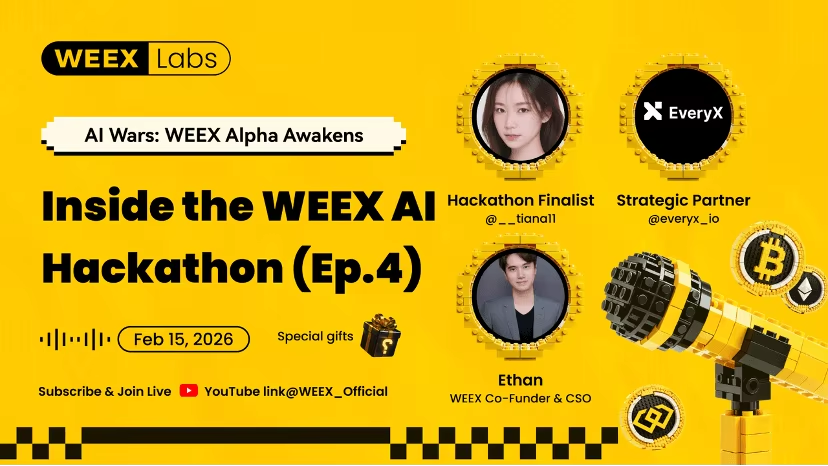
On February 15, the fourth AMA of the WEEX AI Trading Hackathon, the flagship global AI trading event held by WEEX, brought together builders, traders, and innovators to explore one key question: what happens when AI, trading, and global competition meet in one arena?
Hosted by WEEX CSO Ethan, the session featured EveryX CEO Hayate Matts and hackathon participant Tiana, creating a rare three-angle discussion from platform builder, ecosystem partner, and frontline competitor. The conversation went far beyond prizes. It explored AI trading discipline, prediction markets as social signals, and how communities are shaping the next generation of crypto trading. As Ethan described it, this hackathon is “where AI technologies, large-scale trading, and industry innovation come together.” The AMA showed that the event is not just a competition — it is a live experiment redefining how trading evolves.
The Future of AI Trading Hackathons: Building a Global AI Trading Ecosystem
Ethan positioned the WEEX AI Hackathon as more than an event; it is a prototype for the future trading industry. With a $1.8 million prize pool and participants worldwide, the competition creates a high-speed environment where developers, traders, and communities collide. But why does this matter? According to Ethan, innovation happens when ecosystems connect — infrastructure sponsors, mentors, and competitors all pushing boundaries together. He emphasized that the hackathon is “wider than just prizes,” highlighting education, experimentation, and real market exposure. By inviting the community to watch live finals and interact directly, Ethan reinforced a key message: AI trading is no longer reserved for institutions — it is becoming participatory and global.
Prediction Markets in AI Trading: Why Social Opinion Is Becoming Tradable
Hayate Matts, CEO of EveryX, connected prediction markets directly with the spirit of the WEEX AI Trading Hackathon, positioning them as a natural extension of competitive AI trading. With years in crypto and experience at Cointelegraph Japan, he helped build EveryX alongside MIT-trained engineers to rethink how people express conviction through trading decisions. During the AMA, his key insight stood out: “Prediction markets are becoming social opinion.” In the context of the hackathon, this idea takes on new meaning — traders are not only competing with AI strategies on WEEX, but the community can simultaneously trade predictions about outcomes, turning competition itself into a live data signal.
Instead of traditional surveys, real capital reflects collective expectations about which teams, strategies, or AI agents will succeed. From predicting leaderboard changes to forecasting final champions, Hayate framed prediction markets as a parallel battlefield to AI trading — a bridge where competition, community sentiment, and market intelligence merge. When traders and spectators can both price the future, the hackathon itself becomes a smarter market.
Risk-First AI Trading Strategy: From Emotional Trading to Algorithmic Discipline
The hackathon finallist Tiana’s story offered a human perspective inside the competition. A Web3 marketing professional joining from Melbourne, she entered the hackathon as a solo builder with no coding background — proof that AI trading barriers are falling. Her motivation was deeply personal: overcoming emotional trading. “I wanted to build a logical version of myself, one without greed and fear,” she explained. Instead of chasing perfect signals, she prioritized risk control, calling it the true MVP of her system. With strict stop-loss rules and disciplined execution, her AI focused on survival rather than prediction. Her most powerful insight? “Doing nothing was sometimes the hardest and most productive decision.” The lesson challenges a common belief — success in AI trading may come less from intelligence and more from restraint.
AI Trading Evolution: Platform Vision, Market Innovation, and Trader Discipline
Viewed together, the speakers revealed three complementary visions of the AI trading future. Ethan saw hackathons as innovation engines, accelerating collaboration between technology and community. Hayate viewed markets themselves evolving, where prediction platforms and AI agents reshape how collective knowledge forms and trades. Tiana focused on the trader’s internal battle, arguing that AI’s greatest value is removing ego and emotional bias.
Their perspectives converge on one powerful takeaway: AI does not replace humans — it exposes human strengths and weaknesses. As Tiana noted, AI processes data, but humans interpret context; as Hayate warned, humans and AI must learn to coexist; and as Ethan emphasized, ecosystems unlock progress. The shared conclusion can be summed up simply: the future winner is not the fastest bot, but the smartest collaboration between human judgment and machine discipline.
Why AI Trading Matters for the Future of Crypto Markets
This AMA demonstrated that the WEEX AI Hackathon is evolving into a global learning platform rather than a single event. Participants are testing ideas in real markets, audiences are interacting through prediction platforms, and new trading philosophies are emerging in real time. As the finals continue, the competition now becomes a live showcase of human-AI collaboration under pressure.
More importantly, momentum is already building for the next season launching in May, with expanded participation and deeper innovation ahead. The message to the community is clear: don’t just watch the AI trading revolution — step into it. The next wave of builders and traders is already forming.
Watch the full recap to relive the highlights below:
About WEEX
Founded in 2018, WEEX has developed into a global crypto exchange with over 6.2 million users across more than 150 countries. The platform emphasizes security, liquidity, and usability, providing over 1,200 spot trading pairs and offering up to 400x leverage in crypto futures trading. In addition to traditional spot and derivatives markets, WEEX is expanding rapidly in the AI era — delivering real-time AI news, empowering users with AI trading tools, and exploring innovative trade-to-earn models that make intelligent trading more accessible to everyone. Its 1,000 BTC Protection Fund further strengthens asset safety and transparency, while features such as copy trading and advanced trading tools allow users to follow professional traders and experience a more efficient, intelligent trading journey.
You may also like

AI Crypto Trading in 2026: How AI Agents Use Stablecoins for Capital Management and Settlement
Learn how AI agents use stablecoins for crypto trading in 2026 — managing capital, settling transactions, and operating across exchanges and DeFi protocols.
AI Trading's Ultimate Test: Empower Your AI Strategy with Tencent Cloud to Win $1.88M & a Bentley
AI traders! Win $1.88M & a Bentley by crushing WEEX's live-market challenge. Tencent Cloud powers your AI Trading bot - can it survive the Feb 9 finals?

How a Risk-Controlled AI Crypto Trading Bot Protects Capital in Real Markets
Ritmex demonstrates how disciplined risk control and structured signals can make an AI crypto trading bot more stable and reliable on WEEX, highlighting the importance of combining execution discipline with scalable AI trading systems.

How a Structured AI Crypto Trading Bot Won at the WEEX Hackathon
Crypto_Trade shows how structured inputs and controlled adaptability can build a more stable and reliable AI crypto trading bot within the WEEX AI Trading Hackathon, highlighting a practical path toward scalable AI trading systems.

How a Fully Automated AI Trading Bot Won at WEEX Hackathon (From 0 to AI Agent)
Nick’s journey on WEEX shows that successful AI Trading isn’t just about strategy ideas—but about structured AI agents, disciplined execution, and continuous adaptation in real market conditions.

Best AI Crypto Trading Bot? Inside the AI Trading System That Ranked Top 3 on WEEX
Discover the best AI crypto trading bot on WEEX. Learn how AI trading works, how to trade automatically, and why this system stands out among top AI trading apps.

OpenClaw and AI Bots: From AI Trading to BTC Liquidations in the Crypto Gold Rush
AI crypto trading bots like OpenClaw and AI trading apps are reshaping digital markets. From BTC liquidations to crypto bubble charts, automated trading is expanding alongside free crypto airdrops, affiliate programs, LALIGA partnerships, and tokenized gold markets.

From Human Strategy to AI Trading Bot: How Shadow Trading AI Won 2nd Place in the WEEX Hackathon
Ivan’s Shadow Trading AI secured second place in the WEEX AI Trading Hackathon, demonstrating how AI trading systems built on real market expertise can perform under live market conditions.

Who Will Control AI? Why Decentralized AI May Be the Only Alternative to Government and Big Tech
AI has become critical infrastructure, and governments and corporations are competing to control it. Centralized development and regulation are entrenching existing power structures. The Web3 community is building a decentralized alternative — distributed compute, token incentives, and community governance — before that window closes.

WEEX AI Hackathon: How Did This AI Trading Winner Succeed?
A self-taught AI trading enthusiast achieved top-10 results at the WEEX AI Hackathon. Learn about the mindset, AI tools, and lessons behind this impressive performance.

Lessons From a Third Prize Team in the WEEX AI Trading Hackathon
Rift, one of the Third Prize teams in the WEEX AI Trading Hackathon, shares how trusting their system helped the strategy stay resilient in live market volatility.

Champion Crowned at WEEX AI Hackathon: Revealing Strategy That Won $600K
A trader with only 6 months of AI trading experience won $600,000 at the WEEX AI Hackathon. Discover the strategy, tools, and lessons behind this breakthrough victory.

4 AI Trading Strategy Lessons from WEEX Hackathon Finalist
Finalist Bambi shares how AI tools helped turn real trading experience into an automated strategy, why survival-first risk control shaped the system’s design, and how the approach will evolve ahead of WEEX AI Trading Hackathon Season 2.

What Is OpenClaw? How The AI Agent Could Automate Crypto Trading Through APIs
OpenClaw is a rapidly growing AI agent on GitHub that can automate tasks and even execute crypto trades through exchange APIs. Learn how OpenClaw works, how it connects to exchanges, and the risks traders should understand before using AI trading agents.

WEEX AI Hackathon Champions Crowned, Revealing Future of AI Trading
The first-ever WEEX AI Hackathon has concluded, with 10 winners emerging from over 200 global teams. Beyond its $1.8 million prize pool, the event marked a milestone—proving that the future of AI trading belongs to accessible, AI-powered innovation.

Lessons From a Top 10 AI Trading Strategy in the WEEX AI Hackathon
A Top 10 finalist in the WEEX AI Hackathon shares how a market-neutral AI trading system competed against high-leverage strategies in live crypto markets.

From 27th to 4th: The AI Trading "Survivor Strategy" Behind a WEEX Hackathon Comeback
After a logic failure dropped him to 27th place, ClubW_9Kid rebuilt his AI trading framework and finished 4th in the WEEX AI Hackathon. In this interview, he explains the lessons behind disciplined AI execution, risk control, and why survival beats complexity in algorithmic trading.
What Is Vibe Coding? How AI Is Changing Web3 & Crypto Development
What is vibe coding? Learn how AI coding tools are lowering the barrier to Web3 development and enabling anyone to build crypto applications.
AI Crypto Trading in 2026: How AI Agents Use Stablecoins for Capital Management and Settlement
Learn how AI agents use stablecoins for crypto trading in 2026 — managing capital, settling transactions, and operating across exchanges and DeFi protocols.
AI Trading's Ultimate Test: Empower Your AI Strategy with Tencent Cloud to Win $1.88M & a Bentley
AI traders! Win $1.88M & a Bentley by crushing WEEX's live-market challenge. Tencent Cloud powers your AI Trading bot - can it survive the Feb 9 finals?
How a Risk-Controlled AI Crypto Trading Bot Protects Capital in Real Markets
Ritmex demonstrates how disciplined risk control and structured signals can make an AI crypto trading bot more stable and reliable on WEEX, highlighting the importance of combining execution discipline with scalable AI trading systems.
How a Structured AI Crypto Trading Bot Won at the WEEX Hackathon
Crypto_Trade shows how structured inputs and controlled adaptability can build a more stable and reliable AI crypto trading bot within the WEEX AI Trading Hackathon, highlighting a practical path toward scalable AI trading systems.
How a Fully Automated AI Trading Bot Won at WEEX Hackathon (From 0 to AI Agent)
Nick’s journey on WEEX shows that successful AI Trading isn’t just about strategy ideas—but about structured AI agents, disciplined execution, and continuous adaptation in real market conditions.
Best AI Crypto Trading Bot? Inside the AI Trading System That Ranked Top 3 on WEEX
Discover the best AI crypto trading bot on WEEX. Learn how AI trading works, how to trade automatically, and why this system stands out among top AI trading apps.

Popular coins
Latest Crypto News


