
Vitalik Fires First Shot at "Reform," Where Is the Ethereum Foundation Headed?


Original Title: "Vitalik Fires the First Shot of 'Reform,' Where Is the Ethereum Foundation Headed?"
Original Author: Wenser, Odaily Planet Daily
On January 18, Ethereum co-founder Vitalik posted, stating that he is "in the process of making significant changes to the leadership structure of the Ethereum Foundation (EF)."
Upon this news, it sparked a heated discussion: Some believed that he has finally "seen the light"; some said, "It's long overdue to clean up the EF's leadership who are just clinging to their positions"; while others thought, "Due to the rapid development of the Solana ecosystem, the Ethereum ecosystem is facing an unprecedented crisis, and he is feeling the pressure."
It is certain that Vitalik is not the only one feeling anxious.
On the evening of January 22, Konstantin Lomashuk, the co-founder of the important infrastructure project in the Ethereum ecosystem, Lido, first retweeted a tweet about the "second foundation," and then clarified that it was not related to a second EF, just a regular tweet. Last September, in response to the stagnant development of the Ethereum ecosystem, we proposed a solution in the article "Ethereum Is 'Sick': Are These Three Medicines Effective?" Now, it seems that our prediction was correct.
However, a more important question has emerged: How to revitalize the glory of the Ethereum ecosystem? Will the EF reform herald a revival? With such questions in mind, Odaily Planet Daily will provide a systematic analysis in this article on the possible follow-up of the EF's transformation and the future direction of the Ethereum ecosystem for readers' reference.
Pride and Prejudice: The Bright and Dark Sides of the Ethereum Foundation
On January 18, Ethereum ecosystem leader and Ethereum co-founder Vitalik Buterin stated in a post that the EF leadership structure has undergone a significant overhaul for nearly a year. In other words, throughout 2024, the EF leadership led by Vitalik has actually been undergoing a "self-revolution." However, at present, we can draw the interim conclusion that: this self-revolution has had limited success so far.
Signal of Transformation Goals: Focus on the Ecosystem, No Intention to Engage in Politics or Ideology
In light of this, Vitalik also mentioned that the main goals of this transformation are:
· Raise the technical expertise of the EF leadership;
· To improve two-way communication and connection between the EF leadership and ecosystem stakeholders, our responsibility is to support users (individual and institutional), application developers, wallets, L2;
· To bring in fresh blood, increase execution capability and speed;
· To more actively support application developers, ensuring that key values and inalienable rights (especially privacy, open-source, anti-censorship) are realistically available to users, including at the application layer;
· To continue increasing the use of decentralization and privacy technologies, as well as the Ethereum chain, including for payments and fund management.
Additionally, he emphasized that the goal of the EF transformation does *not* include:
· Implementing a shift in ideology/atmosphere (worth mentioning is that here he refers to: from a feminized "wef soyboy" mindset to a Bronze Age mindset, Odaily Star Daily Note: meaning a shift from a soft, feminized perspective to a male-focused perspective that greatly emphasizes practical benefits and success);
· Actively lobbying regulatory agencies and powerful political figures (especially in the United States, focusing more on major powers), risking harming Ethereum's position as a global neutral platform;
· Becoming an arena for vested interests;
· Becoming a highly centralized organization, or even becoming the "protagonist" of Ethereum.
Finally, he mentioned: "These are not things that the EF does, and this will not change either. People are welcome to create their own organizations with different visions."
Upon careful consideration, Vitalik's outlined goals can be summarized as follows: to adhere to a tech-focused mindset; to uphold the ideal of decentralization; to steadfastly pursue L2 development; however, the specific measures are not yet clear. It is evident that Vitalik's reform of the EF is still at a superficial level, and the results are naturally self-evident.
The Most Controversial Aspects of the EF: Transparency, Workload, Sell-Off Speed
Returning to the root of the EF's current predicament, the author believes it mainly stems from the following 3 aspects:
Firstly, a lack of information transparency. This is not only reflected in the ambiguity of foundation-related fund spending but also in the delayed disclosures, contrasting sharply with the agile and efficient Solana ecosystem. In December of last year, the EF officially released the Q3 2024 grant project update report, during which the total amount of funding reached $12,848,780.33, covering community education, consensus layer, cryptography and zero-knowledge proofs, developer experience and tools, execution layer, L2, protocol growth and support, among other areas. Among them, community education projects accounted for the highest proportion, including activities such as the Blockchain Summer Bootcamp, BlockHack, Building Builders, and more. Additionally, the foundation continued to support the development of consensus layer clients such as Lighthouse, Nimbus, Grandine, as well as development tools such as Web3.js, OpenZeppelin's Account Abstraction Contract, and others. It is worth noting that, to my knowledge, the EF's funding has not been audited by a third-party independent organization. (If there are relevant examples, please feel free to provide corrections and clarifications)
At the same time, limited by geographical and time constraints, decision-making power funded by the EF is in the hands of a few, which is to be expected. This has also resulted in some community members who have contributed to the ecosystem not receiving the support they deserve. In early January, Evan Van Ness, the founder of the Ethereum Newsweekly (Week in Ethereum News, abbreviated as WiE), once wrote: "Due to a conversation earlier this year with EF leadership, I announce that this newsletter will cease operations, as the communication indicated that they believe continuing WiE is of no value. In the remaining time of 2024, WiE received minimal funding support from the EF. Although most of this support was symbolic, the EF leadership chose to cut off this insignificant support, clearly indicating that WiE would be terminated immediately."
Secondly, a lack of proof of work. For EF's work, the outside world is unable to see effective proof of work. For the blockchain world, although the Ethereum ecosystem has shifted to a PoS mechanism, at the organizational level, PoW remains the most direct and relatively efficient mode of operation. In this regard, the EF is a worthy negative example. "What you did and others knowing what you did" are two completely different things.
In addition, this result is also influenced by the organizational structure. This is also one of the hotly debated topics in the recent cryptocurrency field. As cryptocurrency KOL @0xAllending pointed out, "One of the main reasons Solana was able to stand out in the blockchain network competition is its concept and strength of operating as a company, challenging ETH's market dominance"; in contrast, the Ethereum ecosystem, especially the EF, is still in the stage of community organization structure similar to "decentralized community governance, top-level leadership + mid-level researchers/developers + ordinary community members/holders," dreaming of Mass Adoption under the banner of the 'world computer,' which is nothing short of a pipe dream.
Lastly, rapid dumping speed. This is the most criticized point of the EF by countless people. It is not that similar sell-off phenomena do not exist in other ecosystems but that EF's selling pressure always seems like a signal of a phase peak, and often at this time, no one mentions "Ethereum faith, holding ETH firmly." Previously, according to LookIntoChain monitoring, since the EF sold 100 ETH on December 17, the price of ETH has dropped by about 17%. In 2024, EF sold 4,466 ETH (approximately $12.6 million) in 32 transactions, with 15 transactions sold at or near the recent high.
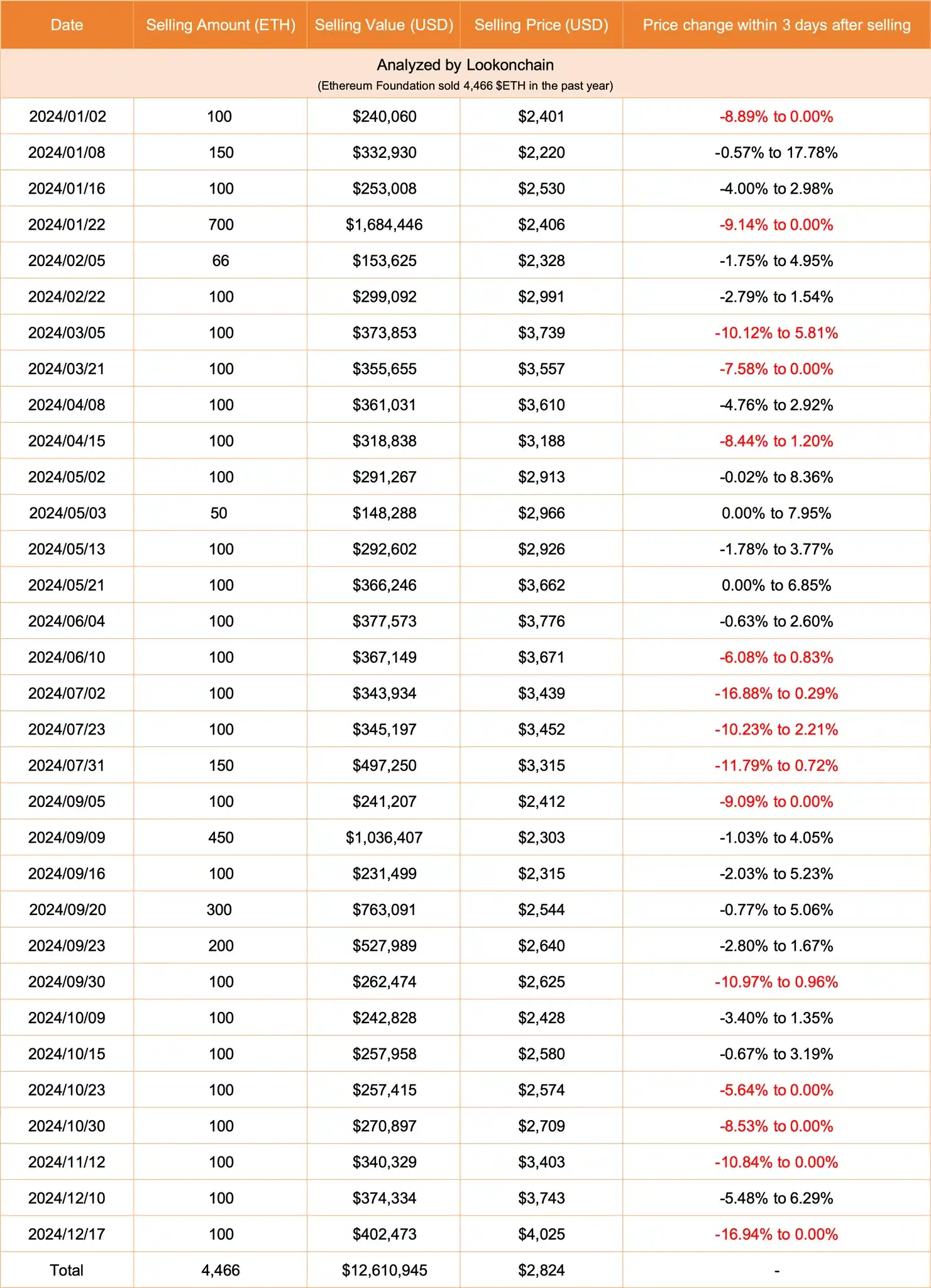
EF has been a "Top Signal" for quite some time
Of note, earlier Token Terminal data showed that Ethereum's L1 network revenue saw a sharp decline, plummeting by 99% since March 2024. On March 5, the Ethereum Layer 1 network revenue reached a peak of over $35 million per day; however, by September 2, daily revenue had fallen to around $200,000, marking the lowest daily revenue of the year. At that time, cryptocurrency analyst Kun warned that if this trend continued, L2 networks might take the lead, potentially abandoning Ethereum's mainnet, especially for consumer applications. Although this revenue eventually recovered to pre-Dencun upgrade levels by the end of 2024, the Ethereum mainnet protocol's revenue decline was evident.
Upon closer examination, perhaps pride and prejudice are the main culprits.
Root Causes: Pride Is the Original Sin, Prejudice Is the Shackle
EF researcher Justin Drake had stated in early December last year that Solana's golden age was about to end, posing no threat to Ethereum. Despite Solana's strong momentum, Drake mentioned, Ethereum focuses on long-term sustainability (does this phrase sound familiar?). "Solana is now at its peak, but I think this will mark the end of Solana's golden age as all of Solana's competitive advantages in latency and throughput will vanish, as the fundamental differences in architecture make it not scalable." Currently, Ethereum developers heavily rely on Layer 2 to provide faster, cheaper transactions. Drake stated: "I think Ethereum L1 is competing with the Bitcoin ecosystem, while L2 networks are competing with Solana. Therefore, competition with Solana doesn't even fall within the responsibility of Ethereum L1; we should compete in terms of security and sustainability. So if Solana has any competition, it should come from applications and L2 networks."
In a parallel development, Evan Van Ness, founder of the Ethereum newsletter, responded to a tweet about the impending closure of the newsletter by referring to "Solana" as "Sqlana," seemingly suggesting that Solana is a centralized database, which was also noted by some in the comments. Veteran node operator @JustDoingItBig found this puzzling: In 2018, Bitcoin believers mocked Ethereum node running as a "centralized database"; now, Ethereum supporters are behaving similarly.
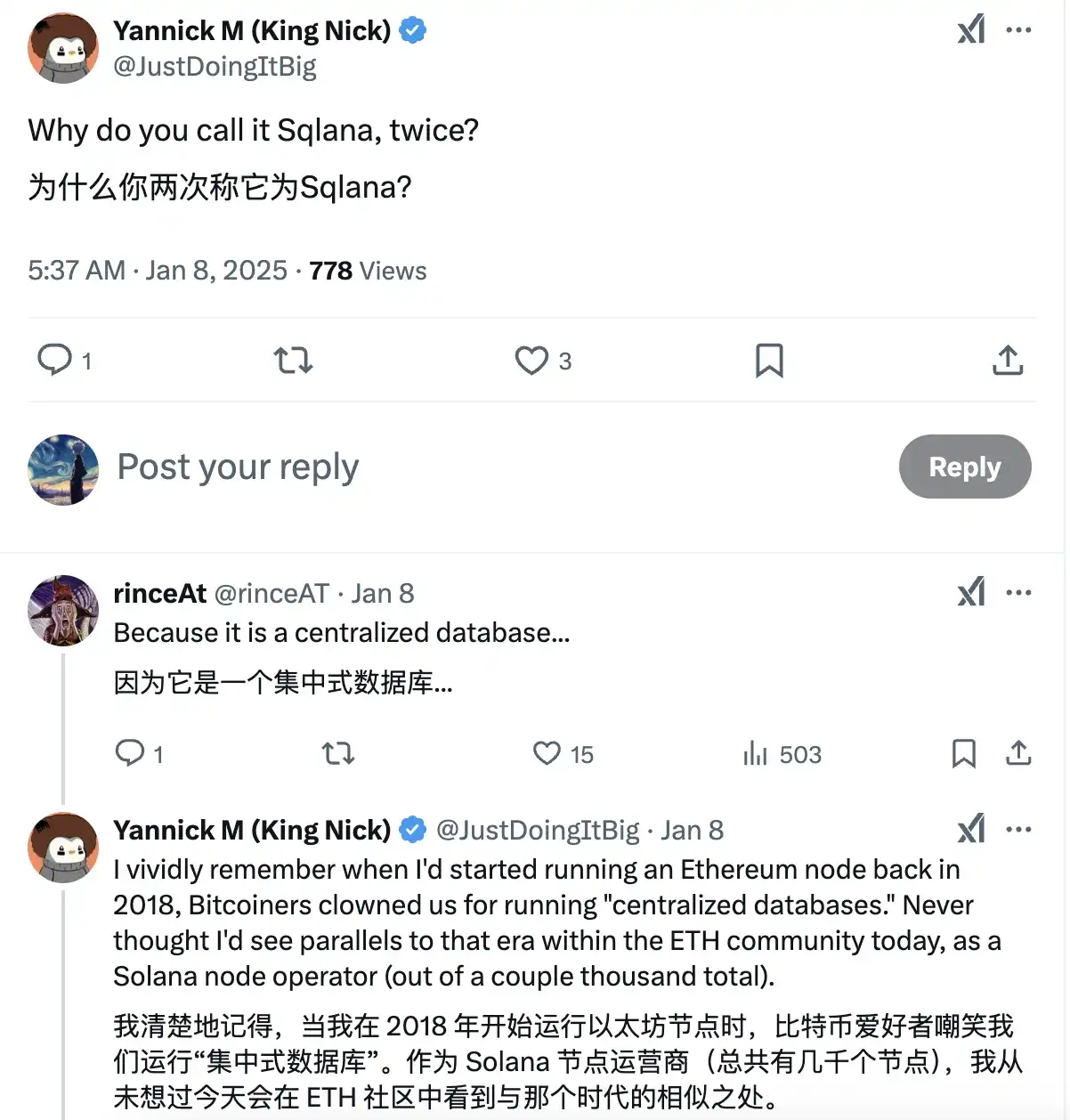
History has always rhymed, as they say.
As for the view on the Ethereum Foundation (EF), from personal observation, the majority of the Ethereum community members still show positive support. Most of the expressions of dissatisfaction come from ETH traders or market retail investors. Among them, perhaps community member fishbiscuit (@not_qz)'s viewpoint can represent a considerable portion of the "EF faithful." He has previously responded to various community criticisms of the Foundation, clarifying:
· Social media activity: Similar to the Solana Foundation, the EF has mainly retweeted content in the past, but has recently started to be more actively sharing updates;
· On-chain usage: The Foundation has staked 42,000 ETH to support client development, while also funding on-chain projects such as EIP-1559 NFT, Beacon Book, and providing grants through the mainnet and L2. Events like Devcon also support crypto payments;
· ETH sales: In response to criticisms of the Foundation's ETH sales, he pointed out that the Foundation's actions are aimed at balancing market pressures through various strategies. He called on the community to avoid double standards, emphasized the regulatory challenges faced by the Foundation, urged the community to rationally assess the Foundation's contributions, and encouraged more constructive discussions.
One cannot deny that, despite the many issues with the EF, the community's attitude remains extremely tolerant.
To some extent, this once again confirms a fact: actions speak louder than words. Since you're already on the Ethereum ship, you have to weather the storm together.
Key Contradictions: The Pressure on Vitalik, the Attacked Executive Director Aya, and the Fragmented Ethereum Community
As time has passed, many contradictions related to this EF reform have gradually come to the surface, with a sharp focus on Ethereum's founder Vitalik, EF Executive Director Aya, and the currently highly fragmented Ethereum community.
The Ethereum Thought Leader's Dilemma: Proactive Change vs. Past Friendships
Since the announcement of the EF reform on the 18th, Vitalik has undoubtedly been at the center of multiple pressures: on the one hand, the ETH price has performed poorly, and the development of the ETH ecosystem has moved away from its high-growth phase, requiring an urgent change in this situation; on the other hand, the EF core team has also entered a painful transition period, with events like "EF researcher Justin Drake and Dankrad Feist joining Eigenlayer" and "core researcher Danny Ryan leaving the EF last year," marking a test for past revolutionary friendships.
Recently, the announcement of Ethereum's early core developer Eric Conner's departure from the Ethereum community has sparked discussions (although, according to a certain Ethereum community member, this is not his first such "farewell"). However, unlike before, he also expressed that as Vitalik Buterin gradually steps back, the Ethereum Foundation's (EF) opacity and disconnect from the community have been increasing. He pointed out that the EF currently exhibits a "anti-victory and competitive mindset," leading many community members to question whether they should continue to stay (which directly conflicts with Vitalik's previous "manifesto of reform").
According to information from the Rootdata website, there are currently a total of 11 departing EF employees, including early BD personnel and the lead of the transition to POS, Danny Ryan. Based on a chart from last May, most departing EF members have chosen to start their own projects, with many still within the EVM ecosystem.
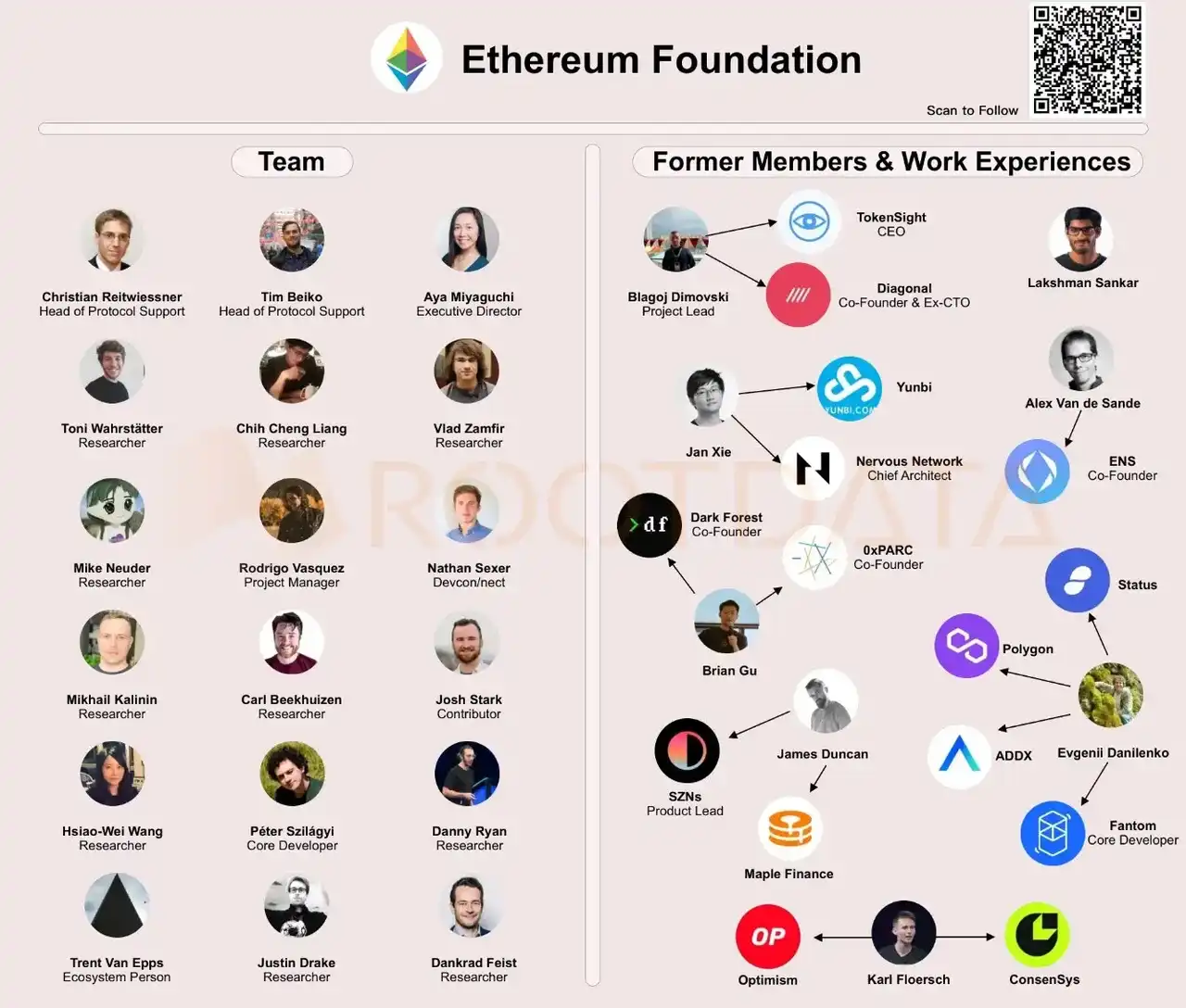
May 2024 EF Member Information

EF Departing Employees List
At the same time, current EF employees include protocol support leads such as Executive Director Aya, Tim Beiko, and many researchers, including Justin Drake. However, the confusion in organizational management has also come to light: recently, Ethereum Foundation researcher Alex Stokes announced that he and barnabe.eth would jointly serve as co-heads of the EF Research Department. Up to that point, many people were first made aware that the EF's research department includes the application research group, consensus R&D, cryptography, protocol security, and RIG teams. This is similar to when Tim Beiko, on his X platform account, published information on new department hires, and people only then realized how rigid EF's staff movements were.
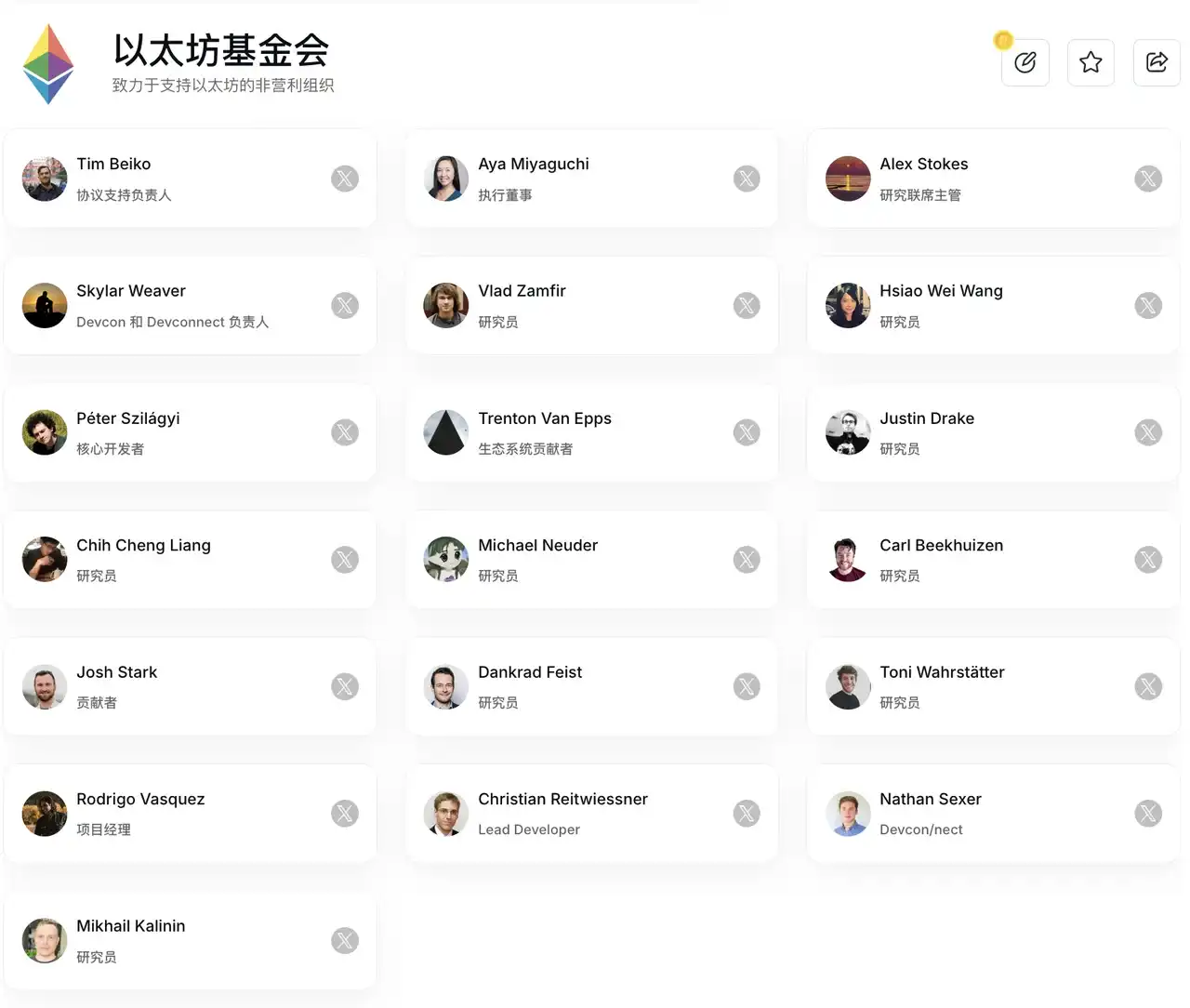
Current EF Employees, total of 16
The convoluted organizational management has brought about widespread questioning and debate, with many directing their criticisms towards EF Executive Director Aya.
In order to maintain his "long-time comrades," the usually emotionally stable Vitalik had to take on the role of a "dictator" proactively — on January 21, he responded to community questions in a post, stating, "I decided who the new EF leadership team is. One of the goals of the ongoing reform is to provide EF with an 'appropriate board,' but until then, it's just me. If community members pressure the EF leadership, it creates a harmful environment for top talent."
EF Executive Director Aya's Middle Way: Against Speculation, Embracing the "Zen" Path
Many people may not know much about EF Executive Director Aya, but she is a key figure in the development of the Ethereum ecosystem.
In the article "Where Is the Road? A Brief Analysis of the 3 Major Abstract Issues Facing the Ethereum Ecosystem," we briefly introduced her, and in an interview in 2019, she mentioned: "When it comes to a blockchain full of infinite possibilities (like the current Ethereum), the path forward may not only include one, two, or three voices, but many voices. Our work (referring to EF) is to coordinate, not to make actual decisions. Decisions can be made by our members, who can also be part of the decision-making process, not necessarily all of it."
In a June 2023 interview with Wired magazine, Aya reiterated: "In response to the cryptocurrency speculation frenzy, if I am the only one saying 'no,' it doesn't make much sense, so I try to spread the same mindset among others, as if I were a Zen practitioner. Once this mindset takes root, people can be motivated without money, punishment, rules, or laws. This is because we are considering how to protect Ethereum culture after we and EF leave. If this mindset becomes the 'Zen' path, it will be great."
In this regard, Aya's views are highly consistent with Vitalik's, which has also drawn strong criticism from the current market. Countless people have used this to attack Aya, calling for her to step down soon. Some have suggested that Danny Ryan should take over the EF Executive Director position, forcing Ryan to clarify: "EF Executive Director Aya has made significant contributions to Ethereum's development, please do not casually attack her," and reiterating, "Whether I am here or not, EF is continuously developing and becoming better. I believe the Ethereum community will develop in a respectful and rational manner."
According to LinkedIn information, Aya graduated from the Business School of Washington State University, previously worked at the cryptocurrency exchange Kraken overseeing the Japan region, and joined EF as an executive director in 2018.
The Fragmented Ethereum Community: Consensus, Liquidity, and Attention
The third major contradiction currently facing the Ethereum community is "fragmentation" —
Firstly, there is fragmentation in consensus regarding Ethereum's value, role, mission, vision, short, medium, and long-term goals;
Secondly, there is fragmentation of liquidity in the Ethereum ecosystem caused by the L2 roadmap, leading to ETH losing price support;
Lastly, there is the most pressing issue of attention fragmentation in the cryptocurrency industry, with past attention gradually shifting from the crowded ETH to the hotspot concentration and wealth effect evident in Solana.
In this regard, the thinking of Solana's ecosystem leaders is undoubtedly clearer. Previously, Solana's co-founder Anatoly Yakovenko wrote: "Solana is a 'pure blockchain.' No DA layer, no L2, no L3, no interference. Just a fast and inexpensive blockchain." "Multiple L2s make no sense. If a single L2 can handle parallel execution, it can take up all blob space and run every use case." "Important base layer smart contracts only need 6; any optional developer increases business risk." In addition, he once stated in a debate with an EF researcher, "Ethereum's biggest problem is the uncertainty of DA's long-term value and the uncertainty of ETH's 'ultrasonic currency' vision." This view was also echoed by Uniswap co-founder Arthur Hayes.
Of course, to find a way out of the dilemma, Ethereum needs more detailed solutions.
The Three-dimensional Solution to the "Ethereum Dilemma": Strategy, Communication, and Positioning
Considering the above information, the author believes that the EF's pursuit of a solution to the "Ethereum Dilemma" includes the following 3 aspects:
Let Go of Biases, Let Go of Fixations
Firstly, the EF leadership led by Vitalik needs to adjust its perception: no longer be fixated on the long-term "world computer" goal but focus on short-term and mid-term realities.
Progress in this area includes the Ethereum Foundation's announcement of the activation of new X accounts, the establishment of an institutional marketing arm Etherealize to promote ETH to Wall Street (backed by Vitalik and the EF), and the EF's decision to use 50,000 ETH (approximately $150 million) through a 3/5 multisig wallet to participate in the Ethereum DeFi ecosystem.
In addition, the latest news shows that Vitalik has finally stopped insisting on "maintaining the neutrality and transcendence of the Ethereum mainnet ecosystem" and unilaterally blood transfusing to L2 networks. Instead, he directly stated that "encouraging Layer 2 to support ETH by contributing a certain percentage of fees, which can be achieved by burning part of the fee, permanently staking, and donating the rewards to public goods of the Ethereum ecosystem or some other schemes." For more information, see "Under Public Opinion Pressure, Vitalik Posts Calling for L2: Let's Support ETH Together".
Regarding the "Sharding" matter, once action begins, it is believed that the "Ghost Chain" issue in the EVM system will be further addressed.
Listening to the Community, Regular Communication
Secondly, the EF can no longer bury its head in the sand like an ostrich, ignoring the external environment and disregarding community feedback. It is worth mentioning that internally, the EF, including Vitalik, although currently not bearing the title of "emperor," does hold the role of a "leader." Therefore, the advice of "frequent the wise, distance from the villain" should be followed. Do not let the desire for approval, flattery, and pandering of those seeking Grants funding cloud your judgment.
Less academic discussions, more regular Ask Me Anything (AMA) sessions with representatives at the organizational level—if they are technical personnel, focus more on technical discussions; if they are marketing personnel, engage more in marketing discussions; if they are merely freeloading and making decisions off the top of their heads, it's time to remove them from the EF.
Most importantly, do not confine yourself in an echo chamber.
Store of Value OR Medium of Exchange? That Is the Question
Lastly, it is about the positioning of ETH and the Ethereum network. The current fragmentation issue caused by dozens of L2 networks and the overwhelming power of the ETH incumbent interest group (i.e., too many profit-takers) are making it increasingly difficult to achieve ETH's value storage function. Simply advocating for "digital silver" is no longer convincing to the market.
As a means of payment is relatively more in line with market demand. In this regard, the Base ecosystem's Coinbase Wallet for consumers may be one of the future focuses of the Ethereum ecosystem. Although Vitalik insists on maintaining the neutrality and decentralization of the Ethereum ecosystem, progress on partnerships related to the United States may be difficult in the short term, but in the medium to long term, this remains an unavoidable issue.
In addition, as mentioned in a post by Marc Zeller, Founder of the Aave Chan Initiative (ACI) of the Aave contribution team, "To address the issues of the Ethereum Foundation, it is necessary to: convert the remaining ETH of the EF into a market-proven LST combination, reduce 95% of the current subsidy, especially initiatives similar to 'running a node in Wakanda,' refrain from selling ETH, and instead use LST to borrow stablecoins through Sky/Aave to reduce operating costs," which also holds some reference value.
Of course, the proposal to "dismiss 80% of non-developers and current leaders" and "hand over the official account to a few highly active ETH Maxi operators" is somewhat one-sided.
Lastly, the community ultrasound.money previously united many ETH Maxis in the Ethereum ecosystem, but eventually faded, which is a regrettable event. Perhaps with the EF reform, the related communities will also usher in a transformational opportunity.
Conclusion: "Don't Rest on Your Laurels, Strive for New Achievements"
Perhaps in the early development of the Ethereum ecosystem, the Ethereum Foundation's laissez-faire leadership style led to the rapid development of the Ethereum ecosystem. However, after experiencing several bull and bear cycles, since harboring the grand vision of "mass adoption," new solutions are needed rather than indulging in the past glory of "Ethereum as the first ecosystem in crypto," being complacent, and refusing to progress.
The TRUMP token has brought millions of people into the cryptocurrency world, and people's participation in wealth creation is understandable. After all, compared to the Web2 world that surrenders privacy and data, the eyeball effect and wealth-creation trend are the Trojan horse that the crypto world can offer to the traditional financial world. When the future arrives where the crypto economy is further linked with the global financial system, we will see the footprint of crypto across the universe.
By eliminating incorrect answers, we can have more courage and strength to face the new challenges posed by the crypto world.
On this point, countless people walk with me, so I am full of confidence, and I hope you are too.
You may also like

In the name of charity, for the benefit of the family: How the Trump family turned charity into profit?

Will Gold Break $4,500 After Tonight's Fed Decision? What XAUT and PAXG Traders Need to Know

Cursor, why did you get on Musk's spaceship?

Morning Report | DeepSeek completes over $7 billion in financing, with a valuation exceeding $50 billion; Musk's personal wealth has surpassed the total market value of Bitcoin

SharpLink CEO: How to understand that Ethereum developers have just surpassed 1 million?

Morning Report | MiCA grace period expires on July 1; Kalshi's trading volume in the first week of the World Cup breaks $5.1 billion, setting a record

The foundation of SpaceX's trillion-dollar valuation: Who is dividing Musk's annual capital expenditure of tens of billions?

How to exit after asset tokenization?

The stablecoin positioning battle escalates: When compliance is just a ticket to entry, will USD1 become the biggest winner?

A16Z: The sun bears witness, SpaceX is worth 7.5 trillion
Mergers and acquisitions in the cryptocurrency market are exceptionally active

Concerns Behind the Binance Customer Service Controversy

SpaceX Stock Prediction After the IPO: Can SPCX Reach $200 Before QQQ Inclusion?

Congratulations to Carl Moon on His Historic Ferrari Challenge Le Mans Podium Triumph
Crypto influencer and racing enthusiast Carl Moon finished third in the Ferrari Challenge Le Mans Coppa Shell class, marking his best result of the year. As his racing partner and sponsor, WEEX celebrates this remarkable achievement and continues to lead crypto’s journey beyond boundaries, uniting the innovation of digital assets with the passion of motorsport.
Can the CLARITY Act Become Law by July 4? Everything You Need to Know About the Final Battle

France vs Senegal World Cup 2026: Mbappe’s New Era Begins Against a Historic Rival
What is the connection between Huang Zheng of Pinduoduo and blockchain?

Morning Report | Prediction market platforms like Kalshi and Polymarket jointly sue Kentucky over 14.25% trading tax; Bridgewater founder discusses decision-making in the AI era: principled thinking should run parallel to AI, human insight remains irre...
In the name of charity, for the benefit of the family: How the Trump family turned charity into profit?
Will Gold Break $4,500 After Tonight's Fed Decision? What XAUT and PAXG Traders Need to Know
Cursor, why did you get on Musk's spaceship?
Morning Report | DeepSeek completes over $7 billion in financing, with a valuation exceeding $50 billion; Musk's personal wealth has surpassed the total market value of Bitcoin
SharpLink CEO: How to understand that Ethereum developers have just surpassed 1 million?
Morning Report | MiCA grace period expires on July 1; Kalshi's trading volume in the first week of the World Cup breaks $5.1 billion, setting a record


