
 Buy Crypto
- Markets
 Futures
- Spot
- Copy Trade
- Earn
- More
Underestimated Veteran Public Chain: ETF Application Drives HBAR to Rise Again

Original Article Title: "Applying for a Spot ETF, Monthly Growth Exceeds 104%, What is HBAR?"
Original Article Author: Golem, Odaily Planet Daily
Today, the L1 blockchain Hedera's native token, HBAR, has broken through 0.38 USDT, reaching a high of 0.39 USDT, with a 24-hour increase of over 40%. In the past month, the price has surged over 104%, returning to November 2021 levels.
The Hedera blockchain was launched as early as 2019. On November 13th this year, the crypto investment firm Canary Capital submitted an HBAR ETF application to the US SEC. Compared to the widespread attention and discussion sparked by ETF applications for SOL, XRP, and LTC, the heat around HBAR has always been less intense, with many crypto newcomers in this bull market round not even having heard of the project.
So, where does the Hedera blockchain come from? What are the other reasons behind the explosive rise in HBAR price? Odaily Planet Daily will briefly introduce and analyze Hedera in this article.
Hedera Introduction
Hedera is a decentralized open-source proof-of-stake public blockchain, with its underlying technology utilizing a leaderless, asynchronous Byzantine Fault Tolerant (ABFT) Hashgraph consensus algorithm. According to its official website data, Hedera blockchain finality only takes 2.9 seconds, with an average transaction cost of $0.0001, and the network has low energy consumption, with an average energy consumption per transaction as low as 0.000003 kWh, whereas Solana's energy consumption is 170 times that amount.
Developers can use the Hedera blockchain for real asset tokenization, building DeFi and NFT ecosystems, creating decentralized identities, and using native consensus timestamps to create low-cost, scalable, and publicly verifiable data logs — recording payment events, supply chain origins, IoT sensor data, etc.
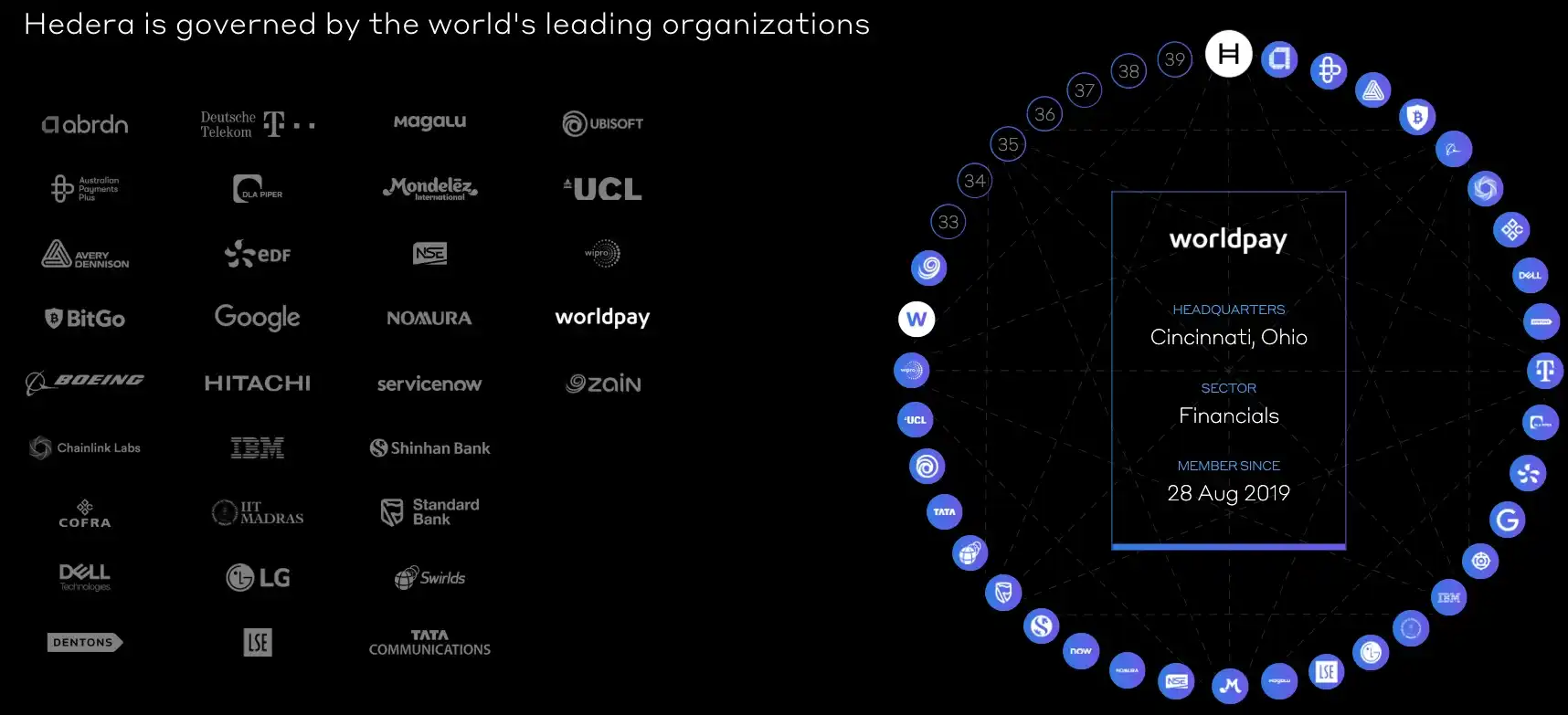
The Hedera blockchain is governed by a board and the Hedera Governing Council, which consists of up to 39 rotating, highly diverse leading organizations and enterprises, including well-known companies and institutions such as Google, Dell, and abrdn.
HBAR is Hedera blockchain's native token, used for network fees and as a staking token for the POS mechanism. The total supply of HBAR is 500 billion, with a current circulation exceeding 381.9 billion, a circulating market cap of 13.28 billion US dollars, and a crypto market rank of 19th.
So far, the impression of Hedera has been nothing more than a run-of-the-mill old L1.
Why Did HBAR Price Skyrocket?
As the price of the HBAR token surged, the market generally attributed the main reason to the favorable HBAR ETF application submitted by Canary Capital on November 13, with HBAR rising over 30% on the day of the announcement.
Generally speaking, token price surges triggered by news events do not last long. On November 26, Bloomberg ETF analyst James Seyffart also stated that the SEC's decision on SOL, XRP, LTC, and HBAR ETFs may be delayed until the end of 2025.
With the favorable news of the ETF still pending, and actual ETF approval a distant prospect, many thought that the HBAR price would retreat. However, the HBAR price remains in an upward trend, reaching levels from the November 2021 bull market. For this reason, Odaily Planet Daily summarizes the following four reasons:
Altcoin ETF Emergence, HBAR Undervalued Compared to Other Tokens
Currently, altcoin ETFs are emerging, with SOL, XRP, LTC, and HBAR ETF applications being submitted in succession. Additionally, according to ETF Store President Nate Geraci, at least one issuer is currently attempting to apply for an ETF for ADA (Cardano) or AVAX (Avalanche). Despite HBAR's token price surging by 104% in the past month, far exceeding the 40%, 32%, and 25% increases for SOL, XRP, and LTC, respectively, HBAR's market capitalization remains low and still ranks below DOT, in 19th place.
In fact, before Canary Capital submitted the HBAR ETF application, in October, Canary Capital launched the HBAR Trust in the United States, specifically catering to eligible individuals and institutional investors. Steven McClurg, CEO of Canary Capital and former CIO of Valkyrie Funds, also stated that this move was to pave the way for the future launch of the HBAR ETF.
Therefore, as one of the few altcoins currently backed by institutions and with an ETF application submitted, investors may believe that the HBAR token is undervalued and still has significant room for growth.
HBAR Board Member Could Become Next SEC Chairman
With the upcoming inauguration of President Trump, the next Chairman of the U.S. Securities and Exchange Commission (SEC) is also drawing significant attention from the crypto market. HBAR board member Brian Brooks is among the potential candidates for the next SEC Chairman. According to prediction market data from Kalshi, while former SEC Commissioner Paul Atkins from the George W. Bush administration has a 70% chance of winning, Brian Brooks still has a 20% chance.
If Brian Brooks is successfully nominated by Trump as the next SEC Chairman, it would not only mean that the SEC may become more crypto-friendly, but it would also be a huge benefit for HBAR. This expectation is also sustaining the upward trend of the HBAR price.
Additionally, according to FOX Business reporter Eleanor Terrett, sources have revealed that Trump will announce the new SEC Chairman to succeed Gary Gensler as soon as tomorrow. It is believed that this answer will be revealed shortly. (BlockBeats Note: Trump announced on December 4th that Paul Atkins was his nominee for SEC Chairman, but sources indicate that Paul Atkins is not willing to take on the position.)
Driving Development in the RWA Track
The RWA track is also gradually gaining momentum, with institutions increasing their investment in RWAs. Stablecoin USDT issuer Tether launched the asset tokenization platform Hadron by Tether on November 14th, and Visa introduced the Visa Tokenized Asset Platform (VTAP). The Hedera blockchain is also actively developing RWAs. According to official Hedera data, the value of assets tokenized through the Hedera blockchain has reached $50 million, providing tokenization services to well-known companies such as Dovu, abrdn, and Shinban Bank.
Steven McClurg, CEO of Canary Capital and former CIO of Valkyrie Funds, also stated that Hedera embodies the type of enterprise technology that connects cryptocurrency to real-world scalability, and he expects further growth in technological applications.
Korean Market FOMO
In terms of trading volume, HBAR is also experiencing Korean market FOMO. According to CoinGecko data, on South Korea's largest exchange Upbit, the highest 24-hour trading volume is for XRP, with a trading volume of over $5.372 billion; next is HBAR, with a 24-hour trading volume of over $1.353 billion, which is 3 times the volume of BTC. Additionally, compared to Binance, HBAR has a trading volume of over $1.289 billion in the last 24 hours, which is less than Upbit.
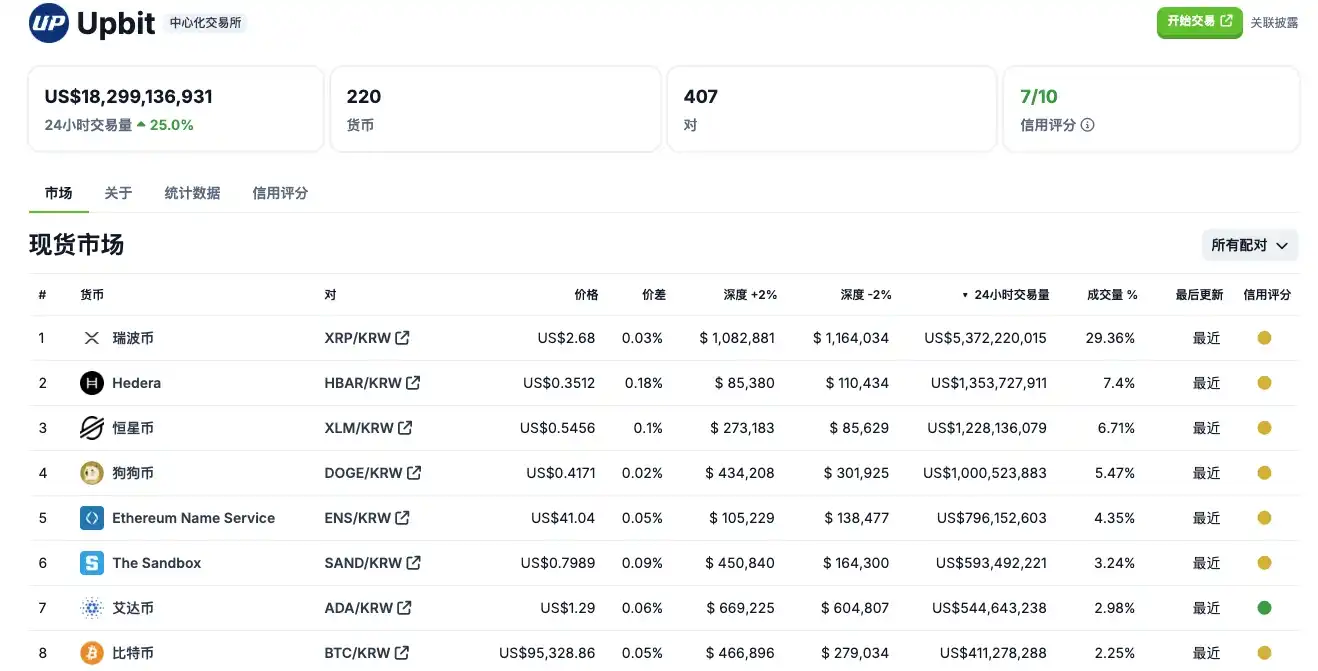
Simultaneously, on another Korean exchange Bithumb, HBAR's 24-hour trading volume reached $1.43 billion, surpassing not only BTC's volume on that platform but even exceeding Upbit's 24-hour HBAR trading volume.
It is evident that the Korean market is not only a major buyer market for XRP but also a major buyer for HBAR.
Altseason Arrives, Old Tokens Can Revitalize
Trends are always unstoppable. In the past year, altcoins have been underperforming, first falling into controversy over VC coins' "high valuation and low circulation" and massive unlockings, then facing the slump in the altcoin market as BTC repeatedly hit new highs, and finally having to deal with the onslaught of meme coins. To the point that even industry veterans, such as Fish the Founder and CEO of Cobo, previously asserted that "this cycle has no altseason."
As a result, the sector rotation, though delayed, has arrived, and altseason has finally come. According to an analysis by Nanzhi from Odaily Star Daily, the funding rate is in the safe zone, and the market share of altcoins has approached the launch point of 2021. (Related Reading: Looking back at market data from the past 4 years, which stage of the bull market are we currently in?)
The market is accustomed to finding reasons for price increases, and HBAR may be just a microcosm, symbolizing that even in a true altseason, even "old tokens" can make market participants dizzy with their rise. Instead of lamenting, it is worth joining the trend.
You may also like

a16z: 5 Ways Blockchain Helps AI Agent Infrastructure

Morning News | The Hong Kong Securities and Futures Commission announced the regulatory framework for secondary market trading of tokenized investment products; Strategy increased its holdings by 34,164 bitcoins last week; KAIO completed a strategic fi...

What Is an XRP Wallet? The Best Wallets to Store XRP (2026 Updated)
An XRP wallet lets you safely store, send, and receive XRP on the XRP Ledger. Learn what wallets support XRP and discover the best XRP wallets for beginners and long-term holders in 2026.

What are the Top AI Crypto Coins? Render vs. Akash: 5 Gems Solving the 2026 GPU Crisis
What are the best AI crypto coins for the 2026 cycle? Beyond the hype, we analyze top tokens like RNDR, AKT, and FET that provide real-world solutions to the global GPU shortage and the rise of autonomous agents.

What Is a Token in AI? What Is an AI Token + 3 Gems You Can't Miss in 2026
The era of AI hype has transitioned into an era of utility. As we move through Q2 2026, the market is no longer rewarding "narrative-only" projects. At WEEX Research, we are seeing a massive capital rotation into Decentralized Compute (DePIN) and Autonomous Agent coordination layers. This guide analyzes which AI tokens are capturing institutional liquidity and how to spot high-conviction setups in a maturing market.

Consumer-grade Crypto Global Survey: Users, Revenue, and Track Distribution

Prediction Markets Under Bias

Stolen: $290 million, Three Parties Refusing to Acknowledge, Who Should Foot the Bill for the KelpDAO Incident Resolution?

ASTEROID Pumped 10,000x in Three Days, Is Meme Season Back on Ethereum?

ChainCatcher Hong Kong Themed Forum Highlights: Decoding the Growth Engine Under the Integration of Crypto Assets and Smart Economy

Why can this institution still grow by 150% when the scale of leading crypto VCs has shrunk significantly?

Anthropic's $1 trillion, compared to DeepSeek's $100 billion

Geopolitical Risk Persists, Is Bitcoin Becoming a Key Barometer?
Annualized 11.5%, Wall Street Buzzing: Is MicroStrategy's STRC Bitcoin's Savior or Destroyer?
An Obscure Open Source AI Tool Alerted on Kelp DAO's $292 million Bug 12 Days Ago

Mixin has launched USTD-margined perpetual contracts, bringing derivative trading into the chat scene.
The privacy-focused crypto wallet Mixin announced today the launch of its U-based perpetual contract (a derivative priced in USDT). Unlike traditional exchanges, Mixin has taken a new approach by "liberating" derivative trading from isolated matching engines and embedding it into the instant messaging environment.
Users can directly open positions within the app with leverage of up to 200x, while sharing positions, discussing strategies, and copy trading within private communities. Trading, social interaction, and asset management are integrated into the same interface.
Based on its non-custodial architecture, Mixin has eliminated friction from the traditional onboarding process, allowing users to participate in perpetual contract trading without identity verification.
The trading process has been streamlined into five steps:
· Choose the trading asset
· Select long or short
· Input position size and leverage
· Confirm order details
· Confirm and open the position
The interface provides real-time visualization of price, position, and profit and loss (PnL), allowing users to complete trades without switching between multiple modules.
Mixin has directly integrated social features into the derivative trading environment. Users can create private trading communities and interact around real-time positions:
· End-to-end encrypted private groups supporting up to 1024 members
· End-to-end encrypted voice communication
· One-click position sharing
· One-click trade copying
On the execution side, Mixin aggregates liquidity from multiple sources and accesses decentralized protocol and external market liquidity through a unified trading interface.
By combining social interaction with trade execution, Mixin enables users to collaborate, share, and execute trading strategies instantly within the same environment.
Mixin has also introduced a referral incentive system based on trading behavior:
· Users can join with an invite code
· Up to 60% of trading fees as referral rewards
· Incentive mechanism designed for long-term, sustainable earnings
This model aims to drive user-driven network expansion and organic growth.
Mixin's derivative transactions are built on top of its existing self-custody wallet infrastructure, with core features including:
· Separation of transaction account and asset storage
· User full control over assets
· Platform does not custody user funds
· Built-in privacy mechanisms to reduce data exposure
The system aims to strike a balance between transaction efficiency, asset security, and privacy protection.
Against the background of perpetual contracts becoming a mainstream trading tool, Mixin is exploring a different development direction by lowering barriers, enhancing social and privacy attributes.
The platform does not only view transactions as execution actions but positions them as a networked activity: transactions have social attributes, strategies can be shared, and relationships between individuals also become part of the financial system.
Mixin's design is based on a user-initiated, user-controlled model. The platform neither custodies assets nor executes transactions on behalf of users.
This model aligns with a statement issued by the U.S. Securities and Exchange Commission (SEC) on April 13, 2026, titled "Staff Statement on Whether Partial User Interface Used in Preparing Cryptocurrency Securities Transactions May Require Broker-Dealer Registration."
The statement indicates that, under the premise where transactions are entirely initiated and controlled by users, non-custodial service providers that offer neutral interfaces may not need to register as broker-dealers or exchanges.
Mixin is a decentralized, self-custodial privacy wallet designed to provide secure and efficient digital asset management services.
Its core capabilities include:
· Aggregation: integrating multi-chain assets and routing between different transaction paths to simplify user operations
· High liquidity access: connecting to various liquidity sources, including decentralized protocols and external markets
· Decentralization: achieving full user control over assets without relying on custodial intermediaries
· Privacy protection: safeguarding assets and data through MPC, CryptoNote, and end-to-end encrypted communication
Mixin has been in operation for over 8 years, supporting over 40 blockchains and more than 10,000 assets, with a global user base exceeding 10 million and an on-chain self-custodied asset scale of over $1 billion.

$600 million stolen in 20 days, ushering in the era of AI hackers in the crypto world
Vitalik's 2026 Hong Kong Web3 Summit Speech: Ethereum's Ultimate Vision as the "World Computer" and Future Roadmap
a16z: 5 Ways Blockchain Helps AI Agent Infrastructure
Morning News | The Hong Kong Securities and Futures Commission announced the regulatory framework for secondary market trading of tokenized investment products; Strategy increased its holdings by 34,164 bitcoins last week; KAIO completed a strategic fi...
What Is an XRP Wallet? The Best Wallets to Store XRP (2026 Updated)
An XRP wallet lets you safely store, send, and receive XRP on the XRP Ledger. Learn what wallets support XRP and discover the best XRP wallets for beginners and long-term holders in 2026.
What are the Top AI Crypto Coins? Render vs. Akash: 5 Gems Solving the 2026 GPU Crisis
What are the best AI crypto coins for the 2026 cycle? Beyond the hype, we analyze top tokens like RNDR, AKT, and FET that provide real-world solutions to the global GPU shortage and the rise of autonomous agents.
What Is a Token in AI? What Is an AI Token + 3 Gems You Can't Miss in 2026
The era of AI hype has transitioned into an era of utility. As we move through Q2 2026, the market is no longer rewarding "narrative-only" projects. At WEEX Research, we are seeing a massive capital rotation into Decentralized Compute (DePIN) and Autonomous Agent coordination layers. This guide analyzes which AI tokens are capturing institutional liquidity and how to spot high-conviction setups in a maturing market.



 App
App