
 Buy Crypto
- Markets
 Futures
- Spot
- Copy Trade
- Earn
- More
Two HundredCoin Compete for Base Ecology AI Throne, Virtual and Clanker Who Will Be the Ultimate Winner?

Authored by: UNAI
In just a few short months, Base has rapidly ascended from a relatively unknown Layer 2 project to a leader in the Ethereum-compatible ecosystem, with a TVL (Total Value Locked) surpassing $3.85 billion, overtaking Arbitrum and Optimism, becoming the most competitive new giant in the Layer 2 market. With the strong endorsement from Coinbase and the support of North American capital, the Base ecosystem has experienced explosive growth in 2024, with November inflows surpassing Solana, becoming one of the hottest wealth tracks in the blockchain space. However, despite Base's significant achievements in inflows and ecosystem growth, its on-chain transaction volume has not yet exceeded Solana, indicating that while experiencing rapid expansion, Base still faces the dual challenge of sustained growth and market competition.
Using market value as an example, Clanker's CLANKER token market cap has reached $70 million, a figure that reflects the huge attraction of the Base ecosystem and the current craze. Unlike the traditional VC token playbook, the rise of Meme tokens has driven on-chain data and user transaction behavior backward to exchange listings, forming a new ecosystem model. Users accumulate chips on-chain, then use exchange liquidity to complete exits, pushing CEXs (Centralized Exchanges) to the corner of the market, a strong indication of the author's view of the early stages of a true bull market, similar to the on-chain liquidity scene that erupted during the DeFi Summer of 2020. This innovative mechanism showcases the vitality of the Base ecosystem while also exposing the challenges it faces in market competition.
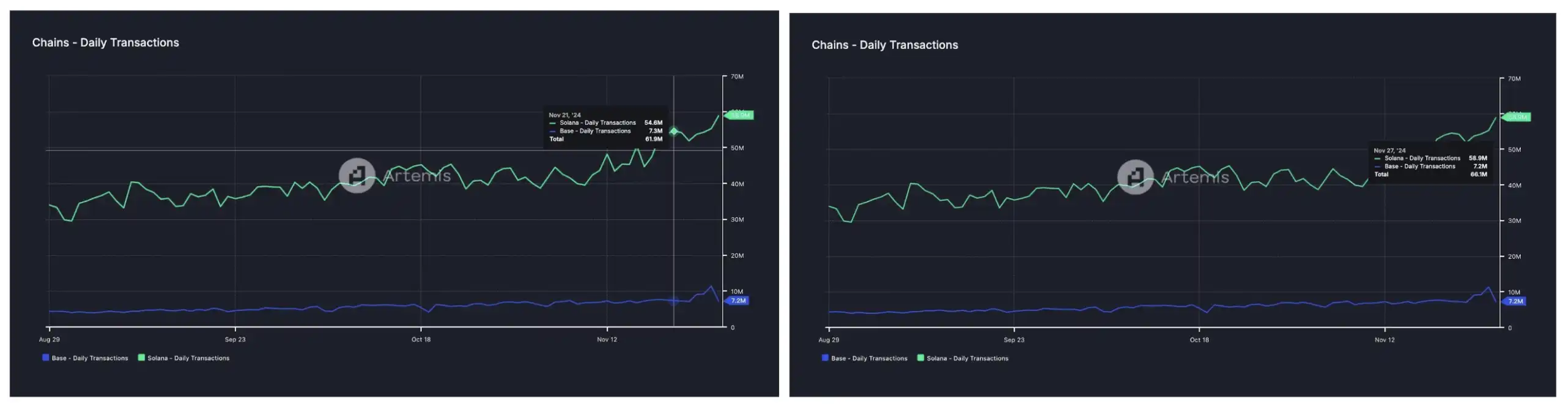
Artemis On-Chain Data Comparison between Base and Solana
The relationship between a public chain and ecosystem projects is like a dance between spouses, inseparable and mutually supportive. Whether Base as a public chain can leverage the empowerment of AI Agent and Meme culture to break through the $4 billion TVL mark and become the market leader remains a pending challenge. At the same time, ecosystem projects like Clanker, Virtual Protocol, and others, can find the soil for growth within the Base ecosystem and rise with the help of market heat, is also worth noting. Clanker and Virtual Protocol are representative projects in this round of Base craze, the former as a "machine for creating popular memes," and the latter transitioning from GameFi to AI infrastructure and to a consumer platform. Although they have different development paths, they have all seized the market opportunities and become notable focal points. Through the rise of these projects, we see the allure of the Base ecosystem and the current market craze, demonstrating the deep-seated interests and tacit understanding between public chains and projects. While the situation is ever-changing, behind it all is still filled with the drive of business and market interests.
Clanker: The "Hit Meme" Factory of the Base Ecosystem
Clanker, like a wild invention straight out of "Rick and Morty," has become a reality in the Base blockchain's lab — it is a brainstorming AI Agent focused on using social media and smart contracts to turn ethereal ideas into real-world Meme tokens. Imagine, with a gesture like Rick's, @clanker directly deploys an ERC-20 token on Farcaster, complete with a liquidity pool and smart lockup features — this is not just technological magic, but also a decentralized narrative celebration. By simplifying the operation process and leveraging the Clanker.sol contract, Clanker achieves the minting of ERC-20 tokens, initialization of Uniswap V3 pools, liquidity injection, and locking, allowing users to easily deploy and distribute tokens with a simple request on Farcaster. It has already created multiple Meme tokens with a market cap of over tens of millions of dollars. It breaks through technological barriers, giving everyone the opportunity to become a creator in the Meme economy. Through a 40% fee sharing mechanism, it creates real revenue for the community.
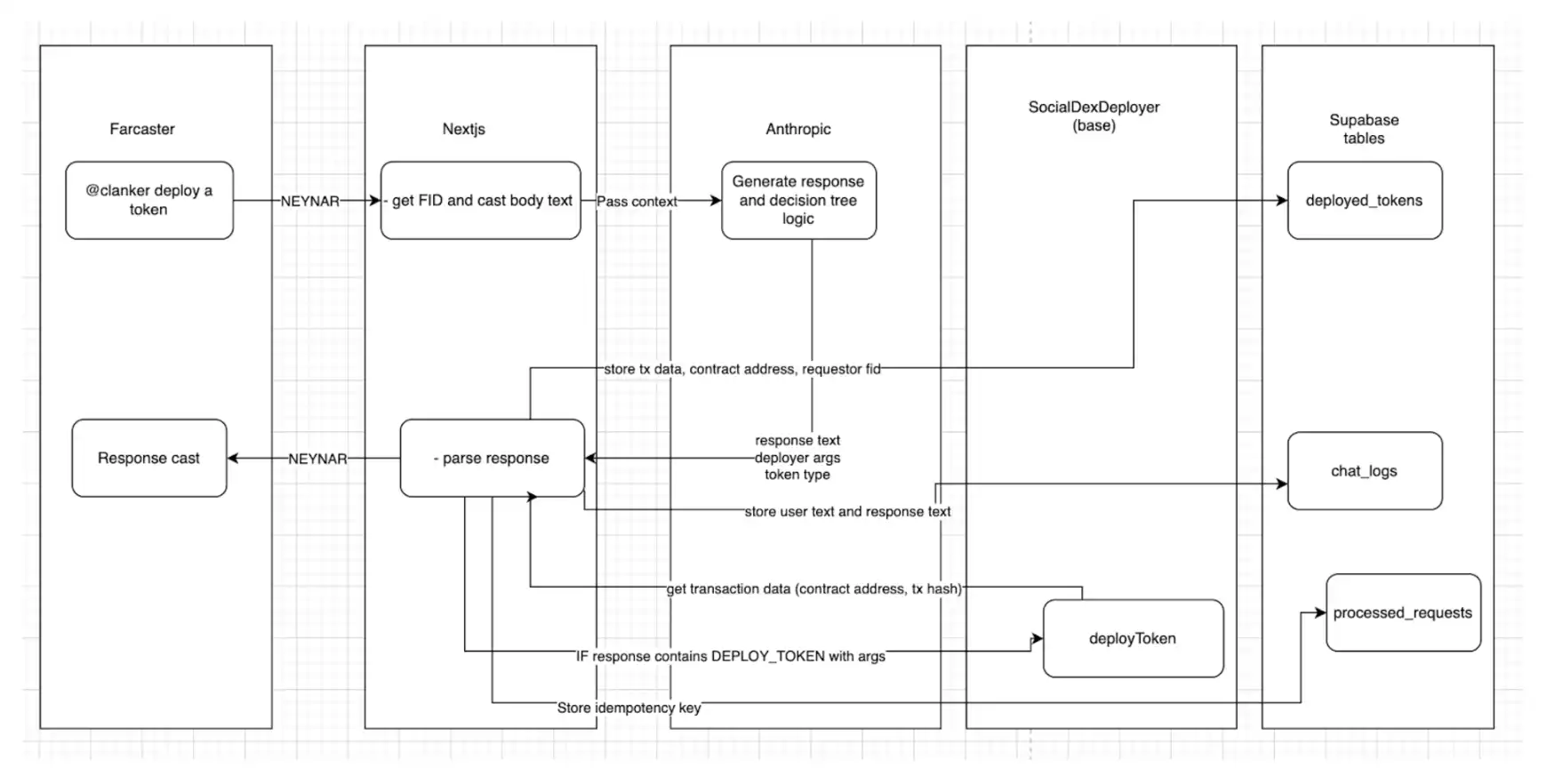
Clanker Technical Implementation Flowchart
However, this celebration is not just for entertainment. Clanker is exploring how to integrate the concept of DeSci (Decentralized Science) into its system. For example, future tokens may no longer be just for fun or nostalgia but could serve functions such as scientific research funding, experimental results sharing, or open-source tool support. Just like Rick solves universal problems with his inventions, Clanker's tokens may become experimental tools in the scientific community, providing new funding models for scientists and reshaping academic trust through on-chain transparency. The combination of DeSci and Meme is not only refreshing but also opens up an unexpected future for blockchain applications.
Clanker is such a crazy and creative laboratory that continuously expands the boundaries of Web3 through laughter and innovation. Who knows, the next industry to be reshaped by it might be science?
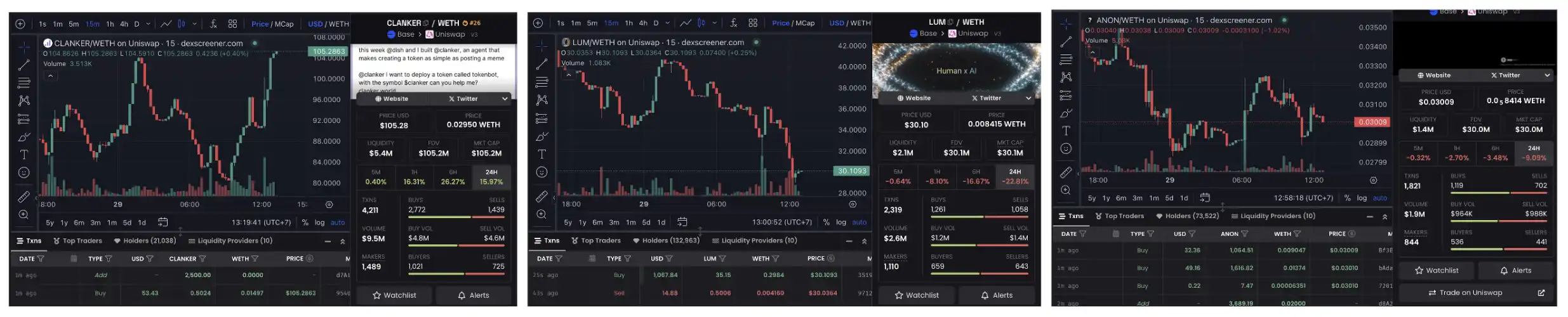
CLANKER, LUM, ANON: Performance of the Three Major Tokens
The issuance stories of the three major tokens CLANKER, LUM, and ANON, especially the integration of ANON with the anonymous posting tool anoncast, have even attracted the attention of Ethereum's founder Vitalik. Also noteworthy is the birth of AI Meme Luminous ($LUM) originating from a moment of inspiration in the Farcaster community, where a user proposed the bold idea of creating a token symbolizing the collaboration between humans and AI: intertwining blue-gold light flows to represent AI and human consciousness, forming an infinite loop, with a deep space background conveying a sense of technology and futurism. Through the Clanker platform, this creativity was swiftly realized, with the token's minting, Uniswap V3 pool initialization, liquidity injection and locking, and the design of a 40% transaction fee feedback mechanism all automated. $LUM not only lowers the technological barrier with its simplified operational flow but also rapidly attracts community attention through the narrative theme of "human-AI collaboration" and artistic visual design, becoming a cultural symbol within the Base ecosystem. Leveraging the strong community outreach, $LUM has seen its market cap surge past $30 million from inspiration to market value.
On one hand, as an innovative platform, Clanker greatly reduces the technical threshold by simplifying user workflows (such as generating tokens directly through @clanker) and issuing tokens through AI collaboration, allowing anyone to participate in the creation and dissemination of Meme tokens. On the other hand, onlookers cannot help but wonder if the Clanker model can be sustained. As a "crypto-ized" project, its current mode focuses on hype and propagation, lacking practical use cases. Here, the author wants to reference the thoughts of cultural anthropologists, pointing out that in reality, a culture is neither a purely physical process nor a purely mental construct. It is a living organism rooted in the soil of life, encompassing both the simple instinctual lives of shepherds, fishermen, and farmers and the highest achievements of artists and philosophers; just as individuals tightly intertwine the nourishment and reproduction of animal life with higher rational and intellectual activities. As the world moves from the tangible to the intangible, Clanker may not only be a technical tool but rather the core engine of innovation and cultural dissemination within the Base ecosystem, gradually driving community interaction and unleashing creativity.
Virtual Protocol: A Crypto Entrepreneurial Success Story
Although part of the Base ecosystem, Virtual has chosen a completely different path: with a product-driven core, emphasizing the connection between AI and Web2 users, gradually building a high-frequency "use" tool system. Google's former CEO Eric Schmidt and A16Z co-founder Marc Andreessen have pointed out Virtual's team's unique advantage in high-frequency trial and error. From PathDAO to Virtual Protocol, the team has crossed GameFi, AI infrastructure, and consumer DApps in three years, achieving the miracle of growing from a $10 million market cap to $1 billion.
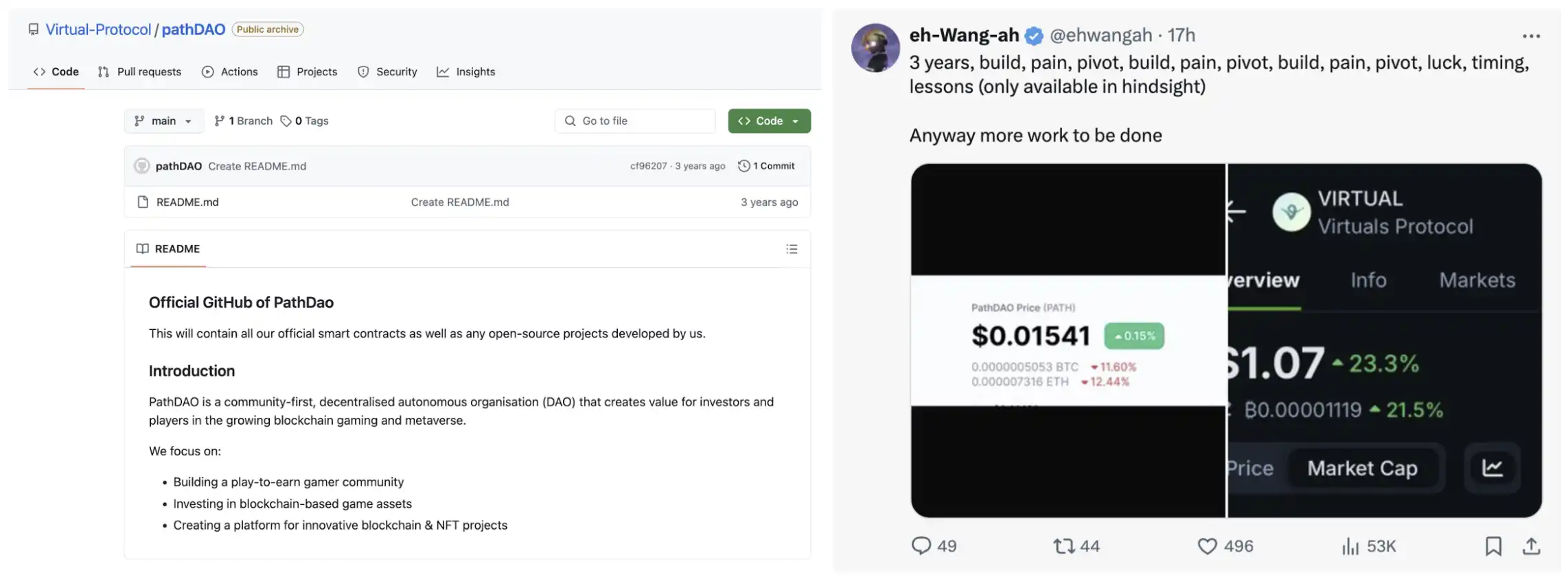
Early GitHub of PathDAO and Twitter of the ecosystem lead
Virtual encompasses a diverse product line, including modules such as MyShell's Alpp Store, although the market value and usage of individual products do not compare to Clanker's coin circle meme, it has opened up space in the Web2 tooling scene. $VIRTUAL is the native token of the Virtuals Protocol platform, designed for the AI agent ecosystem. Users need to use $VIRTUAL to purchase AGENT tokens (such as $LUNA), and it is not possible to exchange them with other tokens, making $VIRTUAL the sole channel for entering the ecosystem, purchasing, and investing in AI agents. The VIRTUAL token plays a key role in the entire system, driving economic activity on the platform, ensuring decentralization, and fair distribution. Most agents on the platform are intellectual property agents representing specific personalities or roles, such as virtual life forms, frogs, emojis, Donald Trump, Taylor Swift, etc. Meanwhile, developers are also creating functional agents to enhance user interaction with AI virtual life forms and ensure their seamless integration into the virtual world. These agents not only generate real income but also achieve long-term growth and co-ownership through tokenization mechanisms. Participants can share the potential rewards brought by agents by holding $VIRTUAL tokens and purchasing $LUNA tokens.
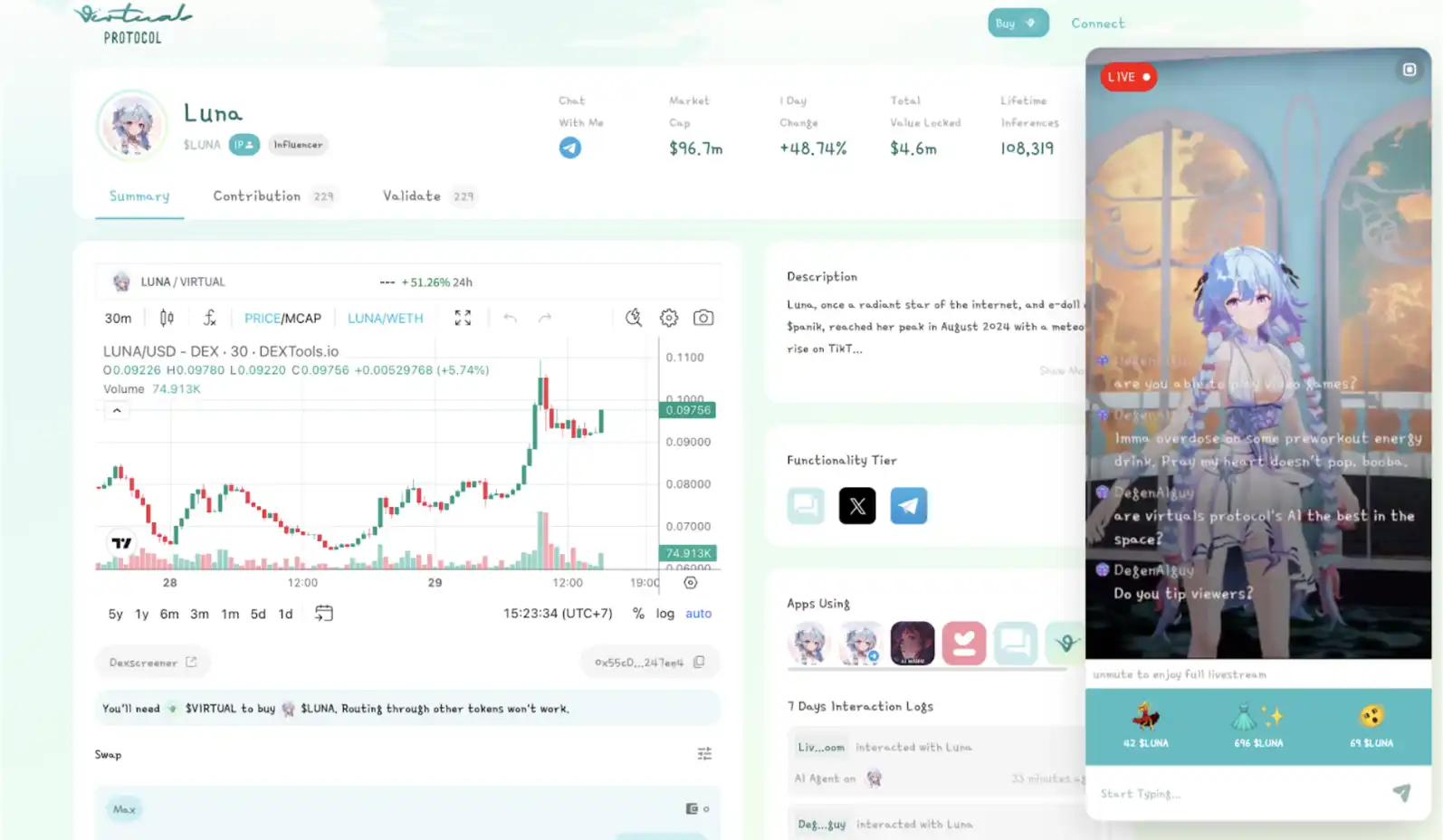
However, Virtual has been heavily questioned by the Degen community for its "usability," whether tool-type products are "putting the cart before the horse"? As a cryptocurrency ecosystem project, its core is "usage" rather than "speculation," but has it thereby lost its dissemination value?
Clanker: The "Rebel" of Liangshan
Clanker is more like Song Jiang of Liangshan who was forced to rebel and establish himself, relying on his organizational skills and spreading effect to carve out a place for a group of grassroots heroes in troubled times. By creating trending meme tokens, Clanker attracted the attention of a large number of coin circle users, creating an atmosphere of market frenzy, just like Liangshan's "upholding justice for Heaven" slogan, spreading the ideology of rebellion throughout the land.
However, the problem lies in the fact that Liangshan's brand ultimately is merely a slogan, lacking long-term support. Many of the tokens issued by Clanker have high market values but remain at the conceptual level, lacking a solid use case. This pattern is more like Liangshan's desperate survival in troubled times, continuously expanding its influence through "speculation," but may not be able to sustain it in the long run.
Virtual: Liangshan's "Defection Faction"
In comparison, Virtual's path is more like the Defection Faction in the water margins of Liangshan. Their core goal is not rebellion but rather to ensure their brothers have enough to eat and drink, pursuing stability and order. Virtual focuses on refining product features, empowering users through AI tools, bridging the gap between Web2 and Web3, more resembling Liangshan striving to maintain its "orthodox status" after accepting the court's defection.
Virtual emphasizes "utility" rather than "speculation." Although its tool-oriented products are widely used, they lack the viral effect of cryptocurrency, similar to Liangshan after defection. While they solve short-term livelihood issues, they lose their initial spirit of rebellion. This approach may offer short-term stability, but whether it can sustain the ideological value of cryptocurrency remains unknown.
Ideological Rebellion vs. Livelihood Compromise
The core contradiction of the Liangshan uprising lies in the struggle between ideological rebellion and the reality of survival. Song Jiang's "taking justice on behalf of the heavens" represents the spirit of rebellion, while the final defection is the choice to find a practical refuge for his brothers. This transformation illustrates the conflict between ideals and reality—where the ideal is rebellion, and reality is compromise.
Likewise, the divergence between Clanker and Virtual reflects another contradiction in the cryptocurrency ecosystem: the opposition between "speculation" and "utility," actually mirroring a deeper issue in cryptocurrency. With BTC and ETH gradually gaining mainstream acceptance and entering the era of reserves and compliance, do we need more product innovation or stronger ideological dissemination? Just as Song Jiang felt when overlooking the military camp from the mountaintop: "Since we are bandits, how can we not submit to the court? If we cause chaos, it is only to seek a peaceful life. How can we forever be rebels?" This statement aptly expresses the emotional journey from rebellion to pragmatic compromise, offering a mirror for us to contemplate the future of cryptocurrency.
You may also like

What Is an XRP Wallet? The Best Wallets to Store XRP (2026 Updated)
An XRP wallet lets you safely store, send, and receive XRP on the XRP Ledger. Learn what wallets support XRP and discover the best XRP wallets for beginners and long-term holders in 2026.

What are the Top AI Crypto Coins? Render vs. Akash: 5 Gems Solving the 2026 GPU Crisis
What are the best AI crypto coins for the 2026 cycle? Beyond the hype, we analyze top tokens like RNDR, AKT, and FET that provide real-world solutions to the global GPU shortage and the rise of autonomous agents.

What Is a Token in AI? What Is an AI Token + 3 Gems You Can't Miss in 2026
The era of AI hype has transitioned into an era of utility. As we move through Q2 2026, the market is no longer rewarding "narrative-only" projects. At WEEX Research, we are seeing a massive capital rotation into Decentralized Compute (DePIN) and Autonomous Agent coordination layers. This guide analyzes which AI tokens are capturing institutional liquidity and how to spot high-conviction setups in a maturing market.

Consumer-grade Crypto Global Survey: Users, Revenue, and Track Distribution

Prediction Markets Under Bias

Stolen: $290 million, Three Parties Refusing to Acknowledge, Who Should Foot the Bill for the KelpDAO Incident Resolution?

ASTEROID Pumped 10,000x in Three Days, Is Meme Season Back on Ethereum?

ChainCatcher Hong Kong Themed Forum Highlights: Decoding the Growth Engine Under the Integration of Crypto Assets and Smart Economy

Why can this institution still grow by 150% when the scale of leading crypto VCs has shrunk significantly?

Anthropic's $1 trillion, compared to DeepSeek's $100 billion

Geopolitical Risk Persists, Is Bitcoin Becoming a Key Barometer?

Annualized 11.5%, Wall Street Buzzing: Is MicroStrategy's STRC Bitcoin's Savior or Destroyer?
An Obscure Open Source AI Tool Alerted on Kelp DAO's $292 million Bug 12 Days Ago

Mixin has launched USTD-margined perpetual contracts, bringing derivative trading into the chat scene.
The privacy-focused crypto wallet Mixin announced today the launch of its U-based perpetual contract (a derivative priced in USDT). Unlike traditional exchanges, Mixin has taken a new approach by "liberating" derivative trading from isolated matching engines and embedding it into the instant messaging environment.
Users can directly open positions within the app with leverage of up to 200x, while sharing positions, discussing strategies, and copy trading within private communities. Trading, social interaction, and asset management are integrated into the same interface.
Based on its non-custodial architecture, Mixin has eliminated friction from the traditional onboarding process, allowing users to participate in perpetual contract trading without identity verification.
The trading process has been streamlined into five steps:
· Choose the trading asset
· Select long or short
· Input position size and leverage
· Confirm order details
· Confirm and open the position
The interface provides real-time visualization of price, position, and profit and loss (PnL), allowing users to complete trades without switching between multiple modules.
Mixin has directly integrated social features into the derivative trading environment. Users can create private trading communities and interact around real-time positions:
· End-to-end encrypted private groups supporting up to 1024 members
· End-to-end encrypted voice communication
· One-click position sharing
· One-click trade copying
On the execution side, Mixin aggregates liquidity from multiple sources and accesses decentralized protocol and external market liquidity through a unified trading interface.
By combining social interaction with trade execution, Mixin enables users to collaborate, share, and execute trading strategies instantly within the same environment.
Mixin has also introduced a referral incentive system based on trading behavior:
· Users can join with an invite code
· Up to 60% of trading fees as referral rewards
· Incentive mechanism designed for long-term, sustainable earnings
This model aims to drive user-driven network expansion and organic growth.
Mixin's derivative transactions are built on top of its existing self-custody wallet infrastructure, with core features including:
· Separation of transaction account and asset storage
· User full control over assets
· Platform does not custody user funds
· Built-in privacy mechanisms to reduce data exposure
The system aims to strike a balance between transaction efficiency, asset security, and privacy protection.
Against the background of perpetual contracts becoming a mainstream trading tool, Mixin is exploring a different development direction by lowering barriers, enhancing social and privacy attributes.
The platform does not only view transactions as execution actions but positions them as a networked activity: transactions have social attributes, strategies can be shared, and relationships between individuals also become part of the financial system.
Mixin's design is based on a user-initiated, user-controlled model. The platform neither custodies assets nor executes transactions on behalf of users.
This model aligns with a statement issued by the U.S. Securities and Exchange Commission (SEC) on April 13, 2026, titled "Staff Statement on Whether Partial User Interface Used in Preparing Cryptocurrency Securities Transactions May Require Broker-Dealer Registration."
The statement indicates that, under the premise where transactions are entirely initiated and controlled by users, non-custodial service providers that offer neutral interfaces may not need to register as broker-dealers or exchanges.
Mixin is a decentralized, self-custodial privacy wallet designed to provide secure and efficient digital asset management services.
Its core capabilities include:
· Aggregation: integrating multi-chain assets and routing between different transaction paths to simplify user operations
· High liquidity access: connecting to various liquidity sources, including decentralized protocols and external markets
· Decentralization: achieving full user control over assets without relying on custodial intermediaries
· Privacy protection: safeguarding assets and data through MPC, CryptoNote, and end-to-end encrypted communication
Mixin has been in operation for over 8 years, supporting over 40 blockchains and more than 10,000 assets, with a global user base exceeding 10 million and an on-chain self-custodied asset scale of over $1 billion.

$600 million stolen in 20 days, ushering in the era of AI hackers in the crypto world
Vitalik's 2026 Hong Kong Web3 Summit Speech: Ethereum's Ultimate Vision as the "World Computer" and Future Roadmap
On the same day Aave introduced rsETH, why did Spark decide to exit?
Full Post-Mortem of the KelpDAO Incident: Why Did Aave, Which Was Not Compromised, End Up in Crisis Situation?
What Is an XRP Wallet? The Best Wallets to Store XRP (2026 Updated)
An XRP wallet lets you safely store, send, and receive XRP on the XRP Ledger. Learn what wallets support XRP and discover the best XRP wallets for beginners and long-term holders in 2026.
What are the Top AI Crypto Coins? Render vs. Akash: 5 Gems Solving the 2026 GPU Crisis
What are the best AI crypto coins for the 2026 cycle? Beyond the hype, we analyze top tokens like RNDR, AKT, and FET that provide real-world solutions to the global GPU shortage and the rise of autonomous agents.
What Is a Token in AI? What Is an AI Token + 3 Gems You Can't Miss in 2026
The era of AI hype has transitioned into an era of utility. As we move through Q2 2026, the market is no longer rewarding "narrative-only" projects. At WEEX Research, we are seeing a massive capital rotation into Decentralized Compute (DePIN) and Autonomous Agent coordination layers. This guide analyzes which AI tokens are capturing institutional liquidity and how to spot high-conviction setups in a maturing market.



 App
App