
Three Weeks of the US-Iran War: Who's Making Money, Who's Paying the Bill?


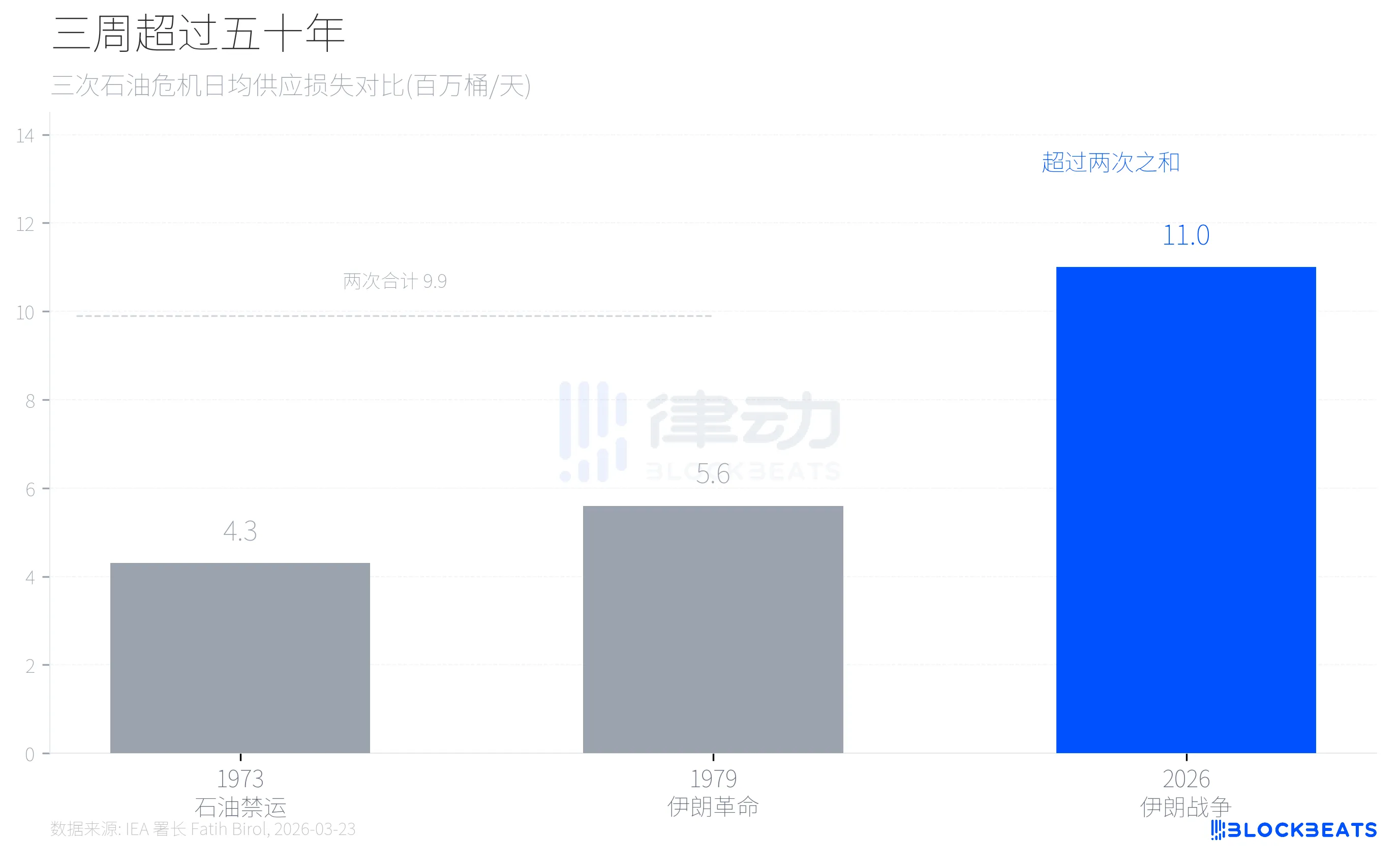
On February 28, the US and Israel launched a military strike against Iran. Iran then blocked the Strait of Hormuz, cutting off 20 million barrels of oil that pass through it daily. Three weeks later, IEA Director Fatih Birol gave a figure on March 23 at the National Press Club of Australia: the global daily oil supply loss caused by this war is 11 million barrels.
This figure surpasses the combined losses of the 1973 oil embargo and the 1979 Iran Revolution crises.
Energy infrastructure in more than 40 locations across 9 countries in the Middle East suffered varying degrees of damage. IEA data for the same period shows that global natural gas supply loss has reached 140 billion cubic meters, nearly double the loss of European natural gas (75 billion cubic meters) during the Russia-Ukraine conflict. In three weeks, the quantifiable impact of this conflict on the energy market has already exceeded that of the entire 1970s.
But supply loss is only half the story. The other half is that this crisis has clear beneficiaries.
Putin's Unexpected Harvest
Before the Iran war, Urals crude oil was trading at less than $60 a barrel. This price had been locked for nearly three years, a direct result of Western sanctions. After the Russia-Ukraine war broke out, the West imposed a price ceiling on Russian oil, and Urals crude maintained a discount of $30 to $40 compared to the international benchmark Brent for a long period. This discount was the most visible signal of the sanctions in effect.
The Iran war changed everything. After the closure of the Strait of Hormuz, a huge gap appeared in the global oil market, and buyers were forced to seek alternative supply. According to data from the Center for Energy and Clean Air (CREA), the total revenue from Russian fossil fuel exports in the first two weeks of March reached 7.7 billion euros, averaging 513 million euros per day, an 8.7% increase from February's 472 million euros. Of this, daily revenue from oil exports was 372 million euros, earning an additional 672 million euros (about 777 million USD) in the two weeks.
In three weeks, Urals crude oil rose from less than $60 to about $90, an increase of nearly 80%. According to Al Jazeera, energy analyst George Voloshin pointed out that during the same period, Brent also rose from about $65 to over $110, but the key is not the absolute price, but the price difference between the two. The discount between Urals and Brent significantly narrowed from around $40 pre-war. Moscow Times reported on March 16 that Urals crude delivered to India even saw a premium over Brent, something that had never happened since the sanctions took effect.
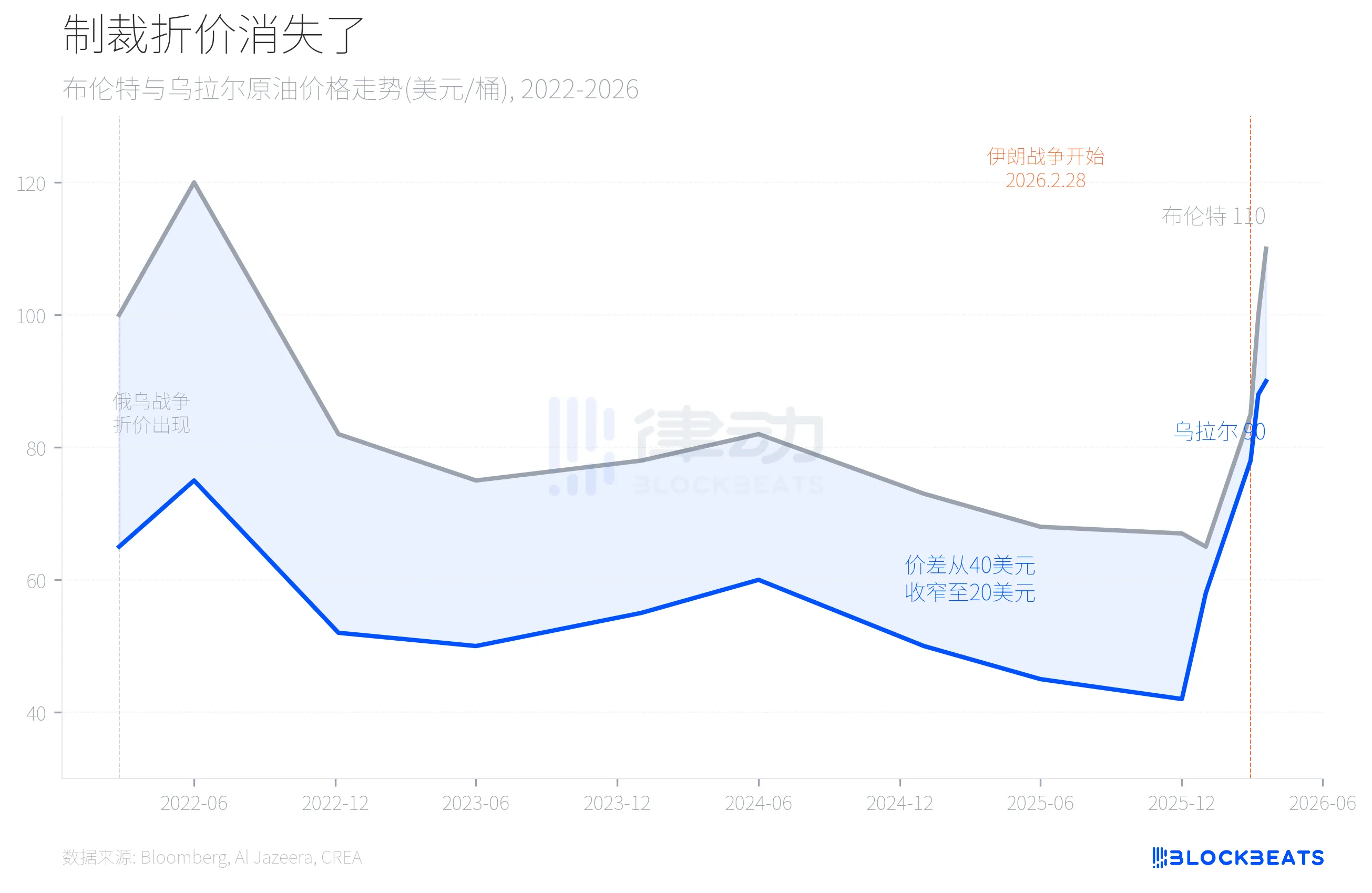
In other words, the three-year economic wall built by the West through sanctions was partially torn down by the three-week Iran War.
The Trump administration announced a 30-day sanction waiver on March 12, allowing countries to purchase Russian crude oil. Treasury Secretary Scott Bessent stated that this action would release approximately 140 million barrels of supply. However, analysts widely believe that the restriction on waivers that do not provide "significant financial benefits" is almost unenforceable. Meanwhile, the IEA announced the release of 400 million barrels from strategic petroleum reserves, the largest in history. This waiver is set to expire on April 11, ushering in a new round of market uncertainty.
India is the most direct actor in this scenario. CREA data shows that in the first two weeks of March, India's total purchases of Russian fossil fuels reached 1.3 billion euros, averaging 89 million euros per day, a 48% increase from February's daily average of 60 million euros. Al Jazeera reported that at least seven tankers originally headed for China changed course en route to India, with one vessel named Aqua Titan arriving at an Indian port on March 21. While the world is anxious about oil prices, the oil trade between Moscow and New Delhi is accelerating.
Who is footing the bill?
The losses on the supply side and the gains on the revenue side will ultimately be passed on to the consumer side. American consumers are the most direct bearers of this burden.
AAA data shows that the national average price of gasoline in the United States has risen from $2.98 before the war to $3.96 on March 23, a 33% increase. California has reached an average of $5.56, with even Kansas at a minimum of $3.23. The average diesel price is $5.07, the highest since 2022.
A Fortune report noted that this round of oil price hikes has coincidentally offset the tax refunds that American households have just received.
The aviation industry is one of the first sectors to feel the impact. Platts assessment data shows that U.S. jet fuel prices have risen over 60% in three weeks, doubling in some regions. United Airlines became the first major U.S. carrier to officially announce capacity cuts. CEO Scott Kirby stated in an internal memo that the company is preparing for oil prices to reach $175 per barrel, meaning annual fuel costs will increase by about $11 billion, more than double the profit of the company's "best year ever." United will cut 5% of its flights in the second and third quarters.
The impact is spreading globally. According to CNBC's March 21 report, Delta Air Lines has also warned of possible capacity cuts. Euronews reports that Qantas, SAS, and Thai Airways have raised prices, while Air New Zealand has canceled over 1,000 flights.
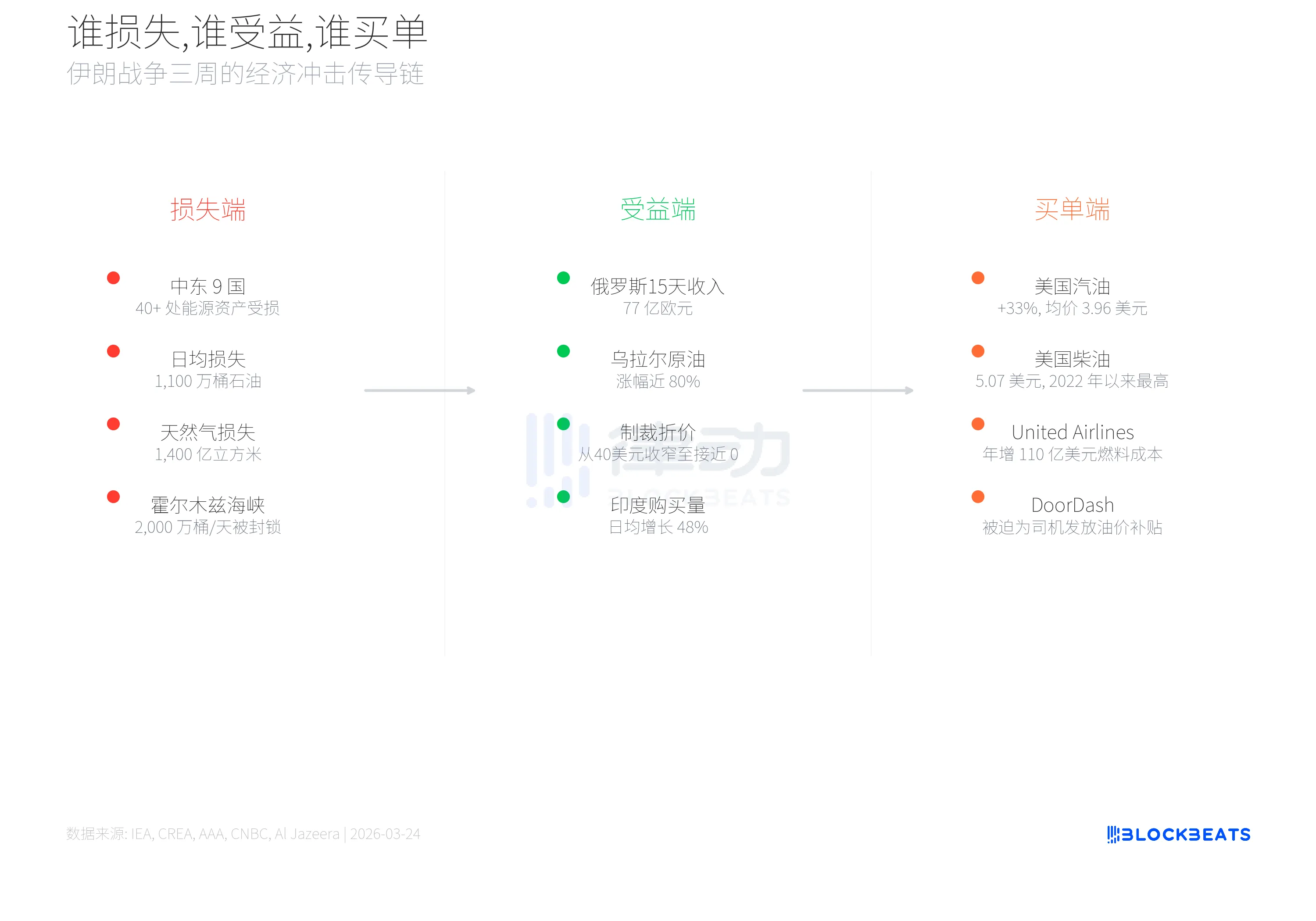
Even the gig economy is being affected. According to the Philadelphia Inquirer's March 23 report, DoorDash has started offering drivers weekly $5 to $15 fuel subsidies and a 10% fuel cashback to deal with a decrease in order acceptance due to rising fuel prices. When a food delivery platform has to foot the bill for a Middle East conflict, the length of the impact transmission chain needs no further explanation.
Three weeks into the Iran war, the world is losing 11 million barrels of oil per day, with Russia earning nearly $800 million extra in 15 days, U.S. consumers seeing a one-third hike in gasoline costs. After the April 11 sanction waivers expire, this transmission chain will further extend.
You may also like

Why is a16z Crypto raising another $2.2 billion to heavily invest in Web3?

Polymarket Underlying Algorithm Explained

What do projects born in the crypto bear market do?

a16z founder's Stanford lecture: Whenever Wall Street and Silicon Valley have different ideas, it's Wall Street that ends up being wrong

Michael Saylor: After three consecutive quarters of losses, Strategy will sell Bitcoin to pay dividends

The toll station at Hormuz and the RMB that cannot be bought

Interview with Coinbase Institutional's Strategic Head: The Institutionalization of Crypto Reaches a Critical Point

Dialogue with Agora CEO Nick: The battle for stablecoin licenses has just begun

Morning Report | a16z Crypto completes $2.2 billion fundraising for its fifth fund; Bullish invests $4.2 billion to acquire share transfer agency Equiniti; PayPal's Q1 performance exceeds expectations

a16z Crypto: What We See Behind the $2.2 Billion New Fund
Web3 is dead, Web2+3 should rise
Stablecoins and Latin American Remittances: The Misunderstood $174 Billion Market

The arrival of the Web 3.0 era: A review of Hong Kong court rulings on digital assets

Track Markets At a Glance: New WEEX Price Widgets for iOS & Android
To streamline your market data access, WEEX has officially launched "Market Watchlist" desktop widgets

The billion-dollar lesson: The focus of DeFi security is shifting from code to operational governance
A Brief Analysis of Stablecoin Licenses and On-Chain Funding
BVNK Founder: Three Stages of Stablecoin Development
The truth about Trump's son's Bitcoin game: he made a staggering $100 million while retail investors lost $500 million
Why is a16z Crypto raising another $2.2 billion to heavily invest in Web3?
Polymarket Underlying Algorithm Explained
What do projects born in the crypto bear market do?
a16z founder's Stanford lecture: Whenever Wall Street and Silicon Valley have different ideas, it's Wall Street that ends up being wrong
Michael Saylor: After three consecutive quarters of losses, Strategy will sell Bitcoin to pay dividends
The toll station at Hormuz and the RMB that cannot be bought


