
 Buy Crypto
- Markets
 Futures
- Spot
- Copy Trade
- Earn
- More
The appointment of the new SEC Chairman is still pending, with the price of the related concept token experiencing a 50% intraday volatility.

Last night, RSR experienced a sudden 50.72% price surge to reach $0.026 before quickly dropping to $0.019, and the current RSR price is $0.023. The RSR-related meme coin DTF saw a price increase from $0.012 to $0.03, with a short-term surge of 235%, then dropping to $0.015 before currently stabilizing at $0.023.
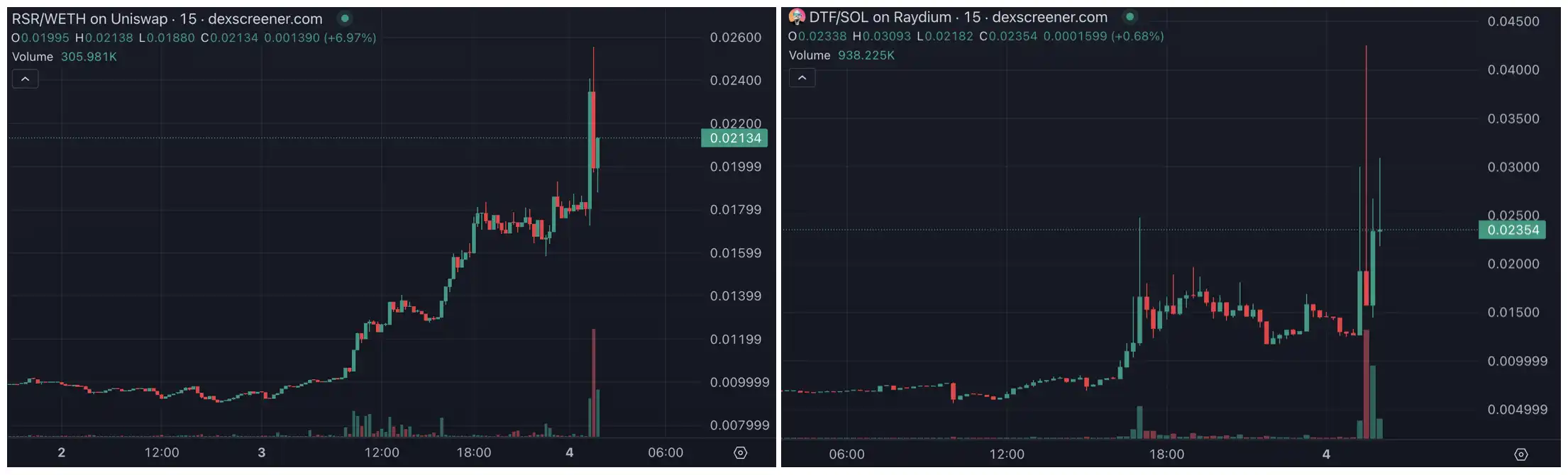
This was due to reports that Trump had chosen Paul Atkins as the next SEC chairman, who had previously served as an advisor to the RSR project. However, because Atkins did not confirm this news and there were rumors of his hesitance, the related tokens experienced a brief but sharp drop in price.
Who is Paul Atkins?
Paul Atkins is a former SEC commissioner during the George W. Bush administration, known for his stance against "imposing heavy fines on companies violating securities laws" and his opposition to the Dodd-Frank Act that sought to strengthen federal regulatory powers after the 2008 financial crisis.
In 2016, Atkins played a key role in Trump's presidential transition team and significantly influenced Trump's hands-off approach to financial regulation.

Currently, Atkins continues to serve at his consultancy firm Patomak Global Partners, which he founded in 2009. Since 2017, he has also been co-chair of the industry group Token Alliance, advocating for digital assets and the blockchain industry.
The connection to RSR stems from the community's discovery that Atkins had previously advised the project.
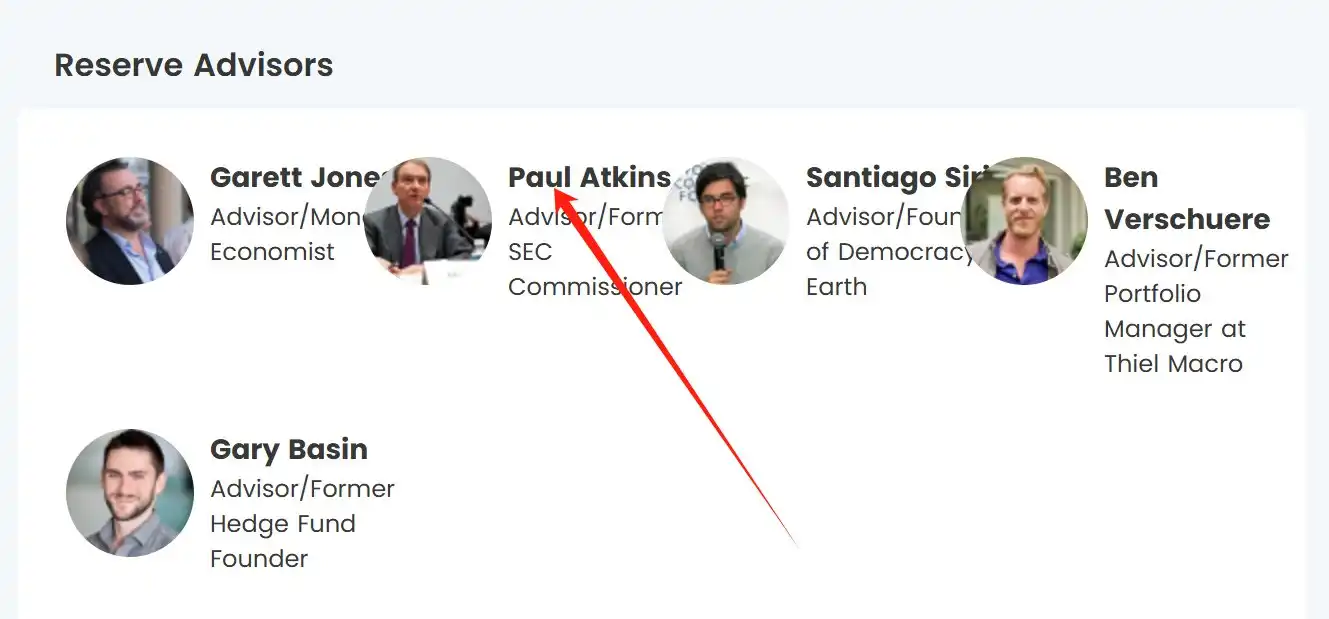
Reserve founder Nevin Freeman clarified that "Paul is not currently actively involved in consulting for Reserve; he was an early advisor to the project. However, his open-mindedness in our interactions impressed me, and his willingness to publicly acknowledge his advisory role with Reserve shows his commitment and support for the cryptocurrency space."
Therefore, when news aggregator account db referenced Unchained's report announcing Trump's selection of Atkins as the next SEC chairman, the price surged dramatically.
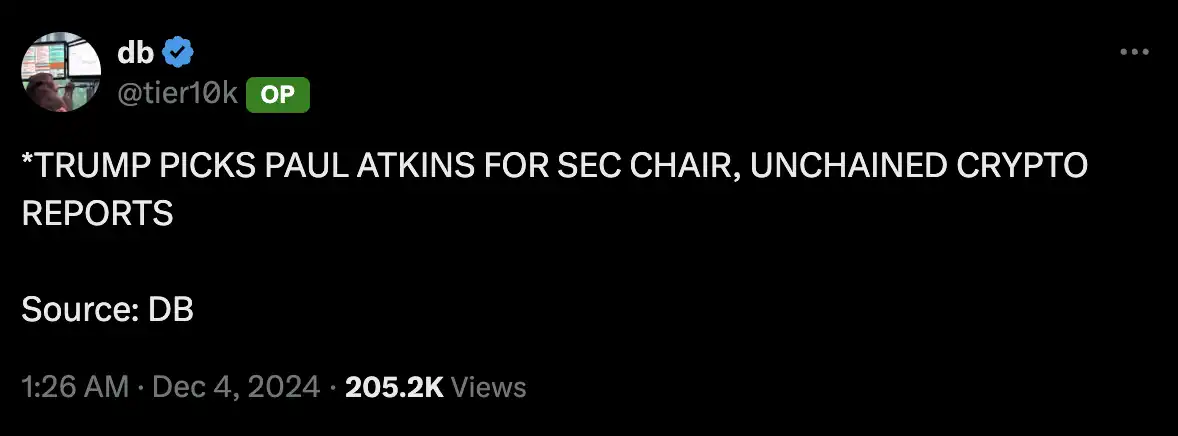
The original news article by Unchained stated: "According to three sources familiar with the matter, Trump has selected cryptocurrency-friendly Paul Atkins to serve as SEC Chair. One source noted that Trump has been in touch with Atkins but is still awaiting his formal acceptance of the appointment."
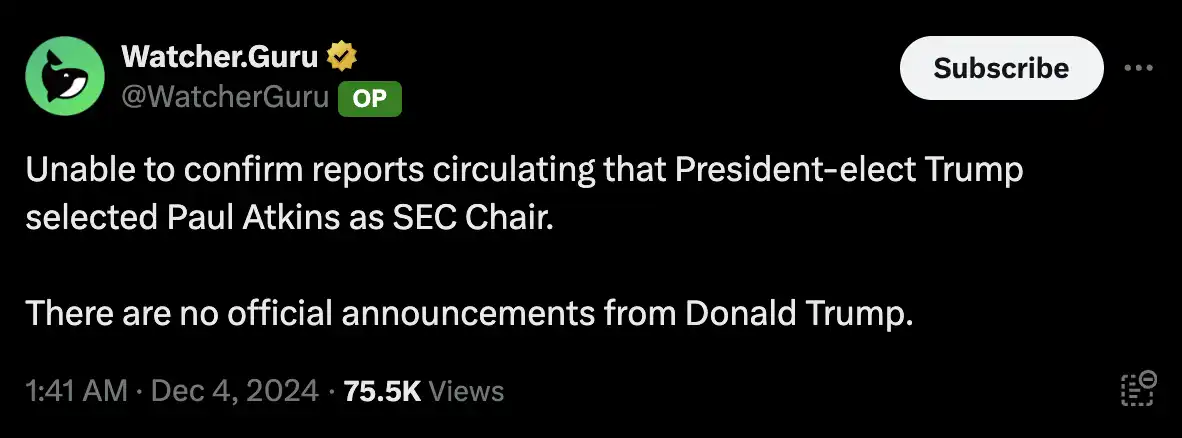
Less than twenty minutes later, another major news aggregation account, Watcher. Guru, released a statement saying, "Unable to confirm the rumors regarding President-elect Trump's selection of Paul Atkins as SEC Chair, as no official statement has been released by the Trump team at this time."
According to Coindesk, a source familiar with Atkins' thinking indicated that Atkins is hesitant about leaving his global consulting firm to tackle what he sees as a poorly run and bloated agency under the outgoing SEC Chair Gary Gensler.
Shortly after, another news terminal, Formula, posted a notification stating that trader GCR had mentioned in Discord that he had sold RSR a long time ago, but this notification has since been deleted.
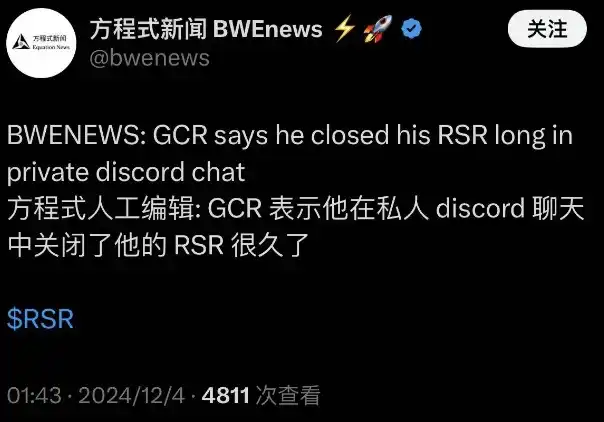
The chain of the trading news above led to a rapid rise and fall in RSR and DTF in a short period, essentially driven by the market's emotions surrounding the SEC Chair outcome.
Currently, compliance prediction platform Kalshi's data shows that the probability of Paul Atkins becoming the next SEC Chair has risen to 88%.
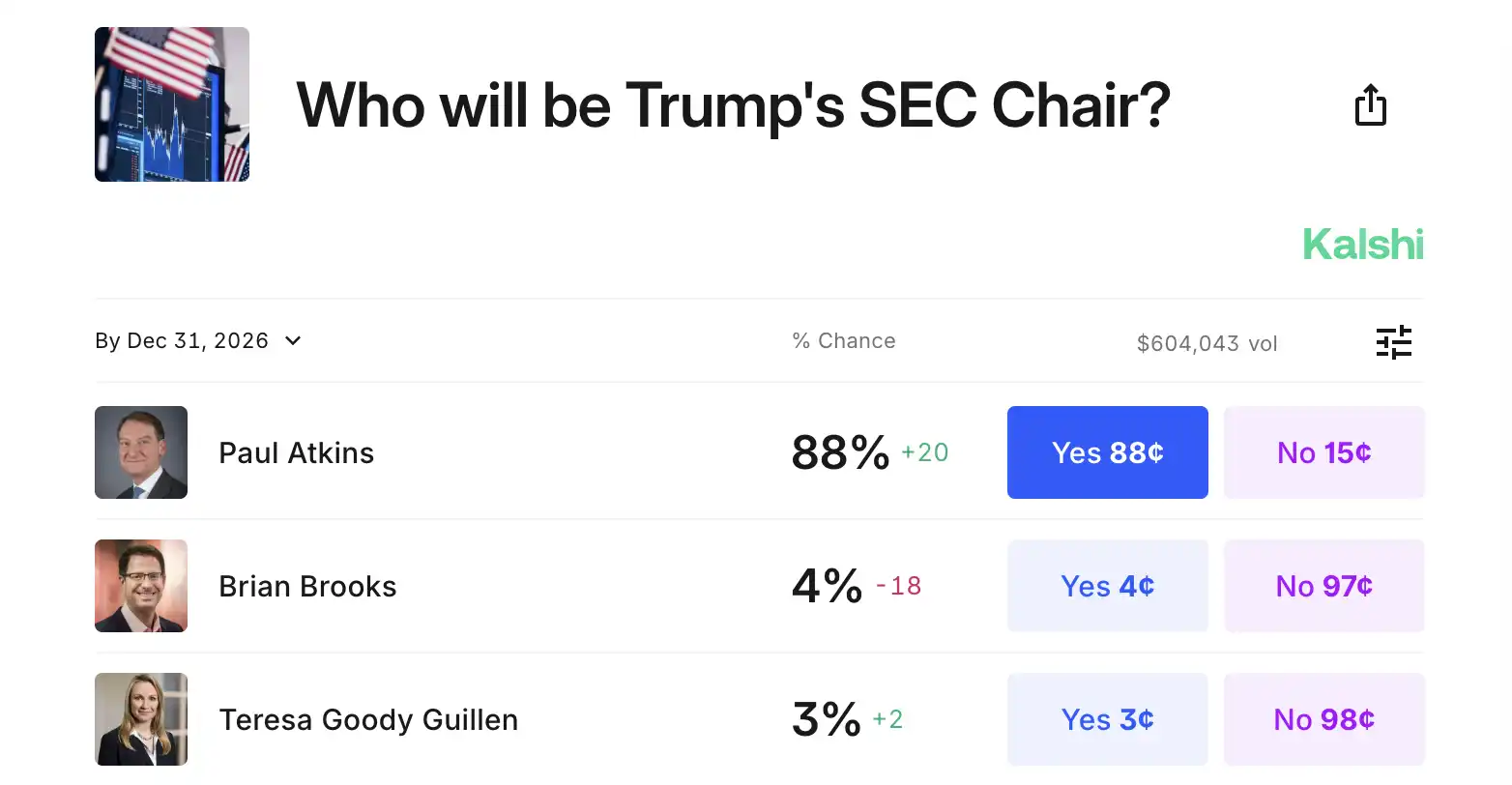
Prior to this, FOX Business reporter Eleanor Terrett revealed that Trump is expected to announce his pick for SEC Chair as early as today, naming veteran financial regulator and conservative financial industry behind-the-scenes advisor Paul Atkins as the most likely contender. President-elect Donald Trump's transition team has also interviewed Paul Atkins, and two sources close to Mar-a-Lago have disclosed that among the senior members of the Trump transition team, former SEC Commissioner Paul Atkins is the most likely to be appointed as SEC Chair.
What are some SEC Chair Hype Concepts
RSR
Reserve Rights (RSR) is a dual-token stablecoin platform launched on the Huobi Prime platform in May 2019. Reserve aims to establish a stable, decentralized stablecoin and digital payment system, with its stablecoin featuring a supply that adjusts based on demand and is backed by 100% or more on-chain collateral.
The main issue that RSR seeks to address is volatility, as the volatility of cryptocurrencies has limited the market's expansion as a medium of exchange. Merchants have been reluctant to accept cryptocurrency due to concerns about potential profit loss during market downturns. The Reserve protocol provides the market with a stable store of value, a medium of exchange, and a deferred payment standard. Today, the focus of the Reserve Rights ecosystem is to assist individuals, governments, treasuries, and DAOs in combating inflation.
The total supply of RSR is 100,000,000,000 tokens, with a current market capitalization of $1,390,407,126 and a TVL of $278,254,588.
DTF
DTF is a meme coin that is not directly related to the Decentralized Token Folios protocol launched by Reserve. Its full name is "Believe In Something," corresponding to the DTF website's "Stop trading, believe in something."
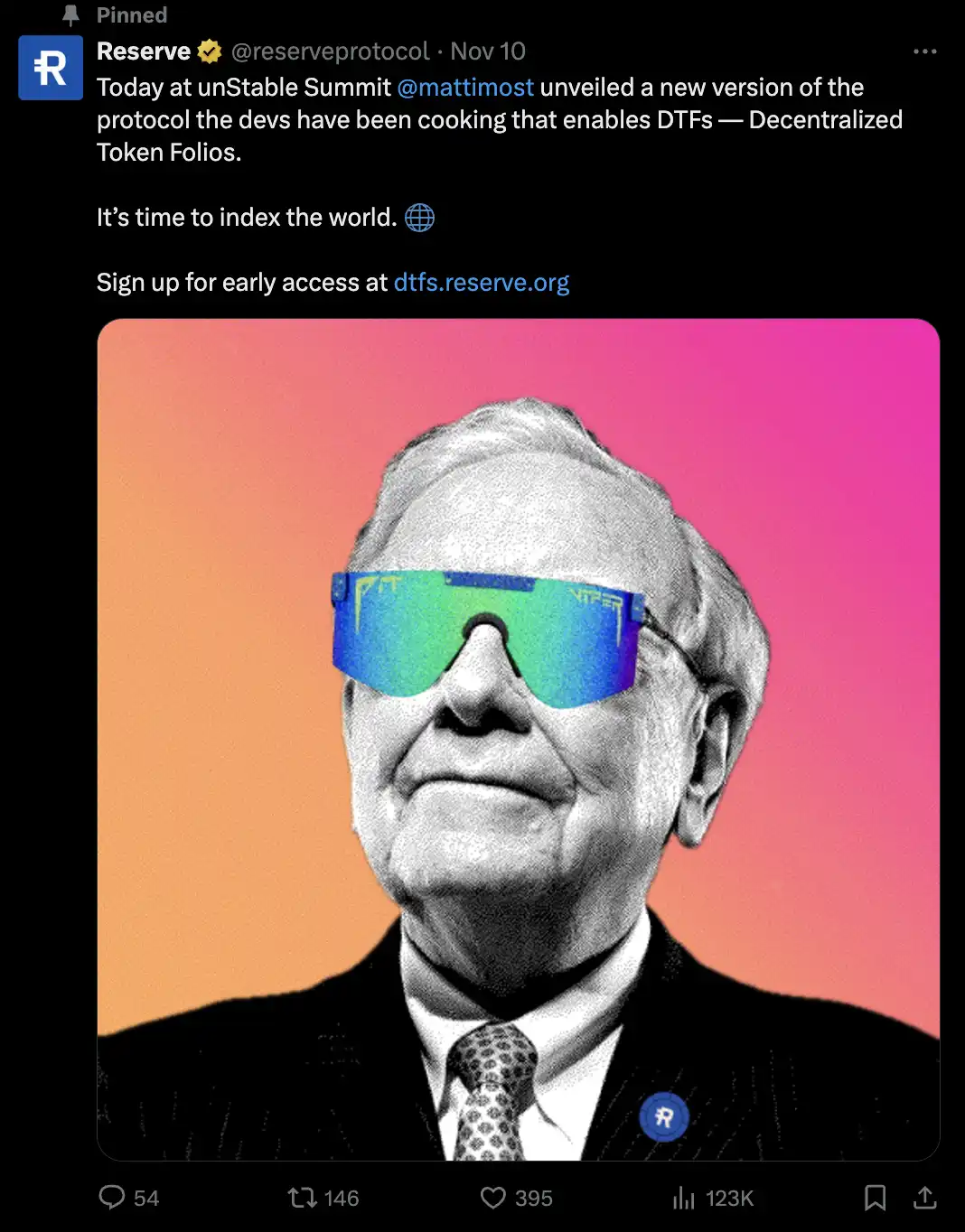
Currently, DTF has a total market capitalization of $23.9 million and a 24-hour trading volume of $20 million.
HBAR
Former Binance CEO and Hedera Governing Council member Brian Brooks is also a top contender on the list of candidates for the next SEC chairman, leading to recent speculation around HBAR as a concept coin for the SEC chairman.
Hedera is designed for fast, fair, and secure applications, leveraging the efficiency of Hashgraph on a trusted, decentralized public network. By limiting the number of nodes involved in critical functions such as timestamping and transaction ordering, Hedera Hashgraph can rapidly achieve finality, reducing the likelihood of later changes to transaction states.
XRP
XRP surged fivefold in a month, reclaiming the third position in the cryptocurrency market cap, back to the level before the 2020 SEC and Ripple lawsuit, making this long-standing token from the cross-border payment company one of the best-performing altcoins recently.
Related Reading: "XRP Reclaims Third Spot in Crypto Market Cap, What's Driving Its Meteoric Rise?"
Ripple is a real-time gross settlement system, currency exchange, and remittance network created by the American technology company Ripple Labs Inc. Ripple was released in 2012, based on a distributed open-source protocol, and supports tokens representing fiat currency, cryptocurrency, commodities, or other units of value. It claims to enable "secure, instant, and nearly free global financial transactions of any size with no chargebacks."
After Trump took office, there have been continuous cryptocurrency-related policies, and the launch of XRP is closely related to the announcement of the resignation of the current SEC chairman. In December 2020, the SEC filed a lawsuit against Ripple and its two executives—CEO Brad Garlinghouse and co-founder Chris Larsen—alleging "an unregistered securities offering of $1.3 billion," a lawsuit that has yet to be resolved.
On December 1st, former CFTC Chairman Chris Giancarlo stated in an interview that the SEC should reconsider its actions, especially considering recent legal outcomes and the changing regulatory environment. When asked if the SEC would drop the Ripple lawsuit, Giancarlo said, "I think they should... I bet they will."
You may also like

a16z: 5 Ways Blockchain Helps AI Agent Infrastructure

Morning News | The Hong Kong Securities and Futures Commission announced the regulatory framework for secondary market trading of tokenized investment products; Strategy increased its holdings by 34,164 bitcoins last week; KAIO completed a strategic fi...

What Is an XRP Wallet? The Best Wallets to Store XRP (2026 Updated)
An XRP wallet lets you safely store, send, and receive XRP on the XRP Ledger. Learn what wallets support XRP and discover the best XRP wallets for beginners and long-term holders in 2026.

What are the Top AI Crypto Coins? Render vs. Akash: 5 Gems Solving the 2026 GPU Crisis
What are the best AI crypto coins for the 2026 cycle? Beyond the hype, we analyze top tokens like RNDR, AKT, and FET that provide real-world solutions to the global GPU shortage and the rise of autonomous agents.

What Is a Token in AI? What Is an AI Token + 3 Gems You Can't Miss in 2026
The era of AI hype has transitioned into an era of utility. As we move through Q2 2026, the market is no longer rewarding "narrative-only" projects. At WEEX Research, we are seeing a massive capital rotation into Decentralized Compute (DePIN) and Autonomous Agent coordination layers. This guide analyzes which AI tokens are capturing institutional liquidity and how to spot high-conviction setups in a maturing market.

Consumer-grade Crypto Global Survey: Users, Revenue, and Track Distribution

Prediction Markets Under Bias

Stolen: $290 million, Three Parties Refusing to Acknowledge, Who Should Foot the Bill for the KelpDAO Incident Resolution?

ASTEROID Pumped 10,000x in Three Days, Is Meme Season Back on Ethereum?

ChainCatcher Hong Kong Themed Forum Highlights: Decoding the Growth Engine Under the Integration of Crypto Assets and Smart Economy

Why can this institution still grow by 150% when the scale of leading crypto VCs has shrunk significantly?

Anthropic's $1 trillion, compared to DeepSeek's $100 billion

Geopolitical Risk Persists, Is Bitcoin Becoming a Key Barometer?
Annualized 11.5%, Wall Street Buzzing: Is MicroStrategy's STRC Bitcoin's Savior or Destroyer?
An Obscure Open Source AI Tool Alerted on Kelp DAO's $292 million Bug 12 Days Ago

Mixin has launched USTD-margined perpetual contracts, bringing derivative trading into the chat scene.
The privacy-focused crypto wallet Mixin announced today the launch of its U-based perpetual contract (a derivative priced in USDT). Unlike traditional exchanges, Mixin has taken a new approach by "liberating" derivative trading from isolated matching engines and embedding it into the instant messaging environment.
Users can directly open positions within the app with leverage of up to 200x, while sharing positions, discussing strategies, and copy trading within private communities. Trading, social interaction, and asset management are integrated into the same interface.
Based on its non-custodial architecture, Mixin has eliminated friction from the traditional onboarding process, allowing users to participate in perpetual contract trading without identity verification.
The trading process has been streamlined into five steps:
· Choose the trading asset
· Select long or short
· Input position size and leverage
· Confirm order details
· Confirm and open the position
The interface provides real-time visualization of price, position, and profit and loss (PnL), allowing users to complete trades without switching between multiple modules.
Mixin has directly integrated social features into the derivative trading environment. Users can create private trading communities and interact around real-time positions:
· End-to-end encrypted private groups supporting up to 1024 members
· End-to-end encrypted voice communication
· One-click position sharing
· One-click trade copying
On the execution side, Mixin aggregates liquidity from multiple sources and accesses decentralized protocol and external market liquidity through a unified trading interface.
By combining social interaction with trade execution, Mixin enables users to collaborate, share, and execute trading strategies instantly within the same environment.
Mixin has also introduced a referral incentive system based on trading behavior:
· Users can join with an invite code
· Up to 60% of trading fees as referral rewards
· Incentive mechanism designed for long-term, sustainable earnings
This model aims to drive user-driven network expansion and organic growth.
Mixin's derivative transactions are built on top of its existing self-custody wallet infrastructure, with core features including:
· Separation of transaction account and asset storage
· User full control over assets
· Platform does not custody user funds
· Built-in privacy mechanisms to reduce data exposure
The system aims to strike a balance between transaction efficiency, asset security, and privacy protection.
Against the background of perpetual contracts becoming a mainstream trading tool, Mixin is exploring a different development direction by lowering barriers, enhancing social and privacy attributes.
The platform does not only view transactions as execution actions but positions them as a networked activity: transactions have social attributes, strategies can be shared, and relationships between individuals also become part of the financial system.
Mixin's design is based on a user-initiated, user-controlled model. The platform neither custodies assets nor executes transactions on behalf of users.
This model aligns with a statement issued by the U.S. Securities and Exchange Commission (SEC) on April 13, 2026, titled "Staff Statement on Whether Partial User Interface Used in Preparing Cryptocurrency Securities Transactions May Require Broker-Dealer Registration."
The statement indicates that, under the premise where transactions are entirely initiated and controlled by users, non-custodial service providers that offer neutral interfaces may not need to register as broker-dealers or exchanges.
Mixin is a decentralized, self-custodial privacy wallet designed to provide secure and efficient digital asset management services.
Its core capabilities include:
· Aggregation: integrating multi-chain assets and routing between different transaction paths to simplify user operations
· High liquidity access: connecting to various liquidity sources, including decentralized protocols and external markets
· Decentralization: achieving full user control over assets without relying on custodial intermediaries
· Privacy protection: safeguarding assets and data through MPC, CryptoNote, and end-to-end encrypted communication
Mixin has been in operation for over 8 years, supporting over 40 blockchains and more than 10,000 assets, with a global user base exceeding 10 million and an on-chain self-custodied asset scale of over $1 billion.

$600 million stolen in 20 days, ushering in the era of AI hackers in the crypto world
Vitalik's 2026 Hong Kong Web3 Summit Speech: Ethereum's Ultimate Vision as the "World Computer" and Future Roadmap
a16z: 5 Ways Blockchain Helps AI Agent Infrastructure
Morning News | The Hong Kong Securities and Futures Commission announced the regulatory framework for secondary market trading of tokenized investment products; Strategy increased its holdings by 34,164 bitcoins last week; KAIO completed a strategic fi...
What Is an XRP Wallet? The Best Wallets to Store XRP (2026 Updated)
An XRP wallet lets you safely store, send, and receive XRP on the XRP Ledger. Learn what wallets support XRP and discover the best XRP wallets for beginners and long-term holders in 2026.
What are the Top AI Crypto Coins? Render vs. Akash: 5 Gems Solving the 2026 GPU Crisis
What are the best AI crypto coins for the 2026 cycle? Beyond the hype, we analyze top tokens like RNDR, AKT, and FET that provide real-world solutions to the global GPU shortage and the rise of autonomous agents.
What Is a Token in AI? What Is an AI Token + 3 Gems You Can't Miss in 2026
The era of AI hype has transitioned into an era of utility. As we move through Q2 2026, the market is no longer rewarding "narrative-only" projects. At WEEX Research, we are seeing a massive capital rotation into Decentralized Compute (DePIN) and Autonomous Agent coordination layers. This guide analyzes which AI tokens are capturing institutional liquidity and how to spot high-conviction setups in a maturing market.






 App
App