
 Buy Crypto
- Markets
 Futures
- Spot
- Copy Trade
- Earn
- More
The $293 million bug wasn't in the code; so, what's the deal with the "DVN Configuration Bug," which led to the largest hack of 2026?

On April 18, 2026, the liquidity restaking protocol of Kelp DAO was exploited, with the attacker siphoning off 116,500 rsETH from a cross-chain bridge within hours, amounting to approximately $293 million at the time. The entire process was efficiently executed with a hint of anomaly, starting from a forged cross-chain message to laundering the stolen funds across Aave V3, Compound V3, and Euler lending protocols with real assets borrowed. The attacker swiftly exited with $236 million worth of WETH on the same day. Aave, SparkLend, and Fluid promptly froze the rsETH market.
This marks the largest DeFi exploit event of 2026.
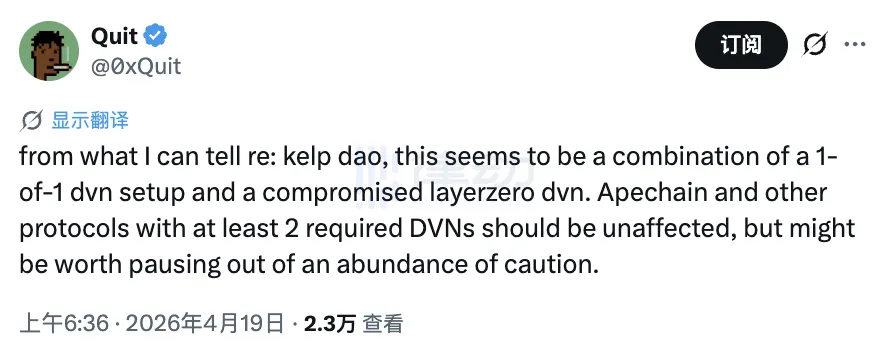
However, one aspect distinguishes this attack from most hacking incidents. The smart contract code of Kelp DAO had no vulnerabilities. Security researcher @0xQuit, involved in the investigation, stated on X, "From what I currently understand, this is a combination of two issues: a 1-of-1 DVN configuration and the compromise of the DVN node itself." In their official statement, LayerZero did not blame the contract code, categorizing the issue as an "rsETH vulnerability" rather than a "LayerZero vulnerability."
$293 million was not in any line of code. It was concealed within a misconfigured parameter during deployment.
The common logic behind DeFi security audits is: find the contract, read the code, find vulnerabilities. This logic operates quite smoothly when dealing with code logic vulnerabilities. Tools like Slither and Mythril are mature in detecting known patterns such as reentrancy attacks and integer overflows. The widely promoted LLM for assisting in code audits also has some capability in identifying business logic vulnerabilities (e.g., flash loan arbitrage paths).
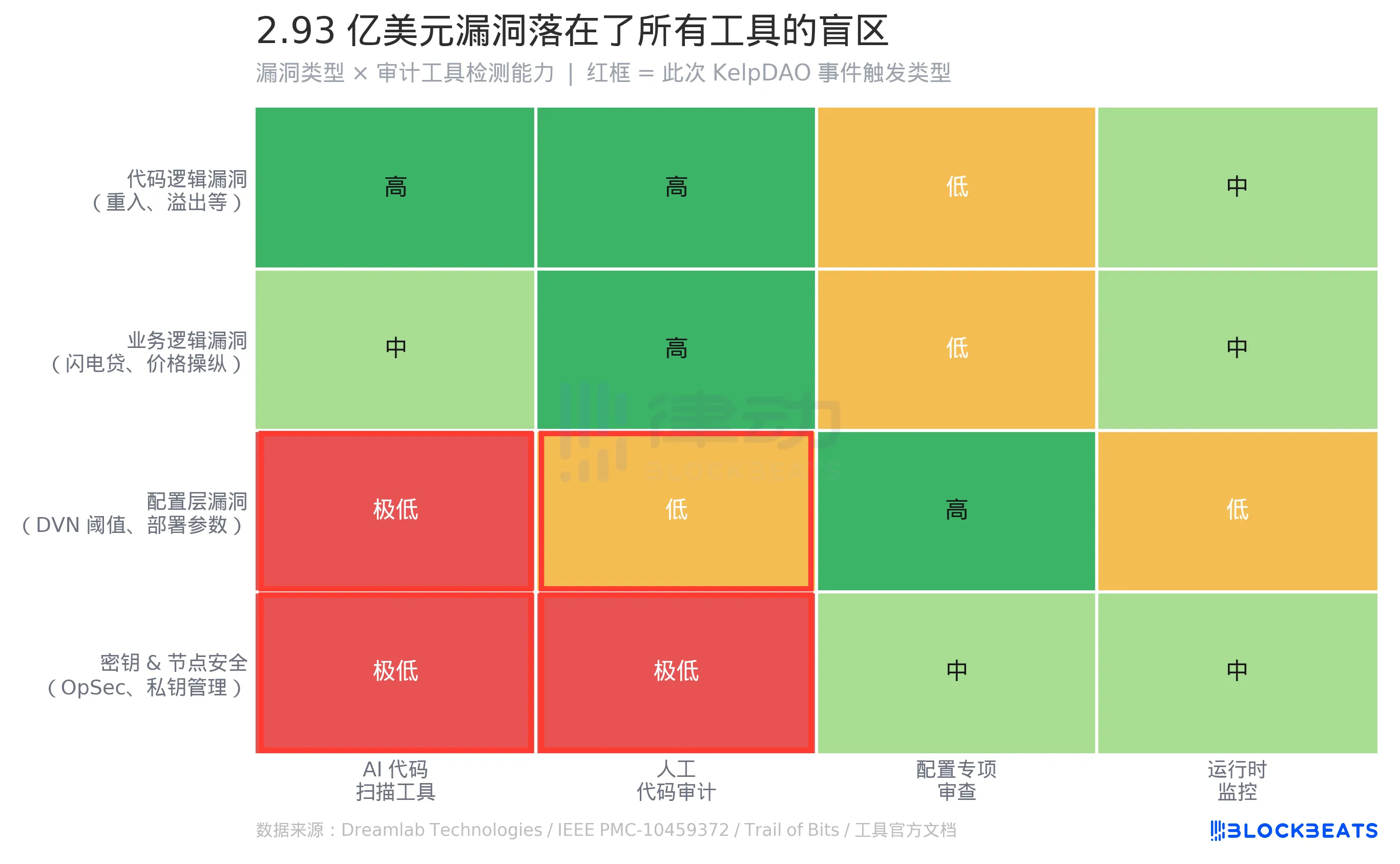
However, in this matrix, two rows are marked in red.
Configuration-level vulnerabilities fall into a structural blind spot in tool-based audits. The issue with Kelp DAO was not in a .sol file but in a parameter—DVN threshold—written during protocol deployment. This parameter determines how many validating nodes a cross-chain message must pass through to be considered valid. It's not in the code, not within Slither's scanning scope, nor in Mythril's symbolic execution path. According to Dreamlab Technologies' comparative study, Slither and Mythril detected 5/10 and 6/10 vulnerabilities in the tested contract, respectively. However, these results are based on the premise that the vulnerabilities exist in the code. According to IEEE research, even at the code level, existing tools can only detect 8%-20% of exploitable vulnerabilities.
From the perspective of the current audit paradigm, there is no tool that can "detect whether the DVN threshold is reasonable." To detect this type of configuration risk, what is needed is not a code analyzer, but a specialized configuration checklist: "Is the number of DVNs for the cross-chain protocol ≥ N?" "Is there a minimum threshold requirement?" Such questions are currently not covered by standardized tools and there is no widely recognized industry standard.
Also within the red zone is key and node security. In @0xQuit's description, it is mentioned that a DVN node was "compromised," which falls under Operational Security (OpSec) and is beyond the detection boundary of any static analysis tool. Whether it is a top-tier auditing firm or an AI scanning tool, none have the ability to predict whether a node operator's private key will be leaked.
This attack simultaneously triggered two red zones in the matrix.
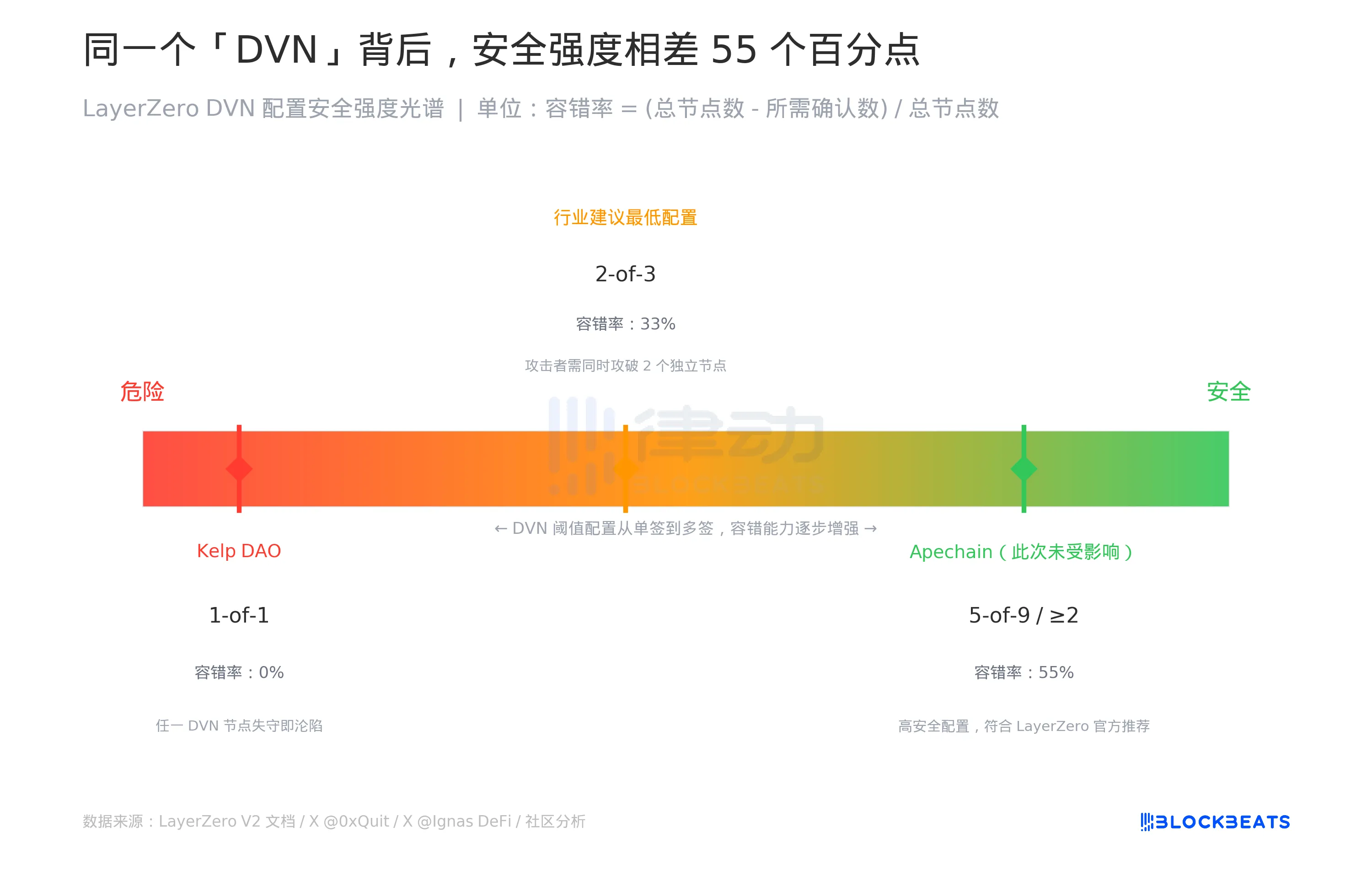
DVN is the cross-chain message verification mechanism of LayerZero V2, fully named Decentralized Verifier Network. Its design philosophy is to entrust security decision-making to the application layer: each protocol connecting to LayerZero can choose the number of DVN nodes required to confirm before allowing a cross-chain message to pass.
This "flexibility" has created a spectrum.
Kelp DAO chose the far-left end of the spectrum with a 1-of-1, requiring only one DVN node to confirm. This means a fault tolerance of zero, as an attacker only needs to compromise that single node to forge any cross-chain message. In contrast, Apechain, also connected to LayerZero, configured more than two required DVNs and was not affected by this event. The wording in the LayerZero official statement was, "All other applications remain secure," implying that security depends on the selected configuration.
The standard industry recommendation is at least 2-of-3, where an attacker would need to compromise two independent DVN nodes simultaneously to forge a message, increasing fault tolerance to 33%. A high-security configuration like 5-of-9 can raise fault tolerance to 55%.
The issue is that external observers and users cannot see this configuration. Also known as being "supported by LayerZero," the backend could range from 0% fault tolerance to 55% fault tolerance, both referred to as DVN in the documentation.
Seasoned crypto investor Dovey Wan, who experienced the Anyswap incident, directly stated on platform X: "LayerZero's DVN turned out to be a 1/1 validator... All cross-chain bridges should immediately undergo a comprehensive security review."
In August 2022, a vulnerability was discovered in the Nomad cross-chain bridge. Someone replicated the initial attack transaction, made minor modifications, and found success, leading to hundreds of addresses replicating the exploit and draining $190 million in a matter of hours.
Postmortem analysis by Nomad attributed the vulnerability to "initializing the trusted root as 0x00 during a routine upgrade." This was a configuration error that occurred during the deployment phase. The Merkle proof validation logic and the code itself were sound; the issue stemmed from an incorrect initial value.
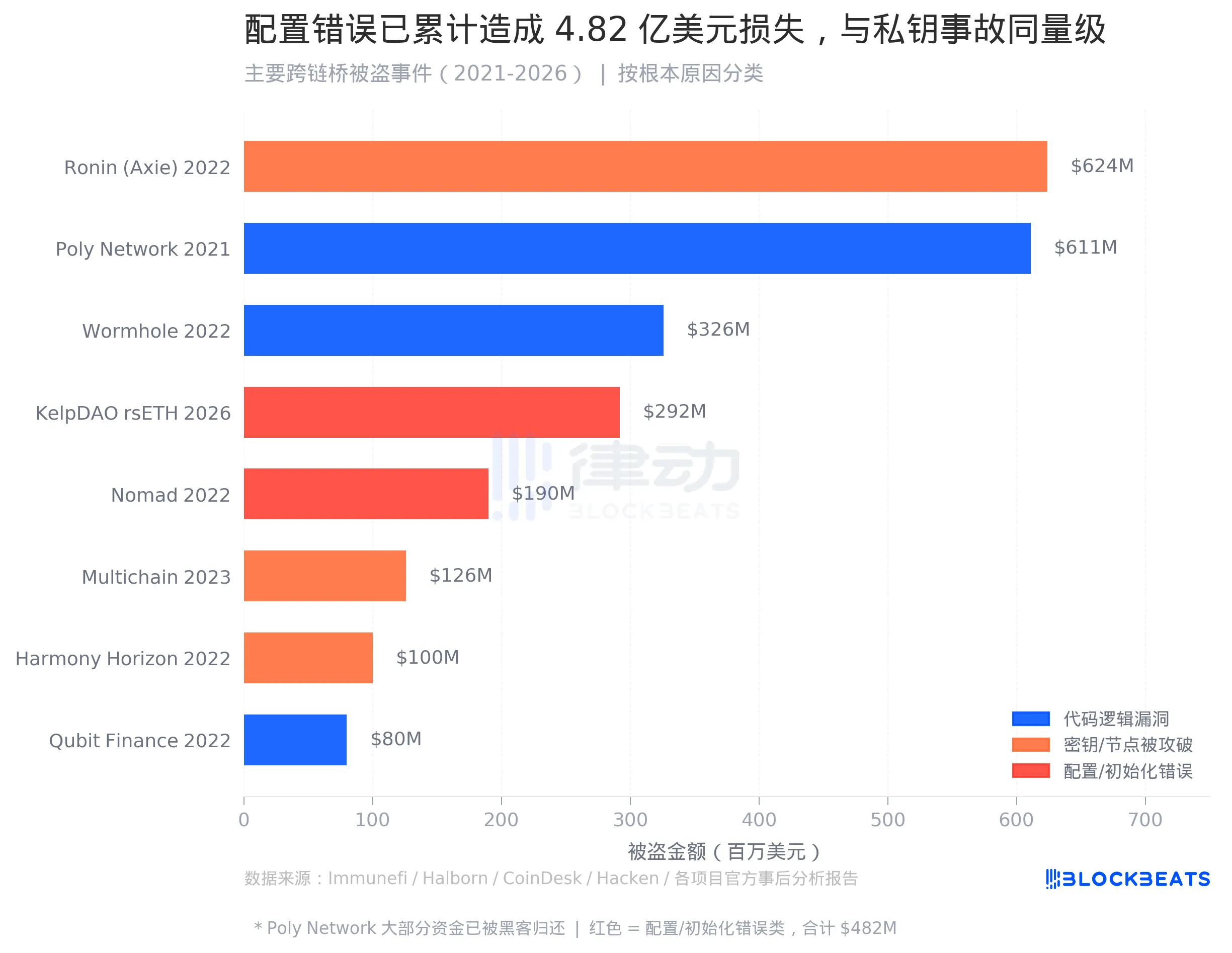
Combining this incident with previous ones involving Nomad, configuration/initialization vulnerabilities have now resulted in approximately $482 million in losses. In the history of cross-chain bridge exploits, this category's scale now rivals that of key exposure incidents (e.g., Ronin $624 million, Harmony $100 million, Multichain $126 million, totaling around $850 million).
However, the product design of the code auditing industry has never been focused on this category of vulnerabilities.
Most discussions in the industry still revolve around code logic bugs. Incidents like Wormhole's $326 million exploit due to signature verification bypass and Qubit Finance's $80 million loss due to a fake deposit event are well-analyzed with detailed vulnerability reports, CVE references, and reproducible PoCs, making them suitable for audit tool training and optimization. Configuration layer issues are not explicitly coded, making it challenging to address within the production cycle.
One notable detail is the distinct triggering mechanisms of the two configuration-related events. Nomad's error stemmed from inadvertently setting an incorrect initial value during a routine upgrade, constituting a mistake. On the other hand, Kelp DAO's 1-of-1 incident was an active configuration choice—LayerZero protocol did not prohibit this option, and Kelp DAO did not violate any protocol rules. A "compliant" configuration choice and a "mistaken" initial value both led to the same outcome in the end.
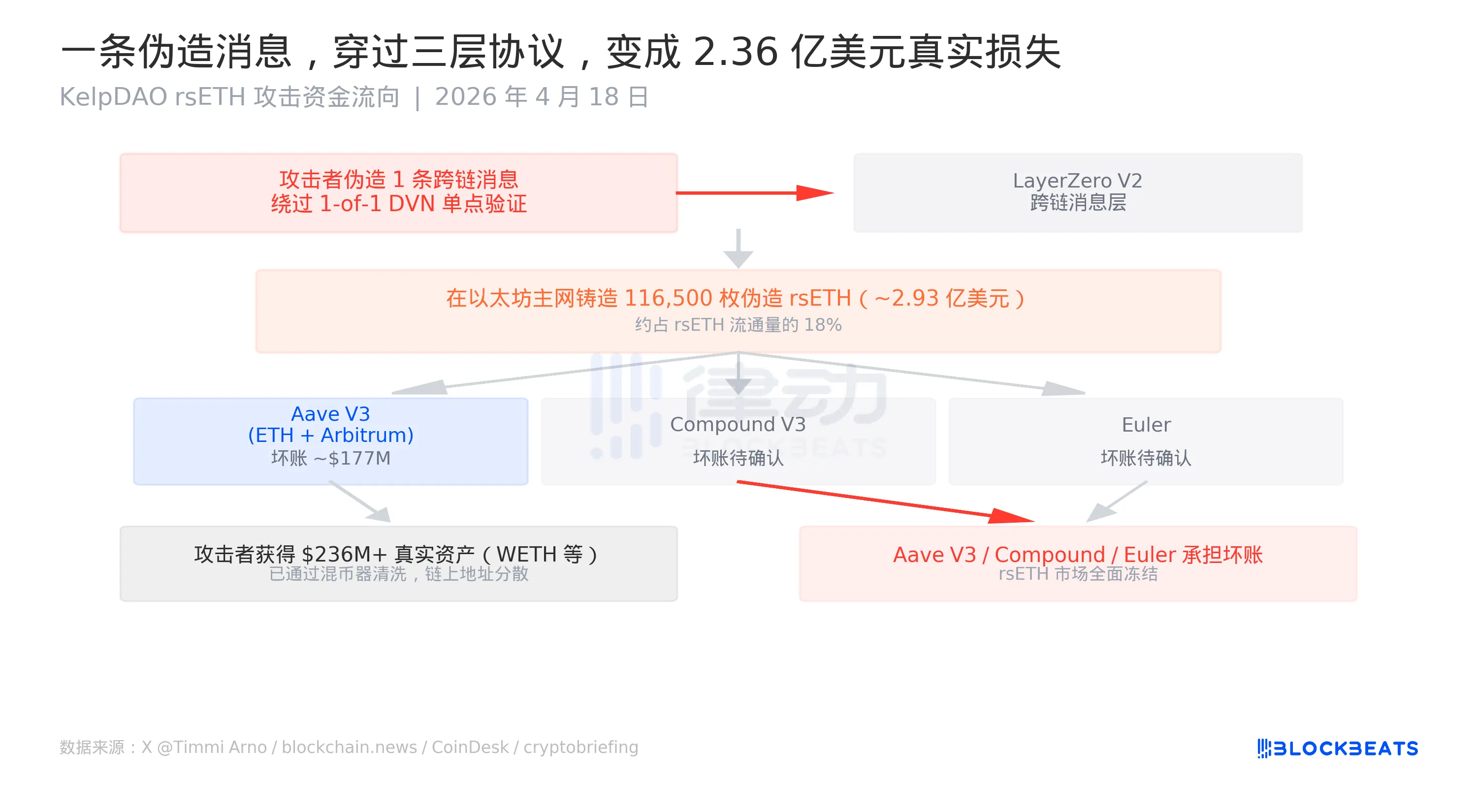
The execution logic of this attack was straightforward. A forged cross-chain message informed the Ethereum mainnet that "someone had already locked up an equivalent asset on another chain," triggering the minting of rsETH on the mainnet. The minted rsETH itself had no real backing, but its on-chain record was "valid" and could be accepted by lending protocols as collateral.
The attacker then dispersed 116,500 rsETH to Aave V3 (Ethereum and Arbitrum), Compound V3, and Euler, borrowing over a total of $236 million in real assets. According to multiple sources, the standalone default estimate for Aave V3 is around $177 million. Aave's security module Umbrella, used to absorb default losses, has a WETH reserve of around $50 million with a coverage ratio of less than 30%, with the remaining amount to be borne by aWETH stakers.
This ultimately falls on those who simply wanted to earn some WETH interest.
As of the time of writing, LayerZero is still conducting a joint investigation with the security emergency response organization SEAL Org and plans to release a post-incident analysis report in collaboration with Kelp DAO once all information is obtained. Kelp DAO has stated that they are working on "active remediation."
The $293 million exploit is not in the code. The phrase "audit passed" did not cover the location of that parameter.
You may also like

Consumer-grade Crypto Global Survey: Users, Revenue, and Track Distribution

Prediction Markets Under Bias

Stolen: $290 million, Three Parties Refusing to Acknowledge, Who Should Foot the Bill for the KelpDAO Incident Resolution?

ASTEROID Pumped 10,000x in Three Days, Is Meme Season Back on Ethereum?

ChainCatcher Hong Kong Themed Forum Highlights: Decoding the Growth Engine Under the Integration of Crypto Assets and Smart Economy

Why can this institution still grow by 150% when the scale of leading crypto VCs has shrunk significantly?

Anthropic's $1 trillion, compared to DeepSeek's $100 billion

Geopolitical Risk Persists, Is Bitcoin Becoming a Key Barometer?

Annualized 11.5%, Wall Street Buzzing: Is MicroStrategy's STRC Bitcoin's Savior or Destroyer?

An Obscure Open Source AI Tool Alerted on Kelp DAO's $292 million Bug 12 Days Ago

Mixin has launched USTD-margined perpetual contracts, bringing derivative trading into the chat scene.
The privacy-focused crypto wallet Mixin announced today the launch of its U-based perpetual contract (a derivative priced in USDT). Unlike traditional exchanges, Mixin has taken a new approach by "liberating" derivative trading from isolated matching engines and embedding it into the instant messaging environment.
Users can directly open positions within the app with leverage of up to 200x, while sharing positions, discussing strategies, and copy trading within private communities. Trading, social interaction, and asset management are integrated into the same interface.
Based on its non-custodial architecture, Mixin has eliminated friction from the traditional onboarding process, allowing users to participate in perpetual contract trading without identity verification.
The trading process has been streamlined into five steps:
· Choose the trading asset
· Select long or short
· Input position size and leverage
· Confirm order details
· Confirm and open the position
The interface provides real-time visualization of price, position, and profit and loss (PnL), allowing users to complete trades without switching between multiple modules.
Mixin has directly integrated social features into the derivative trading environment. Users can create private trading communities and interact around real-time positions:
· End-to-end encrypted private groups supporting up to 1024 members
· End-to-end encrypted voice communication
· One-click position sharing
· One-click trade copying
On the execution side, Mixin aggregates liquidity from multiple sources and accesses decentralized protocol and external market liquidity through a unified trading interface.
By combining social interaction with trade execution, Mixin enables users to collaborate, share, and execute trading strategies instantly within the same environment.
Mixin has also introduced a referral incentive system based on trading behavior:
· Users can join with an invite code
· Up to 60% of trading fees as referral rewards
· Incentive mechanism designed for long-term, sustainable earnings
This model aims to drive user-driven network expansion and organic growth.
Mixin's derivative transactions are built on top of its existing self-custody wallet infrastructure, with core features including:
· Separation of transaction account and asset storage
· User full control over assets
· Platform does not custody user funds
· Built-in privacy mechanisms to reduce data exposure
The system aims to strike a balance between transaction efficiency, asset security, and privacy protection.
Against the background of perpetual contracts becoming a mainstream trading tool, Mixin is exploring a different development direction by lowering barriers, enhancing social and privacy attributes.
The platform does not only view transactions as execution actions but positions them as a networked activity: transactions have social attributes, strategies can be shared, and relationships between individuals also become part of the financial system.
Mixin's design is based on a user-initiated, user-controlled model. The platform neither custodies assets nor executes transactions on behalf of users.
This model aligns with a statement issued by the U.S. Securities and Exchange Commission (SEC) on April 13, 2026, titled "Staff Statement on Whether Partial User Interface Used in Preparing Cryptocurrency Securities Transactions May Require Broker-Dealer Registration."
The statement indicates that, under the premise where transactions are entirely initiated and controlled by users, non-custodial service providers that offer neutral interfaces may not need to register as broker-dealers or exchanges.
Mixin is a decentralized, self-custodial privacy wallet designed to provide secure and efficient digital asset management services.
Its core capabilities include:
· Aggregation: integrating multi-chain assets and routing between different transaction paths to simplify user operations
· High liquidity access: connecting to various liquidity sources, including decentralized protocols and external markets
· Decentralization: achieving full user control over assets without relying on custodial intermediaries
· Privacy protection: safeguarding assets and data through MPC, CryptoNote, and end-to-end encrypted communication
Mixin has been in operation for over 8 years, supporting over 40 blockchains and more than 10,000 assets, with a global user base exceeding 10 million and an on-chain self-custodied asset scale of over $1 billion.

$600 million stolen in 20 days, ushering in the era of AI hackers in the crypto world
Vitalik's 2026 Hong Kong Web3 Summit Speech: Ethereum's Ultimate Vision as the "World Computer" and Future Roadmap
On the same day Aave introduced rsETH, why did Spark decide to exit?
Full Post-Mortem of the KelpDAO Incident: Why Did Aave, Which Was Not Compromised, End Up in Crisis Situation?

After a $290 million DeFi liquidation, is the security promise still there?
ZachXBT's post ignites RAVE nearing zero, what is the truth behind the insider control?




 App
App