
 Buy Crypto
- Markets
 Futures
- Spot
- Copy Trade
- Earn
- More
Stablecoins and PayFi Leadership: Decoding the New Wave of RWA and Future Blueprint

Original Article Title: "WOO X Research: Can RWA Become the Next Wave of Wealth Growth?"
Original Source: WOO X Research
Narrative:
RWA (Real World Assets), literally translated as real-world assets, derives its value from bridging traditional assets with the web3 world to achieve the digital representation of real-world assets. This allows for the efficient utilization or mobilization of real-world assets (such as real estate, art, etc.) to enhance asset liquidity. Moreover, with the integration of RWA and blockchain technology, RWAs can transcend geographical limitations. Regardless of location, currency system, or other influencing factors, users can easily transact or otherwise leverage assets through this combined approach. When RWA is mentioned, people often think of real estate, stocks, and the like. Looking at the fundamental feature of RWA tokenization, stablecoins also fall under the RWA track. It seems like RWA is now closer to us. This also represents another aspect of the RWA narrative, namely, "inclusive," enabling investors who do not have sufficient capital to enter high-value markets to indirectly invest in high-value RWA tokenized products.
What Lies Ahead?
Over the past year, the overall TVL of RWA has shown a fluctuating upward trend. In this cycle, RWA, AI, MEME, and others are relatively popular tracks. RWA has always been one of the more closely watched tracks.
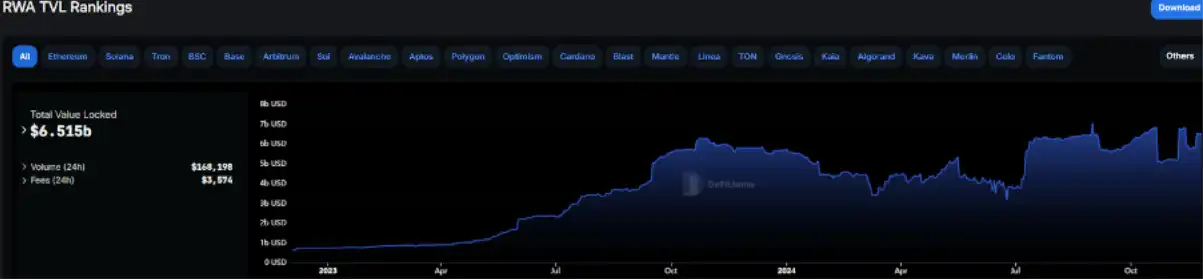
Image Source: https://defillama.com/protocols/RWA
In the future, RWA is likely to continue its trend, and the integration of RWA with the DeFi track may attract more and more investors' attention. In fact, high-value assets such as real estate and commodities face settlement challenges in transactions, and various countries have different laws and regulations. Most likely, projects related to these types of high-value assets will be constrained in development due to the challenges in implementation and regulation. Therefore, for projects of this kind in the RWA track to make better progress, there must be significant progress in PayFi or cross-border settlement regulation and RWA asset validation rather than relying on third parties in various locations for settlement or validation.
In addition, the RWA project related to stablecoins is relatively stable. Basically, the mainstream market may still be dominated by the US dollar, with the euro following. However, in the future, this type of project may see country/region differentiation, where "investors from a certain country/region mostly choose a specific stablecoin." In this scenario, a stablecoin with local regulatory approval can seize the market first. The last trend, which should also be a major trend in the future, is that stablecoins' pegged assets could be bonds, securities, stocks, or funds, leading to more products and projects in the future. The reason behind this is that the settlement and regulatory aspects mentioned earlier have a better advantage than assets like real estate. However, in the early stages of such projects, only institutions with some influence in the traditional financial sector (such as BlackRock) participating in related projects may generate a considerable wave of economic benefits. After that, projects involving institutions/organizations with more influence in the Web 3 space may create more community-centric RWA projects.
Projects
Below is an overview of recently funded projects, presented from an objective perspective for discussion purposes.
OpenTrade
OpenTrade was founded in late 2022 and is headquartered in London, UK. Its investors include a16z CSX, Circle, Draper Dragon, CMCC Global, Ryze Labs, Polygon, and Kronos Ventures, among others. The current total funding amounts to $8.7 million.
It currently offers four products:
1. US Treasury Bonds Vaults: Fixed-term; USDC returns with a fixed term and fixed rate, backed by US Treasury Bonds;
2. USDC Vault: Demand deposit; variable USDC returns. Backed by short-term US Treasury Bonds, money market funds, and other cash equivalents;
3. EURC Vault: Demand deposit; variable EURC returns, backed by euros and short-term euro bonds, money market funds, and other cash equivalents;
4. Fee Rate+ Vault: Fixed-term; backed by investment-grade corporate bonds, commercial paper, emerging market bonds, etc.
Uses the Vault token as a benchmark in accounting and other operations.
USUAL-Government Bonds
It has raised a total of $8.5 million and is a Binance Launchpool project.
Overall, it revolves around three types of tokens:
1. USD0: This is a stablecoin backed 1:1 by Real-World Assets (RWA), permissionless, and fully compliant, aggregating various U.S. Treasury tokenizations.
2. USD0++: It is an enhanced Treasury bond that uses USD0 as collateral locked principal, with USUAL as an incentive.
3. USUAL is its governance token.
Tokenomics: Total supply of 4 billion tokens, with an initial circulating supply proportion of 12.37%.

Image Source: https://docs.usual.money/usual-products/usual-governance-token/usual-tokenomics/distribution-model
Token distribution is as follows:

Huma Finance
Currently, it has raised a total of $46.3 million, with a co-founder of Chinese descent. In general, it is a PayFi lending project. The most recent round of financing includes $10 million in equity investment and $28 million in Huma Platform real asset investment. Distributed Global led the investment, with participation from Hashkey Capital, Folius Ventures, Stellar Development Foundation, and others. In April 17, 2024, it merged with Arf, focusing on real-world asset tokenization-related PayFi.
Contributors utilizing the Huma Points tracking protocol. Currently providing cross-border payment financing, digital asset-backed credit cards. This is achieved through various liquidity pools, such as Arf-Cross-Border Payment Financing Pool (based on USDC instant settlement, simplifying cross-border payments); Rain Accounts Receivable Pool (assisting entities like DAOs in managing expenditures through salary card); Jia Pioneer Fund Pool (providing decentralized financing for small businesses, rewarding borrowers who repay with ownership. i.e., "Small Business Credit") and other liquidity pools to facilitate cross-border payment financing.
This article is contributed content and does not represent the views of BlockBeats.
You may also like

a16z: 5 Ways Blockchain Helps AI Agent Infrastructure

Morning News | The Hong Kong Securities and Futures Commission announced the regulatory framework for secondary market trading of tokenized investment products; Strategy increased its holdings by 34,164 bitcoins last week; KAIO completed a strategic fi...

What Is an XRP Wallet? The Best Wallets to Store XRP (2026 Updated)
An XRP wallet lets you safely store, send, and receive XRP on the XRP Ledger. Learn what wallets support XRP and discover the best XRP wallets for beginners and long-term holders in 2026.

What are the Top AI Crypto Coins? Render vs. Akash: 5 Gems Solving the 2026 GPU Crisis
What are the best AI crypto coins for the 2026 cycle? Beyond the hype, we analyze top tokens like RNDR, AKT, and FET that provide real-world solutions to the global GPU shortage and the rise of autonomous agents.

What Is a Token in AI? What Is an AI Token + 3 Gems You Can't Miss in 2026
The era of AI hype has transitioned into an era of utility. As we move through Q2 2026, the market is no longer rewarding "narrative-only" projects. At WEEX Research, we are seeing a massive capital rotation into Decentralized Compute (DePIN) and Autonomous Agent coordination layers. This guide analyzes which AI tokens are capturing institutional liquidity and how to spot high-conviction setups in a maturing market.

Consumer-grade Crypto Global Survey: Users, Revenue, and Track Distribution

Prediction Markets Under Bias

Stolen: $290 million, Three Parties Refusing to Acknowledge, Who Should Foot the Bill for the KelpDAO Incident Resolution?

ASTEROID Pumped 10,000x in Three Days, Is Meme Season Back on Ethereum?

ChainCatcher Hong Kong Themed Forum Highlights: Decoding the Growth Engine Under the Integration of Crypto Assets and Smart Economy

Why can this institution still grow by 150% when the scale of leading crypto VCs has shrunk significantly?

Anthropic's $1 trillion, compared to DeepSeek's $100 billion

Geopolitical Risk Persists, Is Bitcoin Becoming a Key Barometer?
Annualized 11.5%, Wall Street Buzzing: Is MicroStrategy's STRC Bitcoin's Savior or Destroyer?
An Obscure Open Source AI Tool Alerted on Kelp DAO's $292 million Bug 12 Days Ago

Mixin has launched USTD-margined perpetual contracts, bringing derivative trading into the chat scene.
The privacy-focused crypto wallet Mixin announced today the launch of its U-based perpetual contract (a derivative priced in USDT). Unlike traditional exchanges, Mixin has taken a new approach by "liberating" derivative trading from isolated matching engines and embedding it into the instant messaging environment.
Users can directly open positions within the app with leverage of up to 200x, while sharing positions, discussing strategies, and copy trading within private communities. Trading, social interaction, and asset management are integrated into the same interface.
Based on its non-custodial architecture, Mixin has eliminated friction from the traditional onboarding process, allowing users to participate in perpetual contract trading without identity verification.
The trading process has been streamlined into five steps:
· Choose the trading asset
· Select long or short
· Input position size and leverage
· Confirm order details
· Confirm and open the position
The interface provides real-time visualization of price, position, and profit and loss (PnL), allowing users to complete trades without switching between multiple modules.
Mixin has directly integrated social features into the derivative trading environment. Users can create private trading communities and interact around real-time positions:
· End-to-end encrypted private groups supporting up to 1024 members
· End-to-end encrypted voice communication
· One-click position sharing
· One-click trade copying
On the execution side, Mixin aggregates liquidity from multiple sources and accesses decentralized protocol and external market liquidity through a unified trading interface.
By combining social interaction with trade execution, Mixin enables users to collaborate, share, and execute trading strategies instantly within the same environment.
Mixin has also introduced a referral incentive system based on trading behavior:
· Users can join with an invite code
· Up to 60% of trading fees as referral rewards
· Incentive mechanism designed for long-term, sustainable earnings
This model aims to drive user-driven network expansion and organic growth.
Mixin's derivative transactions are built on top of its existing self-custody wallet infrastructure, with core features including:
· Separation of transaction account and asset storage
· User full control over assets
· Platform does not custody user funds
· Built-in privacy mechanisms to reduce data exposure
The system aims to strike a balance between transaction efficiency, asset security, and privacy protection.
Against the background of perpetual contracts becoming a mainstream trading tool, Mixin is exploring a different development direction by lowering barriers, enhancing social and privacy attributes.
The platform does not only view transactions as execution actions but positions them as a networked activity: transactions have social attributes, strategies can be shared, and relationships between individuals also become part of the financial system.
Mixin's design is based on a user-initiated, user-controlled model. The platform neither custodies assets nor executes transactions on behalf of users.
This model aligns with a statement issued by the U.S. Securities and Exchange Commission (SEC) on April 13, 2026, titled "Staff Statement on Whether Partial User Interface Used in Preparing Cryptocurrency Securities Transactions May Require Broker-Dealer Registration."
The statement indicates that, under the premise where transactions are entirely initiated and controlled by users, non-custodial service providers that offer neutral interfaces may not need to register as broker-dealers or exchanges.
Mixin is a decentralized, self-custodial privacy wallet designed to provide secure and efficient digital asset management services.
Its core capabilities include:
· Aggregation: integrating multi-chain assets and routing between different transaction paths to simplify user operations
· High liquidity access: connecting to various liquidity sources, including decentralized protocols and external markets
· Decentralization: achieving full user control over assets without relying on custodial intermediaries
· Privacy protection: safeguarding assets and data through MPC, CryptoNote, and end-to-end encrypted communication
Mixin has been in operation for over 8 years, supporting over 40 blockchains and more than 10,000 assets, with a global user base exceeding 10 million and an on-chain self-custodied asset scale of over $1 billion.

$600 million stolen in 20 days, ushering in the era of AI hackers in the crypto world
Vitalik's 2026 Hong Kong Web3 Summit Speech: Ethereum's Ultimate Vision as the "World Computer" and Future Roadmap
a16z: 5 Ways Blockchain Helps AI Agent Infrastructure
Morning News | The Hong Kong Securities and Futures Commission announced the regulatory framework for secondary market trading of tokenized investment products; Strategy increased its holdings by 34,164 bitcoins last week; KAIO completed a strategic fi...
What Is an XRP Wallet? The Best Wallets to Store XRP (2026 Updated)
An XRP wallet lets you safely store, send, and receive XRP on the XRP Ledger. Learn what wallets support XRP and discover the best XRP wallets for beginners and long-term holders in 2026.
What are the Top AI Crypto Coins? Render vs. Akash: 5 Gems Solving the 2026 GPU Crisis
What are the best AI crypto coins for the 2026 cycle? Beyond the hype, we analyze top tokens like RNDR, AKT, and FET that provide real-world solutions to the global GPU shortage and the rise of autonomous agents.
What Is a Token in AI? What Is an AI Token + 3 Gems You Can't Miss in 2026
The era of AI hype has transitioned into an era of utility. As we move through Q2 2026, the market is no longer rewarding "narrative-only" projects. At WEEX Research, we are seeing a massive capital rotation into Decentralized Compute (DePIN) and Autonomous Agent coordination layers. This guide analyzes which AI tokens are capturing institutional liquidity and how to spot high-conviction setups in a maturing market.



 App
App