
Rhythm X Zhihu Event Process Revealed, Featuring Skills Demo, Keynote Speech, and Roundtable to Deep Dive into Agent and On-Chain Finance

 Prefer us on Google


EvoMap's mention of Hermes's plagiarism is something that many of you must be somewhat familiar with.
Just as Claude mentioned OpenClaw's plagiarism, similar incidents are bound to increase.
Because fundamentally, it's a turf war: users choosing which Agent to perform similar tasks, or where the originality boundary of a core competence within an Agent lies. This argument signifies one thing—the competition between Agents has become so intense that it can make founders lose their cool. The choice is in the user's hands.
And this will also soon be an issue that each of us will have to face. With an increasing number of Agents capable of doing many things, what should we do? This is precisely the issue we will discuss at our event.
April 21, Hong Kong. Rhythm BlockBeats and Zhihu will host the theme event "Decoding Web 4.0: When AI Agents Take Over On-Chain Permissions." The guests have been announced and can be seen in "Rhythm X Zhihu Event Guest Announcement, covering AI Agent's new financial model from academic, institutional, and personal perspectives."
What we want to discuss are specific issues that have actually occurred: How to choose Skills, how to build a trust layer, and how far we are from a completely new financial paradigm. Below are the contents you will hear and see at the event.
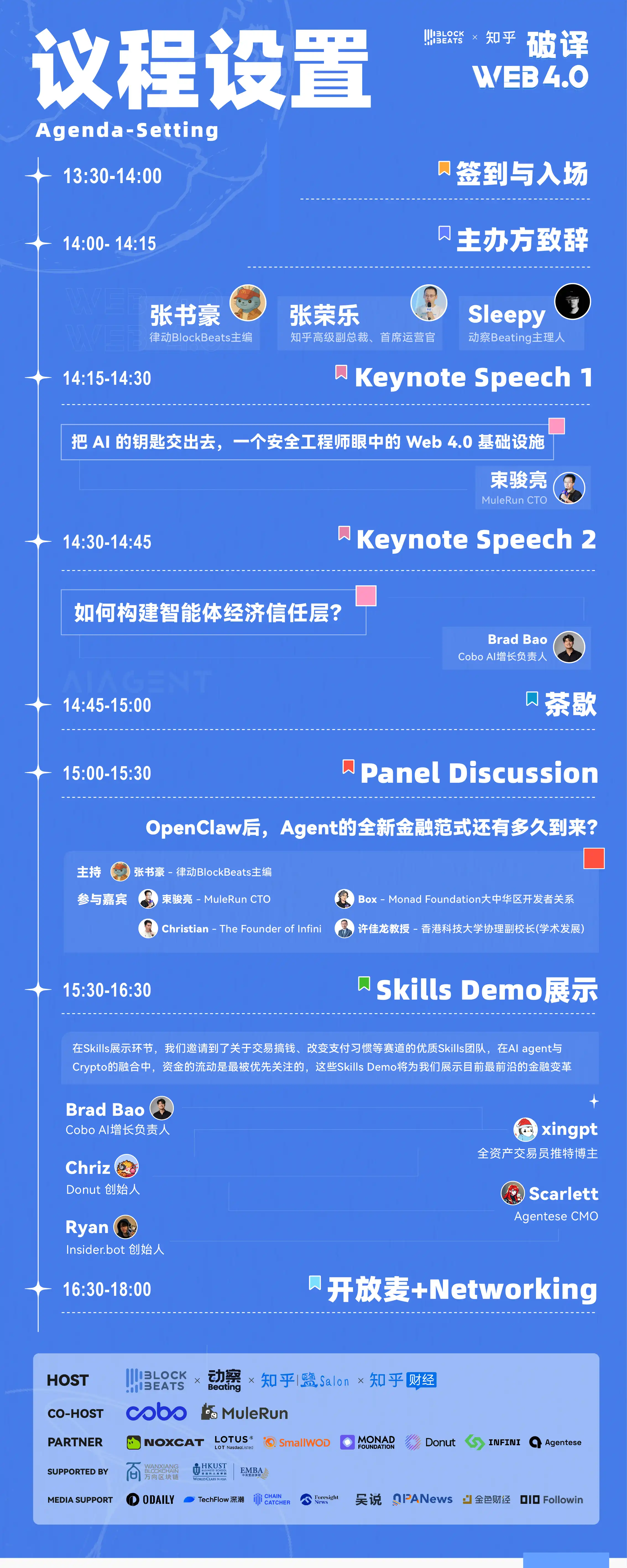
Two Keynote Speeches
Keynote: "Handing Over the Keys of AI, Web 4.0 Infrastructure through the Eyes of a Security Engineer"
Speaker: MuleRun CTO (MuleRun) Junliang Shu
In the 90s, the Bloomberg Terminal allowed analysts to dominate retail investors, and today, Agents are replaying this scenario. However, when AI starts touching your money, security becomes a matter of life and death. Listen to a security engineer discuss how to give capabilities to the Agent while retaining control for oneself.
Keynote: "Building the Trust Layer of the Intelligent Economy"
Speaker: Cobo AI Head of Growth, Brad Bao
AI is evolving from "answering questions" to "acting on our behalf." When software begins to call funds, execute transactions, and manage assets, trust is no longer an add-on but the infrastructure itself. How can we empower the Agent with enough autonomy while ensuring that humans have enough certainty to trust it? We are exploring the answers.
Roundtable Discussion
Theme: "After OpenClaw, How Far Away is the New Financial Paradigm for Agents?"
Participants include MuleRun CTO Junliang Shu, Associate Vice President of The Hong Kong University of Science and Technology Professor Jialong Xu, Infini Founder Christian, and Box from the Monad Foundation Greater China Developer Relations.
During this roundtable, you will hear about the guests' daily use of their own agents and skills, the impact of agents on the financial landscape, and the potential synergies between stablecoins and agents following the launch of the Hong Kong stablecoin.
Skill Demo, Showcasing Real-time Skills
Capital flow is the first dimension in which AI Agents and Crypto integration are being tested. We have invited several teams working on concrete initiatives in this dimension:
Brad Bao (Cobo) will start from an x402 payment to demonstrate how two AI agents take their own Hello World step. However, the true operation of the agents' economy relies not only on the occurrence of payment but also on the layer of trust behind each transaction.
xingpt is working on a global macro and commodity trading monitoring skill, exploring the difference between machine-readable signal density and human-readable financial news.
Donut Founder Chriz presents D0, an active trading agent that monitors the market 24/7 and continuously recommends trading opportunities—it doesn't wait for you to ask, it proactively reaches out to you.
Agentese CMO Scarlett takes a different approach: instead of creating a general agent, she focuses on a vertical AI Employee, narrowing the boundary of capabilities and increasing execution accuracy.
Insider.bot Founder Ryan's skill serves market prediction, emphasizing speed, flexibility, and accuracy—three words that hold different meanings in the prediction market, which will be demonstrated during the live demo.
We believe that the insights shared by these guests on the new financial model brought by AI Agents will provide everyone with a different perspective. The event hosted by Rhythm X Zhihu on April 21 in Hong Kong is still open for registration. To register, please click: https://luma.com/r3h4eqkv
Disclaimer: This content is provided for general branding and informational purposes only and doesn't constitute financial, investment, legal, or tax advice. Any events, rewards, online events, or related information mentioned herein should not be considered a recommendation, solicitation, or invitation to purchase, sell, trade, or otherwise deal in any crypto assets or to use any services. Crypto assets are highly volatile and may result in loss. WEEX services and online events may not be available in all regions and are subject to applicable laws, regulations, and eligibility requirements. You are responsible for ensuring that your use of WEEX services complies with local laws and for carefully assessing the risks before participating in any crypto-related activities.
You may also like

Crypto: XRP ETFs Experience Largest Capital Outflows of the Year
Fear Surrounding Solana Reaches Peak in 2026, According to Santiment

a16z Co-founder Marc Andreessen Joins Federal Reserve AI Working Group

Hotcoin Research | Alphabet (GOOGL) Tokenized Stock Project Report

The European Parliament Extends 'Chat Control' Until 2028

Nine Strategies of Quantitative Trading: Which Ones Can Ordinary People and AI Easily Handle?

What is OTC trading in crypto? How whales buy without moving the price

Japan's Finance Minister Satsuki Katayama: Japan's Cryptocurrency ETF Should Consider Lifting Restrictions

Standard Chartered Reaffirms: Bitcoin Will Surpass $100,000 by the End of 2026! Now is the Perfect Buying Opportunity
Bank of America: Keep an Eye on the Japanese Market, It Will Be the "Canary in the Coal Mine" for a Global Decline
AscendEX Exchange Announces Shutdown! Concerns Over Insufficient Hot Wallet Assets Rise, Users Panic Withdrawals
Computing Capital Markets
IPCA Below Expectations in June: What It Means for the Dollar and Interest Rates

SemiAnalysis Latest Interview: Storage Has Room to Double, Be Cautious with CPO in the Short to Medium Term, CPU is Just a Supporting Role

FDV vs market cap: The two numbers that decide if a token is cheap

Is Ethereum Really a 'World Computer'?

An Investor's 17 Judgments on Embodiment, Models, and Computing Power
The Intellectual Arbitrage Trap of Bittensor: Capital Only Speculates on Tokens, Quality AI Goes Unnoticed

Litecoin Wallet Addresses Grow by Over 22 Million in Just 6 Months

Shiba Inu: After a Pause, Eternity and Metaverse Projects Prepare for Their Return

What are wallet drainers? Inside the approval-phishing industry
The Era of AI Trading Has Arrived: LTP Launches the World's First AI Agent Live Quantitative Trading Championship

Can Changing Chains Really Change the Game?
Revolut integrates its crypto exchange with AI assistants as agentic trading spreads
DOJ charges inmate over alleged $290K forfeited crypto theft

June Trading Volume Doubles: x402 Ecosystem Continues to Expand, Content Monetization Narrative Faces Key Test

Walsh's 'Unified Front': Aiming for Rate Cuts?
Ethereum vs Solana Whitepaper Comparison (2026)

French Tech: AI and Quantum on the Rise, Crypto Absent

Home Robot NEO Grows "Dexterous Hands": How Do Hands Become the API to the Physical World?
Crypto: XRP ETFs Experience Largest Capital Outflows of the Year
Fear Surrounding Solana Reaches Peak in 2026, According to Santiment
a16z Co-founder Marc Andreessen Joins Federal Reserve AI Working Group
Hotcoin Research | Alphabet (GOOGL) Tokenized Stock Project Report
The European Parliament Extends 'Chat Control' Until 2028
Nine Strategies of Quantitative Trading: Which Ones Can Ordinary People and AI Easily Handle?

Contents
Latest articles


Latest coin listings on WEEX


