

OpenLedger's OpenLoRA: Pioneering a New Paradigm for Decentralized AI Model Serving

In the rapidly evolving decentralized AI field, OpenLedger is redefining the construction, fine-tuning, and commercialization foundation of AI models as the next-generation blockchain network. With a vision to democratize artificial intelligence, OpenLedger is building a full-stack infrastructure that allows contributors to not only be passive participants in the ecosystem but also to become stakeholders in a value-distributing, transparent, scalable, and verifiable decentralized network. The project has secured top-tier funding from Polychain Capital, Borderless Capital, HashKey, as well as support from industry leaders such as Sreeram Kannan, Balaji Srinivasan, Sandeep Nailwal, and Kenny Li, quietly constructing the infrastructure layer that will take decentralized AI from concept to practicality.
Within its innovative technology matrix, OpenLoRA stands out as a breakthrough—this model serving framework redefines the efficiency, scalability, and cost-effectiveness of fine-tuning AI models. But to understand the significance of OpenLoRA, we first need to examine the systemic flaws in current AI infrastructure.
Core Issue: Centralized AI and Inference Bottleneck
Despite AI applications accelerating across industries, the vast majority of innovation remains centralized. AI models are typically trained and deployed by tech giants, locked behind private APIs, with opaque training datasets and untraceable value attribution mechanisms.
More importantly, as fine-tuning AI models (especially in vertical domain-specific applications) becomes increasingly common, a key bottleneck has emerged: model serving.
Core Challenge of Model Deployment:
• High GPU Costs: Each fine-tuned model typically requires a separate instance, leading to exponential scaling costs
• Latency-Throughput Tradeoff: High concurrency often results in response delays or model accuracy degradation
• Memory Constraints: Traditional deployment frameworks preload multiple models, leading to very low memory utilization
• Rigid Personalized Services: Large-scale deployment of user-specific models faces both technical and economic feasibility barriers
The market urgently needs a model serving solution that can cater to large-scale personalization, low cost, high efficiency, and native decentralization.
OpenLoRA: A Paradigm Shift in Model Serving
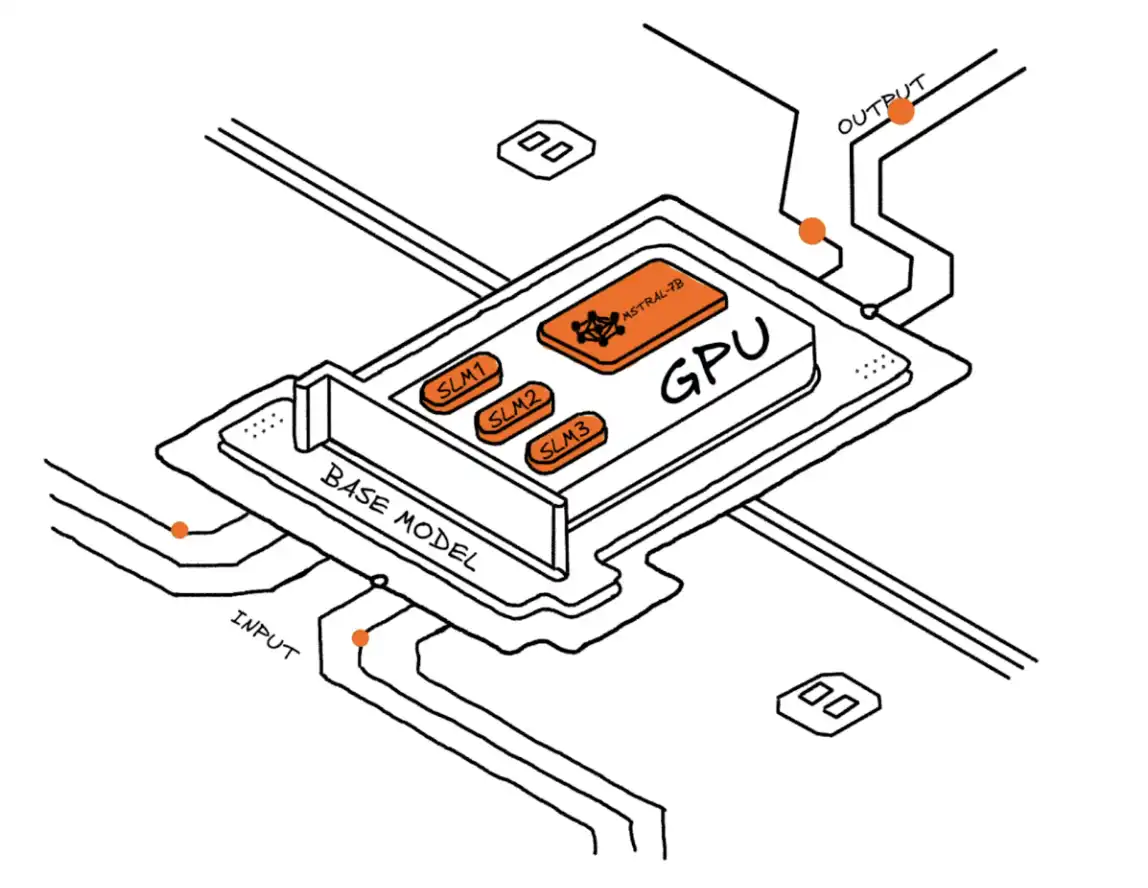
OpenLoRA is the solution provided by OpenLedger. This high-performance, scalable framework can parallelly serve thousands of LoRA (Low-Rank Adaptive) models on a single GPU block, significantly reducing operational costs and unlocking possibilities for the next generation of AI applications.
Breakthrough Features of OpenLoRA:
• Dynamic Adapter Loading: Adopt instant loading mechanism to replace full preloading, freeing up GPU memory
• Real-time Model Fusion: Support runtime multi-adapter merging, achieving integrated inference
• Streaming Quantization Processing: Support token streaming and 4-bit quantization, achieving ultra-low latency real-time inference
• High-Performance Metrics:
Token Generation Speed: 2000+/sec
Latency: 20-50ms
Memory Footprint: <12GB (traditional frameworks require 40-50GB)
• Developer Friendly: Achieve adapter loading, merging, running, and unloading through a simple API, perfectly suited for productization scenarios
Benchmarking: Quantifying the OpenLoRA Advantage
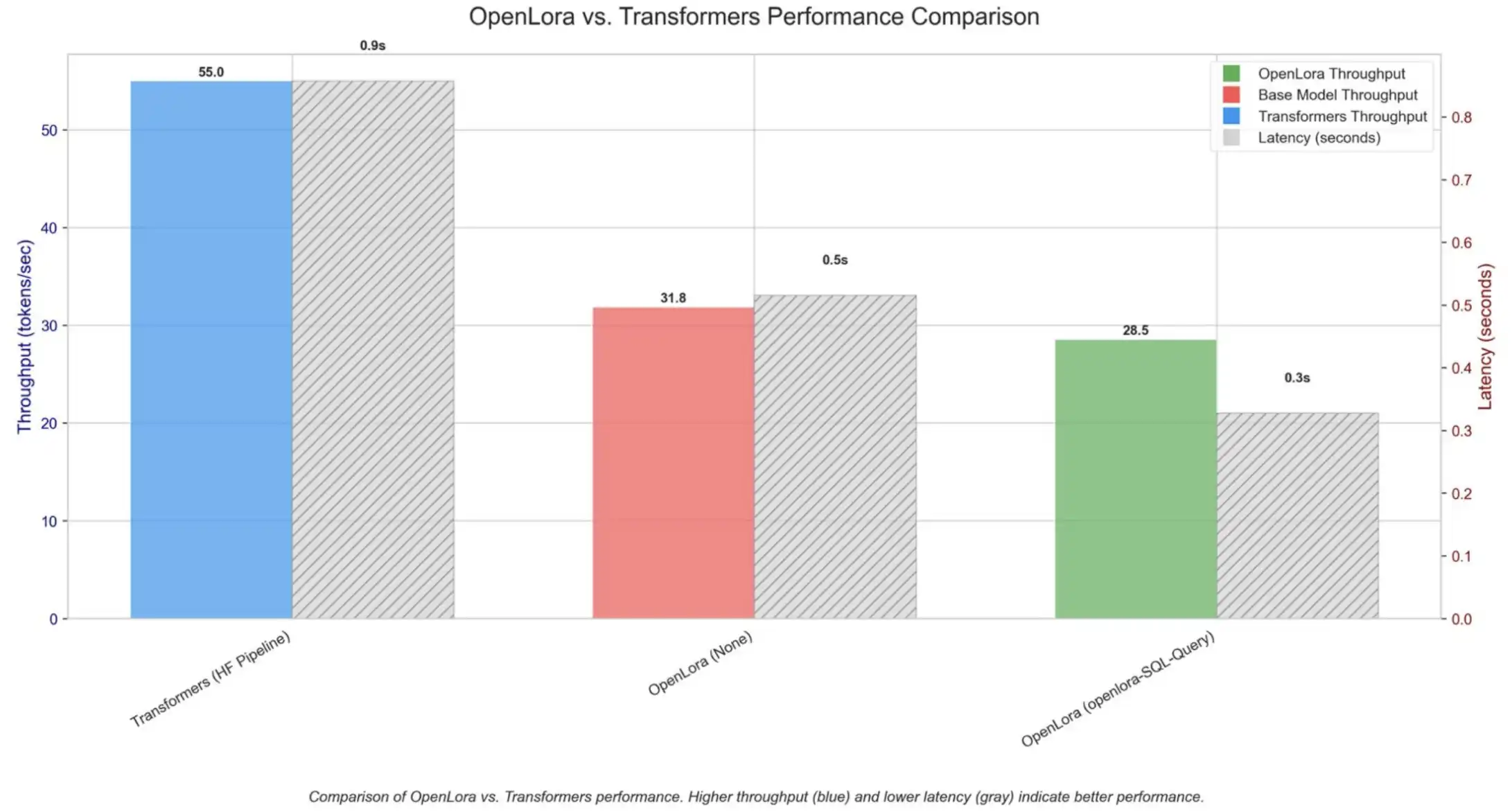
The latest performance tests confirm OpenLoRA's comprehensive superiority over traditional model serving frameworks.
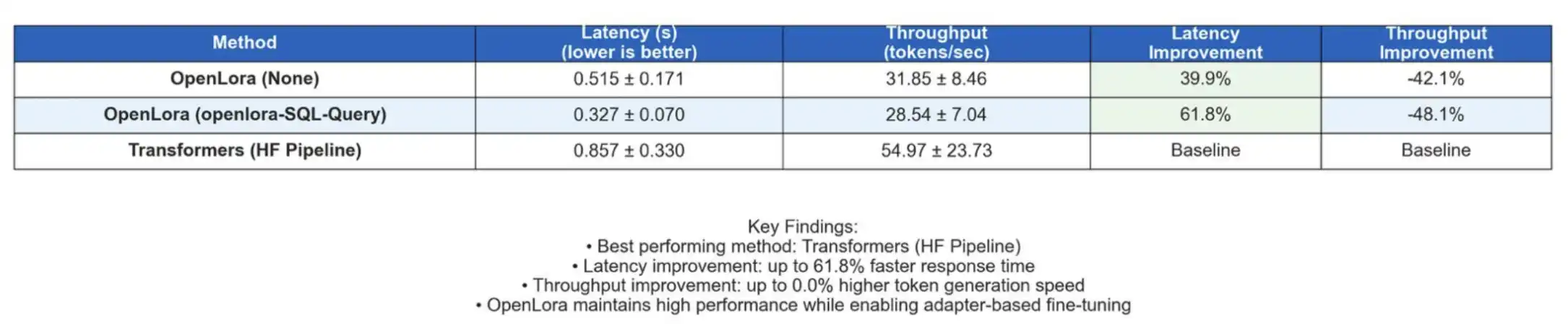
In comparative tests, OpenLoRA's token generation speed exceeds that of traditional solutions by over 4 times, with significantly reduced memory usage. Even under high-concurrency loads, it can maintain a 20ms ultra-low latency while serving thousands of LoRA adapters with less than 12GB of VRAM. These metrics have been validated across multiple hardware environments, demonstrating that OpenLoRA consistently outperforms traditional architectures in throughput and efficiency. This performance leap establishes OpenLoRA as the preferred infrastructure for scalable real-time AI deployments in decentralized environments.
For developers looking to deploy personalized assistants, multi-domain intelligent agents, or build real-time AI services, the OpenLoRA architecture completely eliminates the GPU resource burden.
Built on the Native AI Blockchain Infrastructure of OpenLedger
OpenLoRA is not a standalone service but deeply integrated into the OpenLedger blockchain network designed specifically for AI applications. This infrastructure includes:
• ModelFactory: GUI-based LoRA/QLoRA model fine-tuning engine
• Proof of Attribution: Ensures data integrity and aligns incentives with contributors through cryptographic proof
• Datanets: Decentralized data networks providing high-quality domain-specific training data
These layers together form the cornerstone of "Payable AI," where models not only achieve decentralization and transparency but also enable value distribution based on user contributions. By addressing the final barrier of this technology stack — large-scale, cost-effective model deployment for real-world applications — OpenLoRA further advances this mission.
Testnet Progress
To prepare for the mainnet launch, OpenLedger has initiated a public testnet, creating an openly accessible decentralized ecosystem. Participants can earn points through:
• Running testnet nodes
• Completing tasks in various Datanets
• Contributing high-quality data
• Inviting new users
These points will tie into OpenLedger's tiered rewards mechanism, where early contributors will receive launch incentives upon the mainnet release. Of particular note is its extremely low barrier to entry:
• Mobile (Android) and browser extension nodes can be deployed within 30 seconds
• No technical background required as the participation process is designed for scalability
A notable development is that China has emerged as one of the most active participating regions, with testnet traffic ranking among the highest globally. Of the 24.8 million requests recorded on the platform, China leads in contribution.
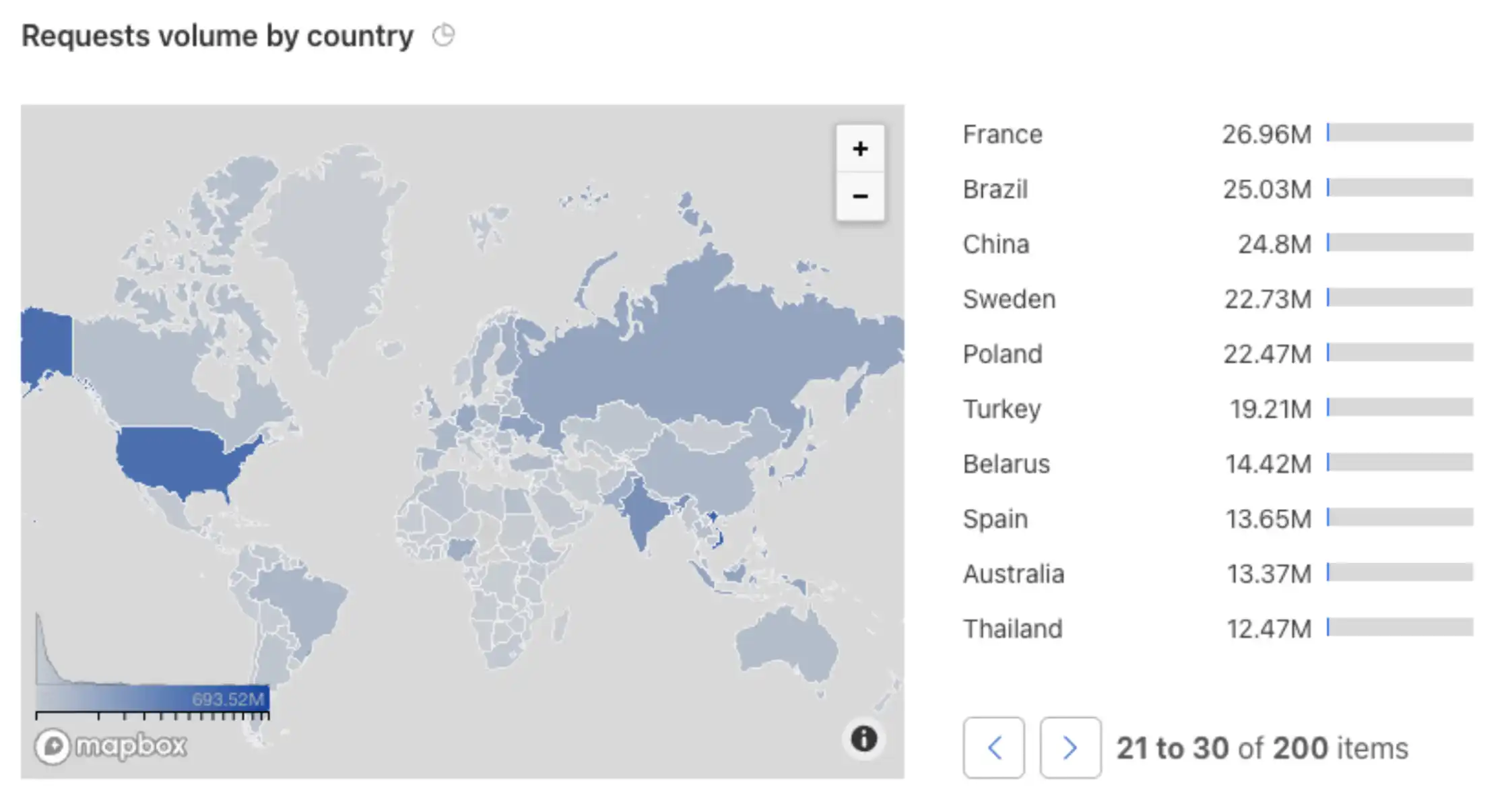
This sends a strong signal: developers, researchers, and AI practitioners in China are actively embracing OpenLedger's vision, seeking a more cost-effective, decentralized, and scalable alternative to traditional AI infrastructure.
Future Outlook
OpenLoRA has already empowered applications in various fields:
• Professional scientific advisors
• Localized legal assistants
• Web3 data-based transaction co-pilots
• On-chain communication real-time translators
In the future, it will support zero-shot LoRA adapters, multi-GPU deployments, and inference capabilities for edge devices, including mobile endpoints.
Why OpenLoRA? Why Now?
AI needs decentralization, which is not only about ideological purity, but also about the practical need for scalability, trust, and innovation. OpenLoRA removes the final technological bottleneck of decentralized AI—large-scale model serving—and achieves a breakthrough in efficiency. This is not just a tool innovation, but a call to participate in shaping the next generation of AI infrastructure. With the help of OpenLedger's ModelFactory and Proof of Contribution mechanism, developers can now transparently fine-tune, deploy, and monetize AI models with precision. The
The birth of OpenLoRA finally enables all of this to be achieved at scale, on demand, and without the burden of exorbitant GPU costs.
Join the OpenLedger ecosystem, follow our X account to get the latest updates, version releases, and ecosystem news on decentralized AI.
This article is contributed content and does not represent the views of BlockBeats.
You may also like

The Rise of Composable RWA

MAGA Up 350% in 24 Hours, PEPE Up 46% in One Day: Which Memecoins Are Next in 2026?
MAGA +350% in 24hrs. PEPE +46% in one day. RAVE +4,500% then -90%. In 2026's memecoin market, the gains are real. So are the traps? Here's how to tell the difference before you buy.

RCD Espanyol vs Real Madrid: Can the Pericos Delay the Inevitable?
RCD Espanyol vs Real Madrid lineups, standings, and stats for May 3, 2026. Real Madrid visits RCDE Stadium as Barcelona closes in on the LALIGA title. Full preview inside.

MegaETH goes live with an FDV exceeding 2 billion USD. Which ecological projects are worth paying attention to?

Dialogue with "Wood Sister" Cathie Wood: The next bull market is about to arrive

Can prediction markets win the competition for perpetual contracts?

Who is trading on Trade.xyz?

Binance quietly placed a bet on a leading large model company

Best Crypto Discord Server 2026: Why Jacob’s Crypto Clan Is Gaining Massive Attention
Jacob’s Crypto Clan has grown into one of the most active crypto Discord communities, with over 45K members and continuing to expand. This rapid growth reflects strong demand for structured trading insights and real-time collaboration.

Tom Lee Buying ETH: Why Wall Street’s Loudest Ethereum Bull Keeps Doubling Down
Tom Lee keeps buying ETH through every dip, every drawdown, and every moment of market doubt. Inside the strategy that's turning Ethereum into a treasury asset — and what it signals for the rest of the market.

Stripe Sessions 2026: AI Agent, Global Payments, and Invisible Crypto Infrastructure

Where will South Korea's cryptocurrency taxation head?

Legendary investor Naval: Apple is dead, SaaS will follow suit, and entrepreneurs have 18 months to reshape their moats

Morning Report | Visa includes Polygon in its global stablecoin settlement program; MoonPay invests $100 million to acquire security company Sodot; Digital wallet platform Belo completes $14 million Series A financing

Full text of the Federal Reserve's decision: Holding steady for the third consecutive time but increasing divisions

Dan Bin takes action, building a position in Circle
The Impossible Triangle of DeFi Lending

Bitcoin ETF News: Why Bitcoin Is Falling Even After $2.43B ETF Inflows in April
Bitcoin ETF news today shows $2.43B in April inflows as institutions absorbed thousands of BTC, yet the price dropped from $79K to $76K. Traders are now watching whether the $80K resistance breaks or triggers another pullback.
The Rise of Composable RWA
MAGA Up 350% in 24 Hours, PEPE Up 46% in One Day: Which Memecoins Are Next in 2026?
MAGA +350% in 24hrs. PEPE +46% in one day. RAVE +4,500% then -90%. In 2026's memecoin market, the gains are real. So are the traps? Here's how to tell the difference before you buy.
RCD Espanyol vs Real Madrid: Can the Pericos Delay the Inevitable?
RCD Espanyol vs Real Madrid lineups, standings, and stats for May 3, 2026. Real Madrid visits RCDE Stadium as Barcelona closes in on the LALIGA title. Full preview inside.
MegaETH goes live with an FDV exceeding 2 billion USD. Which ecological projects are worth paying attention to?
Dialogue with "Wood Sister" Cathie Wood: The next bull market is about to arrive
Can prediction markets win the competition for perpetual contracts?


