

On-Chain Data School (Part 2): The Evergreen Profitable Hodlers, What Was Their Cost Basis for Buying BTC?

Original Article Title: "On-chain Data School (Part 2): The Evergreen Hodlers, What Is Their $BTC Acquisition Cost?"
Original Article Author: Mr. Berg, On-chain Data Analyst
TLDR
- This article will continue the concept of MVRV from the previous part, introducing LTH-MVRV
- LTH = Long Term Holder, defined as BTC held for over 155 days
- LTH-MVRV represents the profitability status of long term holders
- LTH-RP represents the average cost of long term holders
Let's now dive into the main content!
What Is LTH?
LTH = Long Term Holder, defined by Glassnode as "BTC held for over 155 days".
As for why it is 155 days, Glassnode has provided a detailed explanation on their official website; due to the complexity of the content, I will not delve into it here, but interested readers can explore it on their own.
Introduction to LTH-RP
LTH-RP, which stands for Long Term Holder's Realized Price, is essentially their average holding cost. The algorithm divides LTH-Realized Cap by the circulating supply.
As shown in the graph below, the light green color represents the overall market's Realized Price, while the dark green color represents the LTH's Realized Price. The holding cost of long term holders is usually lower than the overall market's average cost.
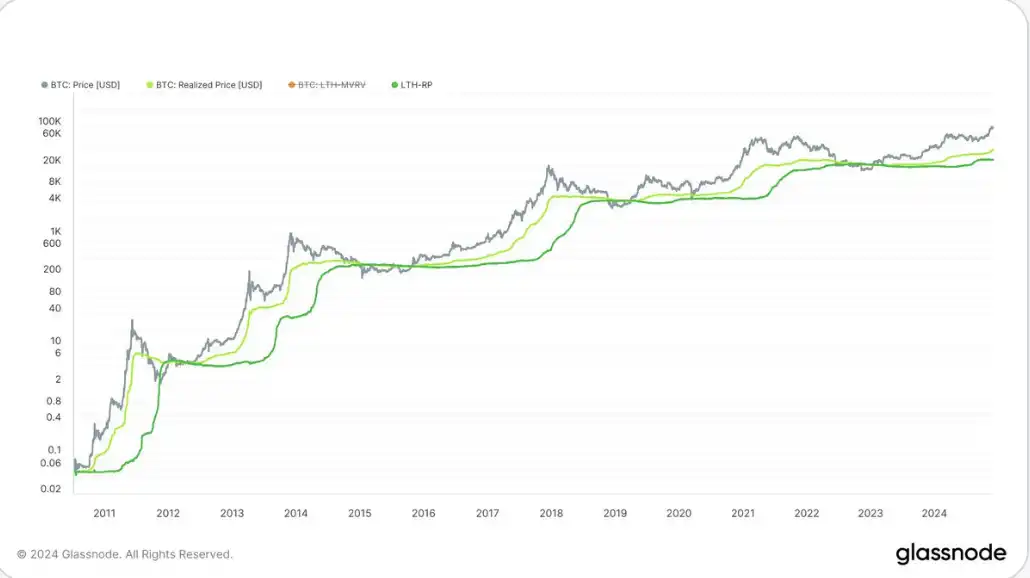
Comparison of Realized Price and LTH-RP
Introduction to LTH-MVRV
Representing the profit situation of long-term holders, similar to the calculation of MVRV, the LTH-MVRV algorithm is "current market value / LTH-Realized Cap," which can also be expressed as "current market price / LTH-Realized Price."
As shown in the chart below, the change in LTH-MVRV is usually more pronounced than MVRV, because the profits of long-term holders are usually substantial.
Comparison ofMVRV and LTH-MVRV, where the orange line represents LTH-MVRV and the yellow line represents MVRV
Application of Bottom Fishing for LTH-MVRV
When LTH-MVRV < 1 (or in other words, when the market price is below LTH-RP), it means that even the average long-term holder is at a loss, usually indicating a good bottom fishing opportunity.
As shown in the chart below, I have marked the times when LTH-MVRV < 1, which mostly correspond to cyclical major bottoms. When designing a bottom fishing strategy, this indicator can be taken into consideration~
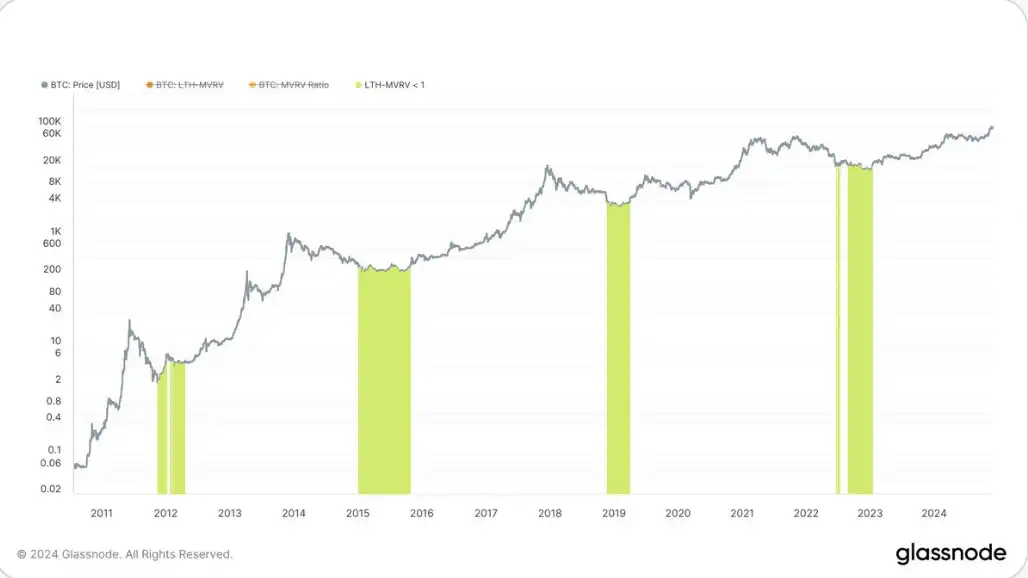
Prices corresponding to LTH-MVRV < 1
Conclusion
Above is all the content of On-Chain Data Academy (Part Two). Readers interested in delving deeper into on-chain data analysis, be sure to follow this article series!
If you want to see more analysis and educational content on on-chain data, feel free to follow my Twitter (X) account!
Hope this article has been helpful to you. Thank you for reading.
You may also like

The Impossible Triangle of DeFi Lending

Bitcoin ETF News: Why Bitcoin Is Falling Even After $2.43B ETF Inflows in April
Bitcoin ETF news today shows $2.43B in April inflows as institutions absorbed thousands of BTC, yet the price dropped from $79K to $76K. Traders are now watching whether the $80K resistance breaks or triggers another pullback.

What Is RWA in Crypto? Real-World Assets Explained (2026 Guide)
What Is RWA in Crypto?RWA stands for Real-World Assets — traditional financial assets like bonds, real estate, gold, and private credit that have been converted into blockchain tokens.

Revisiting RWA: Nearly 50,000 people's first on-chain transaction was not Bitcoin, but stock indices and crude oil

Altcoin Price Outlook 2026: The Rotation Is Coming — Just Not the Way You Think
Bitcoin dominance at 58%, Fear & Greed at 39. If you think altcoin season is dead, you're reading the wrong signals. Here's what the data actually says about what comes next.

Oracle: The Second Battlefield Behind the Prediction Market War

a16z's key bet: Kalshi's weekly trading volume approaches $3 billion, transitioning from "prediction games" to financial infrastructure, the market begins to price "uncertainty."

Morning Report | Galaxy Digital announces Q1 2026 financial report; Liquid completes $18 million Series A financing; Polymarket plans to bring major exchanges to the U.S

From a banned economist to the new CEO of Xinhua: Fu Peng has figured out the second half of traffic

Why Private Credit Became the First True Bridge from TradFi to DeFi

Senior cryptocurrency investor: Blockchain is showing a siphoning effect on capital

When traditional crypto derivatives start to subtract: Insights from Hyper Trade's products

My view on blockchain has changed

Will AI Agents use bank cards? Why can't Agentic Payment avoid stablecoins and blockchain?

Deconstructing 80 mainstream payment institutions and wallets worldwide
The MiCA Fast Track for Cryptocurrency Licenses: Why OKX and BVNK Choose Malta
a16z Crypto: Stablecoins are rebuilding the global financial infrastructure
ENI's RWA ambition: to create an enterprise-level BaaS platform that allows Web2 institutions to "go beyond just asset on-chain."
The Impossible Triangle of DeFi Lending
Bitcoin ETF News: Why Bitcoin Is Falling Even After $2.43B ETF Inflows in April
Bitcoin ETF news today shows $2.43B in April inflows as institutions absorbed thousands of BTC, yet the price dropped from $79K to $76K. Traders are now watching whether the $80K resistance breaks or triggers another pullback.
What Is RWA in Crypto? Real-World Assets Explained (2026 Guide)
What Is RWA in Crypto?RWA stands for Real-World Assets — traditional financial assets like bonds, real estate, gold, and private credit that have been converted into blockchain tokens.
Revisiting RWA: Nearly 50,000 people's first on-chain transaction was not Bitcoin, but stock indices and crude oil
Altcoin Price Outlook 2026: The Rotation Is Coming — Just Not the Way You Think
Bitcoin dominance at 58%, Fear & Greed at 39. If you think altcoin season is dead, you're reading the wrong signals. Here's what the data actually says about what comes next.
Oracle: The Second Battlefield Behind the Prediction Market War


