
Is Whale Watching a Reliable Trading Signal?



Original Article Title: Whale Alerts: Are They Tradable?
Original Article Source: Presto Research
Original Article Translation: Golem, Odaily Daily Planet
Key Points:
· Whale alerts are popular because large on-chain transactions are often seen as a precursor to an imminent token sell-off and a sell signal. To assess these claims, Presto Research analyzed the price movements of BTC, ETH, and SOL after large deposits to Binance.
· According to the regression analysis, the R-squared values between large transaction deposits and subsequent price movements are low (ranging from 0.0017 to 0.0537). Narrowing the data to deposits from VCs and MM (Market Makers) slightly increased the R-squared values, but their practical utility as trading signals remains limited. The research results strongly suggest that whale deposits to exchanges lack predictive power as a reliable trading signal.
· On-chain metrics are effective in other areas, such as analyzing blockchain fundamentals, tracking illicit fund flows, or explaining price fluctuations. Only when investors have a more realistic expectation of the capabilities and limitations of these metrics can they better serve the industry.
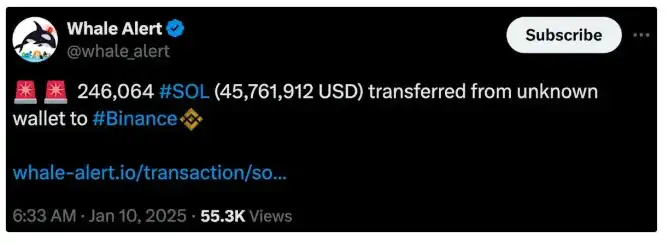
One of the key differences between crypto assets and other assets is the public availability of their transaction records, which are stored on a distributed ledger. This transparency of the blockchain has led to the emergence of various tools that leverage this unique feature, categorized as "on-chain data." One such tool is "Whale Alerts," which is a service that automatically notifies large on-chain crypto transactions. They are popular because large transactions are often seen as a precursor to imminent sell-off activity, hence traders consider them a "sell signal."
This report evaluates the effectiveness of this widely accepted assumption. After briefly outlining the popular whale alert services in the market, we will analyze the relationship between large transaction deposits and the prices of BTC, ETH, and SOL. We will then present the analysis results and provide key conclusions and recommendations.
Whale Alerts Overview
Whale Alerts refer to services that track and report large crypto transactions. These services have emerged with the development of the crypto ecosystem, reflecting market participants' high regard for the transparency features of blockchain.
History
As early Bitcoin adopters, miners, and investors (such as Satoshi Nakamoto, the Winklevoss Twins, F2Pool, Mt. Gox) accumulated a significant amount of Bitcoin, the term "whale" began to circulate. Initially, blockchain enthusiasts monitored large transactions through a blockchain explorer (such as Blockchain.info) and shared this information on forums like Bitcointalk or Reddit. This data was often used to explain significant fluctuations in the Bitcoin price.
During the bull market of 2017, with the increase in whale transactions and large transactions, the market saw a pressing need for automated monitoring solutions. In 2018, a European development team introduced a tool called "Whale Alert," which could track large cryptocurrency transactions in real-time across multiple blockchains and send alerts via Twitter, Telegram, and a web interface. The tool quickly gained popularity among market participants, becoming the preferred service for those seeking actionable trade signals.
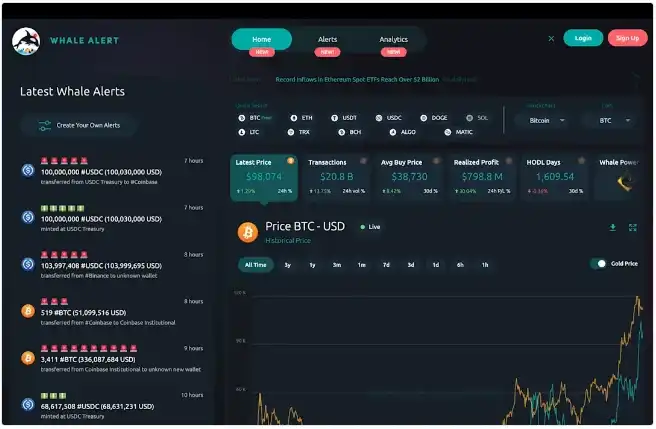
Source: Whale Alert (@whale_alert)
Key Assumption
Following the success of Whale Alert, many platforms offering similar services have emerged over the years, as shown in the image below. While many new platforms have added more features to provide background information for alerts, the original Whale Alert still focuses on simple, real-time notifications and remains the most popular service, as evidenced by its large following on Twitter. A common feature of all these services is their reliance on the assumption that large on-chain transactions, especially exchange deposits, signal imminent sell-offs.
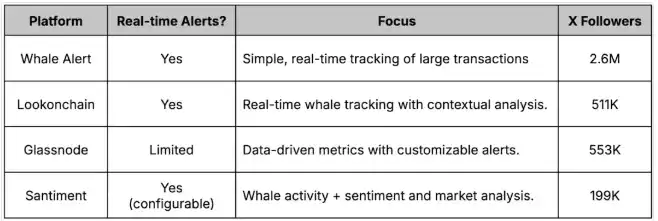
Mainstream Whale Alert Services, Data Source: Whale Alert, LookIntoBitcoin, Glassnode, Santiment, Twitter, Presto Research
Signal Validity Assessment
Supporters of the Whale Alert service believe that on-chain asset transfers to exchanges often precede liquidations, making them effective sell signals. To validate this assumption, we analyzed the price change of digital assets after large deposits entered exchanges, with the key parameters of the analysis shown in the chart below. The assumption is that if large deposit transactions can serve as reliable trading signals, a clear relationship should be observed between deposits and the corresponding asset's price.

Key Analysis Parameters, Source: Presto Research
Assets, Exchanges, Analysis Period, and Deposit Threshold
Our analysis focuses on three major cryptocurrencies—BTC, ETH, and SOL—between January 1, 2021, and December 27, 2024, along with their USDT prices on Binance. This time range was chosen to align with the operational duration of the wallet addresses currently used by Binance for deposit aggregation.
The deposit threshold was set based on data analysis from an exchange. Specifically, benchmarking against the Whale Alert thresholds of $50 million, $50 million, and $20 million for BTC, ETH, and SOL whales, respectively, we adjusted the deposit thresholds to $20 million, $20 million, and $8 million to match Binance's 40% share of global spot trading volume.
Entity Types
We also conducted a specific analysis of known entity deposits and performed the same analysis on a narrower data sample to examine if deposits from specific entity types showed a stronger relationship with price movements. These entities were identified by Arkham Intelligence and supplemented by our own investigations, as shown in the figure below.
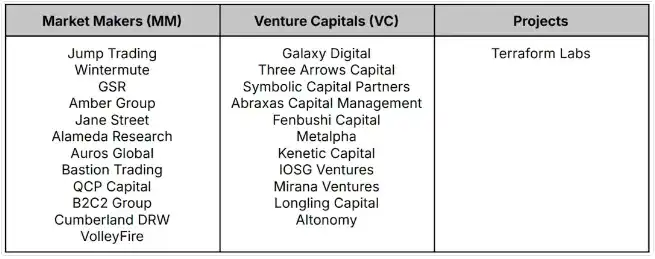
Entities with Known Addresses, Source: Arkham Intelligence, Presto Research
Measuring Market Impact
To assess the potential selling pressure from whale deposits, we made the following assumptions:
· Selling pressure would manifest within a specific time window after on-chain confirmation of deposits exceeding the threshold. We analyzed two time periods: one hour and six hours.
· The Maximum Drawdown (MDD) within the specified interval was used as a metric to gauge the price impact of deposits (if any), effectively filtering out noise during that period.
Results
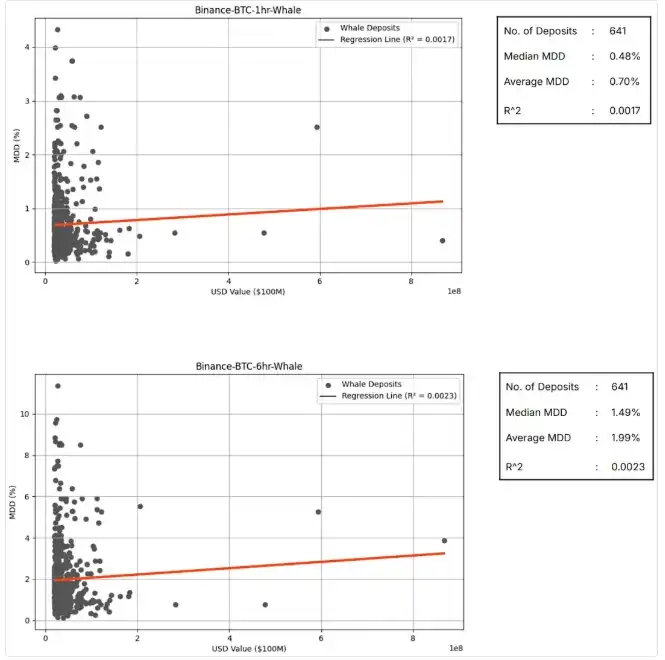
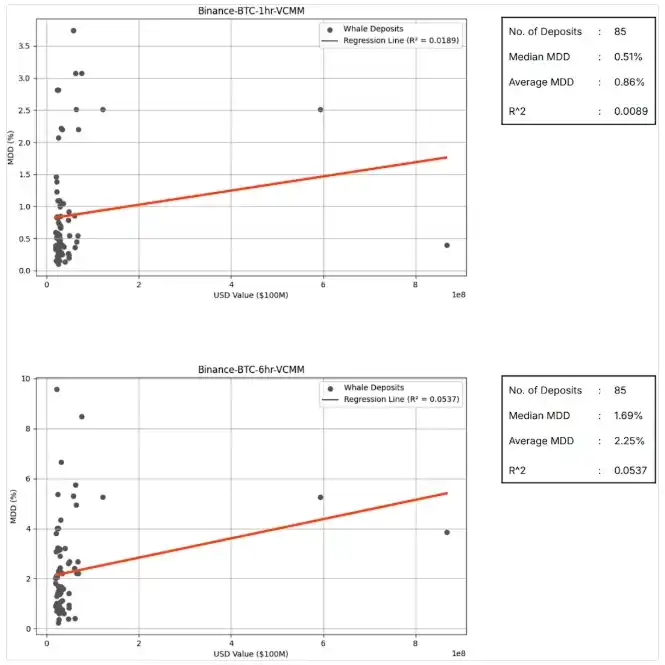
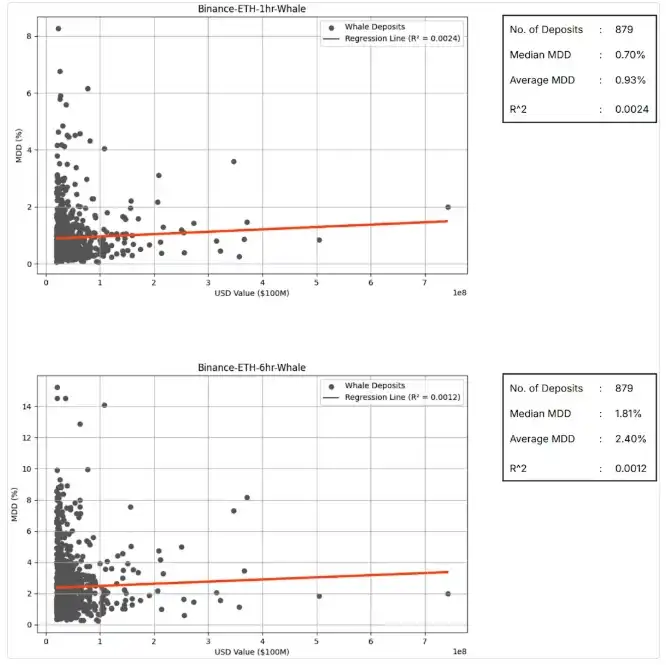
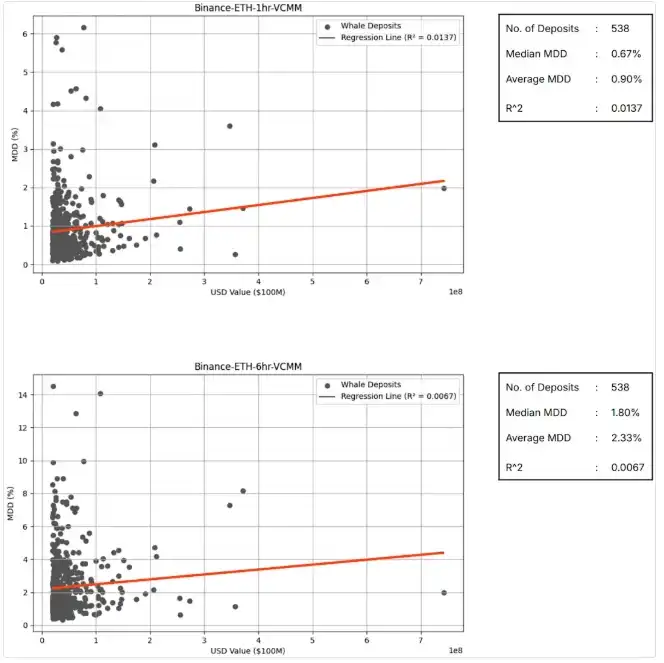
The analysis results are depicted in the following charts
· BTC Whale Deposit Impact (Overall):
Source: Binance, Dune Analytics, Presto Research
· BTC Whale Deposit Impact (VC and MM only):
Source: Binance, Dune Analytics, Presto Research
· ETH Whale Deposit Impact (Overall):
Source: Binance, Dune Analytics, Presto Research
· ETH Whale Deposit Impact (VC and MM only):
Source: Binance, Dune Analytics, Presto Research
· SOL Whale Deposit Impact (Overall):
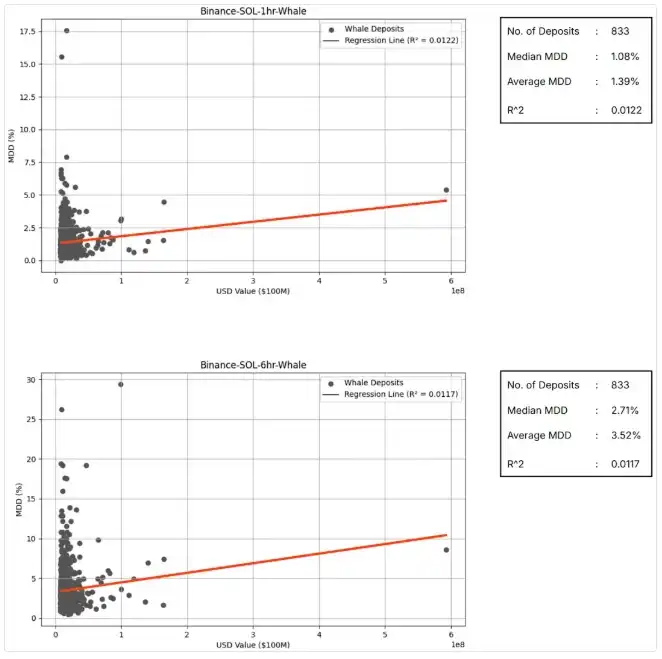
Source: Binance, Dune Analytics, Presto Research
· SOL Whale Deposit Impact (VC and MM only):
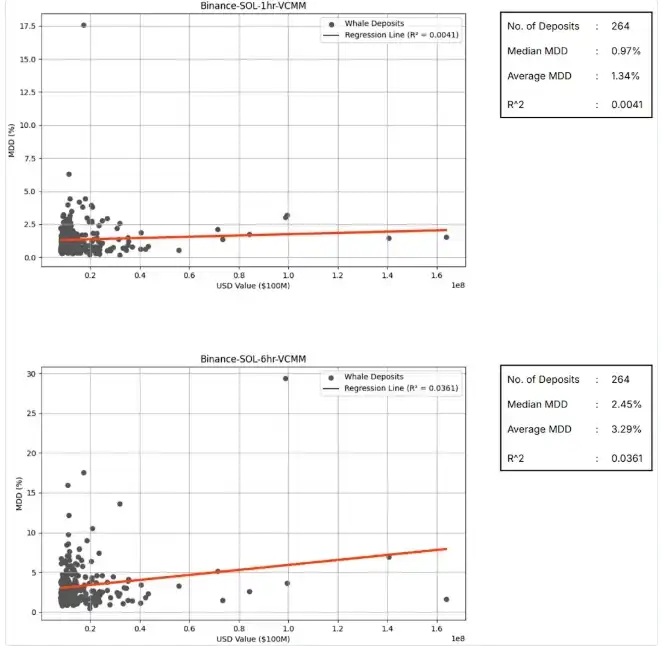
Source: Binance, Dune Analytics, Presto Research
Key Points
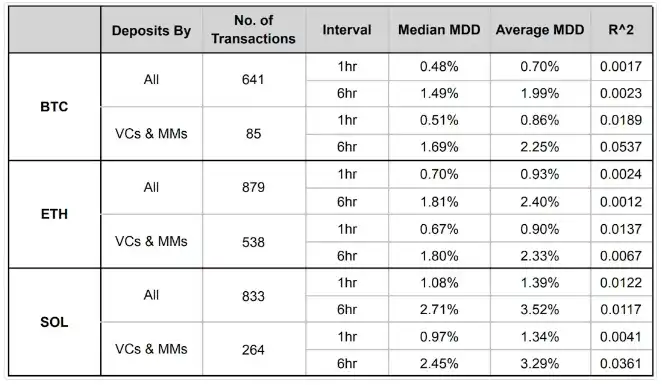
Data Source: Binance, Dune Analytics, Presto Research
The chart above summarizes the results of the above statistics and draws the following 3 conclusions:
1. Large Exchange Deposits and Price Drop Prediction: The R-squared values for all 12 scenarios indicate a very weak predictive power, ranging from 0.0017 to 0.0537.
2. VC and MM Deposits May Be Slightly Better Predictive Signals: In this data set, the R-squared values show some improvement, but this improvement may only be the result of reduced sample noise rather than a true stronger correlation. Furthermore, the absolute values are still low, indicating limited actual effectiveness as a trading signal.
3. ETH Whale Deposits Mainly Come from VC and MM: They represent 61% of ETH whale deposits (i.e., 538 out of 879 transactions), while BTC accounts for only 13%, and SOL for 32%. This reflects the characteristics of different assets: ETH, with its diverse Web3 uses (such as gas fees, staking, DeFi lending, and swap intermediation), has higher turnover, while BTC, as a store of value asset, is more stable.
Conclusion
Undoubtedly, our analysis method has certain limitations, and regression analysis has its inherent constraints, so drawing conclusions solely based on R-squared values can sometimes be misleading.
Nevertheless, this analysis, combined with background and individual observation results, strongly suggests that whale deposits to exchanges lack sufficient predictive power to be a reliable trading signal. This also provides us with profound insights into the broader use of on-chain metrics.
On-chain metrics are undoubtedly valuable tools, especially for analyzing blockchain fundamentals or tracking illicit fund flows, and they may be useful in retrospectively explaining price movements. However, using them to predict short-term price changes is an entirely different matter. Price is a function of both supply and demand, and exchange deposits are just one of many factors influencing the supply side, even if they are indeed useful. Price discovery is a complex process influenced by fundamentals, market structure, behavioral factors (such as emotions, expectations), and random noise.
In the highly volatile cryptocurrency market, participants are constantly seeking a "foolproof" trading strategy, and there will always be an audience drawn to the "magic" of on-chain metrics. As some "overzealous" data providers are eager to exaggerate the promises of their platforms, investors can only better serve the industry when they have a realistic expectation of the capabilities and limitations of these tools.

You may also like

The other side of Musk's trillion-dollar fortune: 85% cannot be sold

The U.S. government prohibits foreigners from using Fable 5, Anthropic issues a rebuttal

Citibank releases "2030 Asset Tokenization Market Outlook": 6 major trends may create a $8.2 trillion market

The trillion-dollar valuation test: Are the three major super IPOs a celebration for tech stocks or a nightmare for the crypto market?

Morning Report | Digital Asset completes $355 million financing led by a16z Crypto; Meta completes operational separation from Manus

a16z Crypto Partner: Cash flow is the moat

Cryptocurrency market makers collectively seek change as it becomes increasingly difficult to make money

How TradeXYZ, xStocks, and Alpaca break down the SpaceX IPO into three different strategies
$75 billion in risk asset redistribution: How will SpaceX's IPO affect U.S. stocks and Bitcoin?

Why Is BlackRock Investing $5 Billion in the SpaceX IPO?
Morning News | CME Group launches Nasdaq Cryptocurrency Index futures; Asset management giant Janus Henderson strategically invests in Ethena

Bitcoin Layer 2 Network Botanix: Why Did We Choose to Dissolve?

Why did Oracle deliver the strongest financial report in history, yet its stock price fell?
When the P2P illicit funds from ten years ago turned into 60,000 bitcoins
Dialogue with OmenX Founder: Why does the prediction market need an evolution from "spot" to "derivatives"?
Galaxy in-depth report: Is Solana still worth paying attention to?
Young people in South Korea make a "final effort" in the epic bull market
The pricing controversy of Trade.xyz exposes the fatal weakness of Pre-IPO perpetual contracts
The other side of Musk's trillion-dollar fortune: 85% cannot be sold
The U.S. government prohibits foreigners from using Fable 5, Anthropic issues a rebuttal
Citibank releases "2030 Asset Tokenization Market Outlook": 6 major trends may create a $8.2 trillion market
The trillion-dollar valuation test: Are the three major super IPOs a celebration for tech stocks or a nightmare for the crypto market?
Morning Report | Digital Asset completes $355 million financing led by a16z Crypto; Meta completes operational separation from Manus
a16z Crypto Partner: Cash flow is the moat


