

If the US Treasury yield rises above 5%, will Bitcoin drop below $50,000?

Original Title: What happens to Bitcoin if US bond yields soar above 5%?
Original Source: Cointelegraph
Original Translation: AiddiaoJP, Foresight News
During the US-Iran war, Bitcoin has been one of the strongest performing assets. However, as the bond market shows signs of 'uncontrolled' behavior, Bitcoin's upward momentum is showing signs of exhaustion.
Key Points:
· If the US-Iran war continues to escalate, the US Treasury bond yield may rise by 200 basis points.
· Historical experience indicates that conflicts related to oil often drive up inflation and suppress risk appetite, speculating that the price of Bitcoin may fall below $50,000 in 2026.
Oil Supply Shock Could Drive US Treasury Yields Above 5%
Since the US and Israel launched attacks on Iran on February 28, the benchmark 10-year US Treasury bond yield has risen to around 4.42%, reaching a nine-month high.
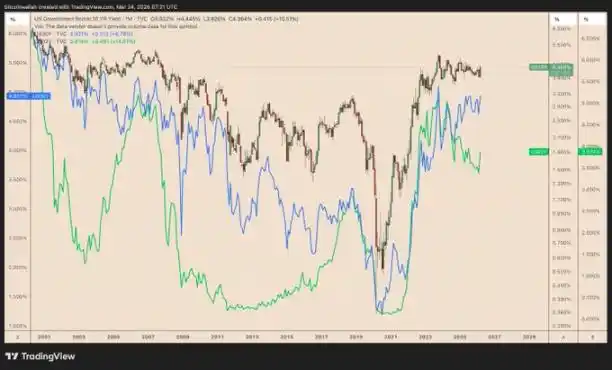
US 2-year, 10-year, and 30-year Treasury yield monthly performance. Source: TradingView
In particular, the 30-year Treasury bond yield has risen to around 4.97%, and the 2-year Treasury bond yield has also increased to the range of 3.95% to 3.98%.
Impacted by the war, oil prices surged, exacerbating market concerns about rising inflation, thereby driving up bond yields. Against this backdrop, the market generally expects no interest rate cuts within 2026.
US President Donald Trump announced a five-day pause in action, temporarily easing immediate concerns in the market about Iranian energy facilities being targeted. However, as Iran has denied engaging in any negotiations and cross-border attacks continued as of this Tuesday, the conflict situation remains uncontained.
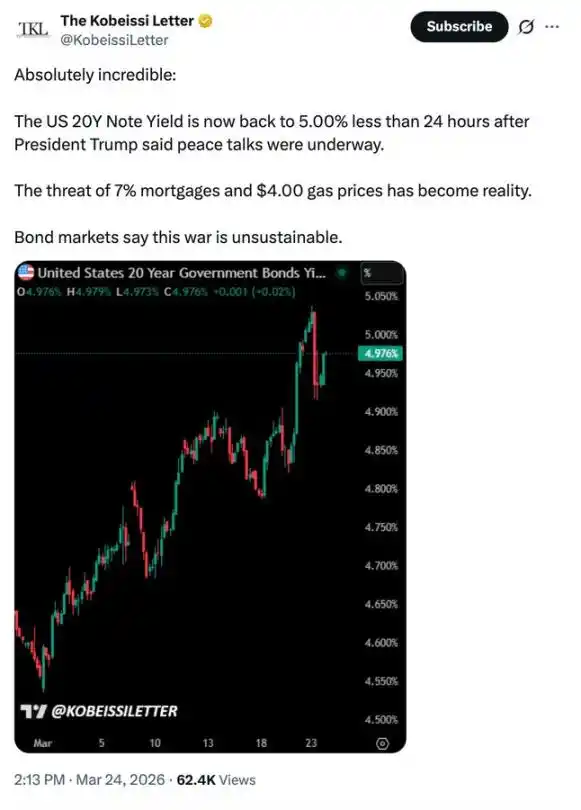
Source: X
Market observers have expressed concerns, noting the risk of further upside in U.S. Treasury yields. Technical analysts further point out that if the 10-year Treasury yield breaks above the current symmetrical triangle formation, it could rise by 200 basis points to reach 6.4%.
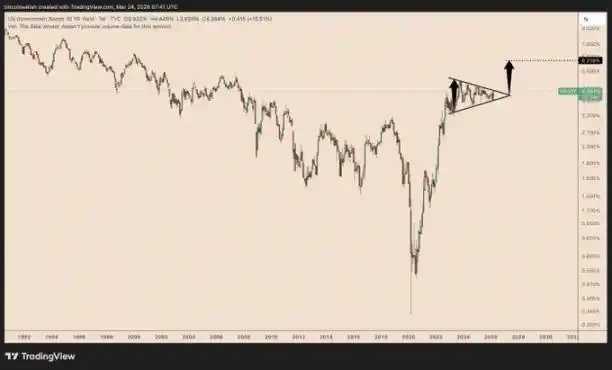
U.S. 10-Year Treasury Yield Monthly Chart. Source: TradingView
An increase in yields will reduce the opportunity cost of holding stocks, Bitcoin, and other risk assets. If Bitcoin continues to exhibit risk asset characteristics, once the 10-year Treasury yield surpasses 5%, it may trigger selling pressure in the Bitcoin market.
Historical Cases of Oil-Related Shocks
Based on historical experience, short-term oil-related conflicts have typically led to sharp but brief fluctuations in bond yields and the stock market, while long-term supply shocks may drive sustained yield increases and exert continuous pressure on the stock market.
During the 1973 Yom Kippur War and Arab oil embargo, the bond yields initially rose modestly, then surged significantly alongside worsening inflation, with the S&P 500 Index falling around 41% to 48% during the "stagflation" phase.
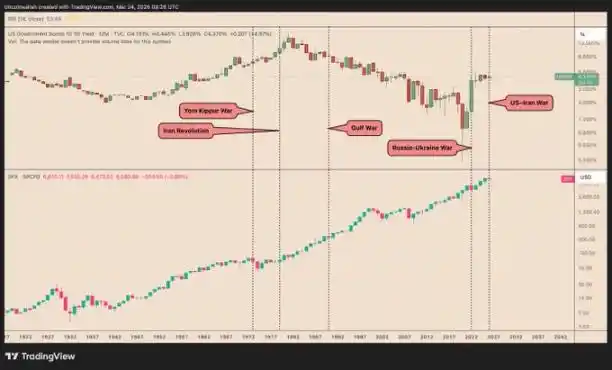
U.S. 10-Year Treasury Yield vs. S&P 500 Index Annual Chart. Source: TradingView
During the 1979 Iranian Revolution, the bond market reaction was more intense, with the 10-year Treasury yield rising by approximately 150 to 200 basis points over the following year, while the stock market experienced a relatively mild pullback.
During the 1990-1991 Gulf War, the 10-year Treasury yield increased by about 50 to 70 basis points, and the S&P 500 Index declined by around 16% to 20%, followed by a rebound once the conflict was resolved.
After the 2022 Russia-Ukraine conflict erupted, there was also a scenario of rising bond yields and a short-term 5% to 10% decline in the S&P 500 Index.
The current conflict between the U.S. and Israel and Iran appears to be in the early stage of the aforementioned historical pattern. If the conflict escalates further, oil prices remain elevated, Treasury yields could continue to rise, and risk assets may face a new round of downward pressure.
Bitcoin continues to exhibit a high correlation with the S&P 500 Index. Therefore, unless the conflict situation is resolved quickly, the Bitcoin price may face even greater downward pressure.
How Low Could the Bitcoin Price Drop?
From a technical analysis perspective, if the Bitcoin price falls below the current bearish flag pattern, it could further drop to $50,000 or even lower in the coming months.
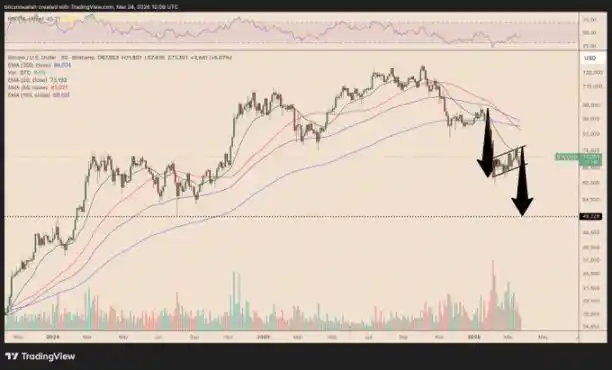
Bitcoin / USD three-day price chart. Source: TradingView
The above technical outlook aligns closely with trading data from prediction markets. Currently, traders estimate a 70% probability of Bitcoin falling below $55,000 in 2026 and a 46% probability of dropping below $45,000.
Arthur Hayes, Co-founder of BitMEX, suggested that if the US-Iran conflict prolongs, it may force the Federal Reserve to implement a loose monetary policy, which would be a positive development for Bitcoin.
He stated: "The longer the conflict persists, the more likely the Fed will print money to support America's war machine, which is good for Bitcoin."
He further added:
"When central banks start to print money, I would choose to buy Bitcoin."
You may also like

Where will South Korea's cryptocurrency taxation head?

Legendary investor Naval: Apple is dead, SaaS will follow suit, and entrepreneurs have 18 months to reshape their moats

Morning Report | Visa includes Polygon in its global stablecoin settlement program; MoonPay invests $100 million to acquire security company Sodot; Digital wallet platform Belo completes $14 million Series A financing

Full text of the Federal Reserve's decision: Holding steady for the third consecutive time but increasing divisions

Dan Bin takes action, building a position in Circle

The Impossible Triangle of DeFi Lending

Bitcoin ETF News: Why Bitcoin Is Falling Even After $2.43B ETF Inflows in April
Bitcoin ETF news today shows $2.43B in April inflows as institutions absorbed thousands of BTC, yet the price dropped from $79K to $76K. Traders are now watching whether the $80K resistance breaks or triggers another pullback.

What Is RWA in Crypto? Real-World Assets Explained (2026 Guide)
What Is RWA in Crypto?RWA stands for Real-World Assets — traditional financial assets like bonds, real estate, gold, and private credit that have been converted into blockchain tokens.

Revisiting RWA: Nearly 50,000 people's first on-chain transaction was not Bitcoin, but stock indices and crude oil

Altcoin Price Outlook 2026: The Rotation Is Coming — Just Not the Way You Think
Bitcoin dominance at 58%, Fear & Greed at 39. If you think altcoin season is dead, you're reading the wrong signals. Here's what the data actually says about what comes next.

Oracle: The Second Battlefield Behind the Prediction Market War

a16z's key bet: Kalshi's weekly trading volume approaches $3 billion, transitioning from "prediction games" to financial infrastructure, the market begins to price "uncertainty."

Morning Report | Galaxy Digital announces Q1 2026 financial report; Liquid completes $18 million Series A financing; Polymarket plans to bring major exchanges to the U.S

From a banned economist to the new CEO of Xinhua: Fu Peng has figured out the second half of traffic

Why Private Credit Became the First True Bridge from TradFi to DeFi

Senior cryptocurrency investor: Blockchain is showing a siphoning effect on capital

When traditional crypto derivatives start to subtract: Insights from Hyper Trade's products

My view on blockchain has changed
Where will South Korea's cryptocurrency taxation head?
Legendary investor Naval: Apple is dead, SaaS will follow suit, and entrepreneurs have 18 months to reshape their moats
Morning Report | Visa includes Polygon in its global stablecoin settlement program; MoonPay invests $100 million to acquire security company Sodot; Digital wallet platform Belo completes $14 million Series A financing
Full text of the Federal Reserve's decision: Holding steady for the third consecutive time but increasing divisions
Dan Bin takes action, building a position in Circle
The Impossible Triangle of DeFi Lending


