
 Buy Crypto
- Markets
 Futures
- Spot
- Copy Trade
- Earn
- More
Figma's stock price drops over 7%, will Claude Design be the terminator?


Original Title: "Is Anthropic About to Kill Figma?"
Original Author: Dance Dance Forest, Geek Park
From selling models to building products, Anthropic has taken a step that was faster than anyone expected.
In 2010, a small company called Instagram was acquired by Facebook for $1 billion. Many people at the time didn't understand why they would spend so much money on a filter app. The later story is well known—Facebook wasn't buying a product but a species that could threaten itself, and incidentally turning it into its weapon.
Mike Krieger, the co-founder who helped Instagram grow from zero to hundreds of millions of users, joined the thriving Anthropic in May 2024 as Chief Product Officer.
On April 14, 2026, this Krieger resigned from the Figma board. Three days later, Anthropic announced the release of Claude Design.
This timing doesn't seem like a coincidence.
01 Between the Three Days, the Industry Landscape Changed
Figma's stock price dropped by over 7% on that day, from $20.32 to $18.84. Market reactions are always more honest than press releases.
Claude Design is an experimental product, powered by Anthropic's latest flagship model, Opus 4.7, from the internal Anthropic Labs team. What can it do? Prototypes, slides, one-page summaries, and various visual content—exactly what designers and product managers open Figma or Canva to do every day.
But if Claude Design is seen merely as "another AI design tool," the significance of this matter is underestimated.
What truly caught the industry's attention is the "handover" mechanism between Claude Design and Claude Code.
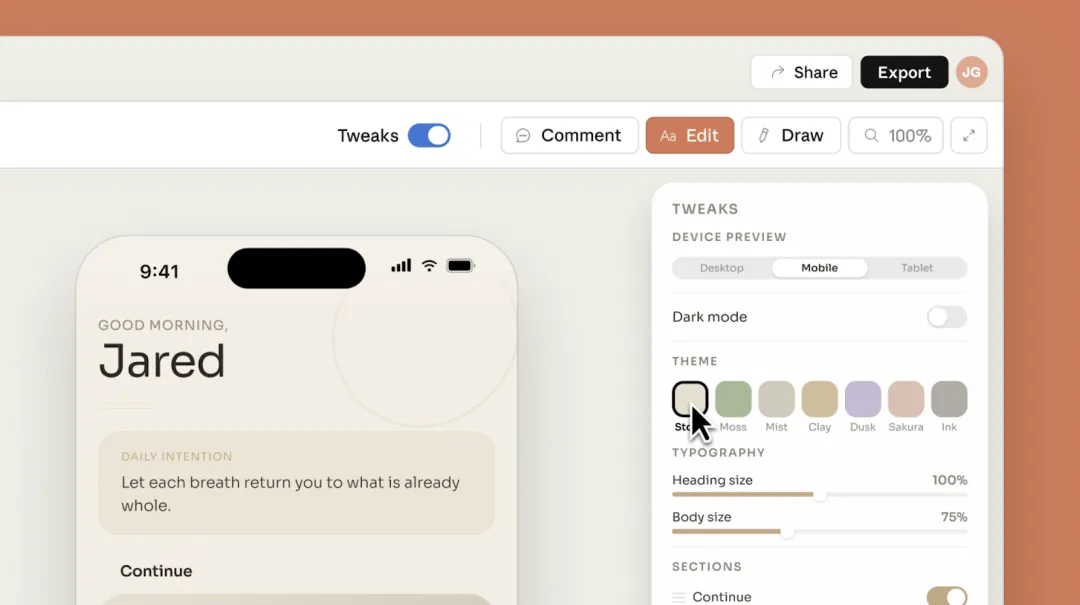
Claude Design Page | Image Source: Anthropic
When you finish a UI prototype with Claude Design, the system will automatically package the complete design specifications into a "handoff package," which can be directly passed to Claude Code for further development.
More importantly, when Claude Design is enabled, it reads your codebase and existing design files, automatically creating a design system tailored to your team—font, color, layout standards, brand governance rules, all read once and applied throughout.
Developers on Reddit commented that this solves the "most annoying part" of using AI for design tools—having to explain your brand specifications to AI again for each new project.
From design to development, it used to be two tools, two workflows, two sets of people. Now Anthropic wants to turn this process into a closed loop.
02 Clear Strategic Cadence
If you look at the recent timeline with Claude Design, you will see a faster-paced Anthropic.
In early April, Anthropic announced the limited release of Claude Mythos Preview. This model can discover and exploit vulnerabilities hidden in critical software systems for decades, with such high security risks that the company decided not to open it to the public—instead, in the form of "Project Glasswing," providing selective access to over 50 top institutions such as Amazon, Apple, Microsoft, Google, JPMorgan Chase, etc., each with a complimentary $100 million user credit limit, specifically for defensive cybersecurity research.
On April 14, Opus 4.7 was officially released, bringing enhanced coding capabilities, clearer visual understanding, and new "self-check" abilities. Anthropic itself admits that the performance of Opus 4.7 is not as good as Mythos—but Mythos has not been publicly released for security reasons.
On April 17, CEO Dario Amodei met with White House officials, with the topic being cybersecurity concerns raised by the Mythos model. On the same day, Claude Design was released.
Also on April 17, foreign media reported that Anthropic's valuation had reached $800 billion and was in early discussions with Goldman Sachs, JPMorgan Chase, and Morgan Stanley for a possible IPO as early as October this year.
This is no longer a "model-selling company." This is a company preparing to go public, needing to articulate to the capital market "why we are worth this price," systematically completing its product matrix.
From disrupting the developer tools market with Claude Code to entering the design workflow with Claude Design, Anthropic's strategy is very clear: identify tools used frequently by professionals every day, redo them in an AI-native way, and then use "model capability" as a moat to make it difficult for competitors to catch up.
03 Challenging Figma, but Facing Reality
However, there is often a gap between the ideal closed loop and actual use.
Some reviewers found that after experiencing Claude Design, simply building a design system, setting up a prototype website, and making a few adjustments had already consumed over 50% of their weekly quota. Beyond the quota, additional token fees are required. For design scenarios that require frequent iterations, this cost pressure is significant.
There are also noticeable bugs at present, such as the design system preview sandbox being unable to correctly read image files, resulting in broken image links.
At its current stage, Claude Design is more like an accelerator for internal demos and rapid prototyping, rather than a production-level design tool that can be delivered directly.
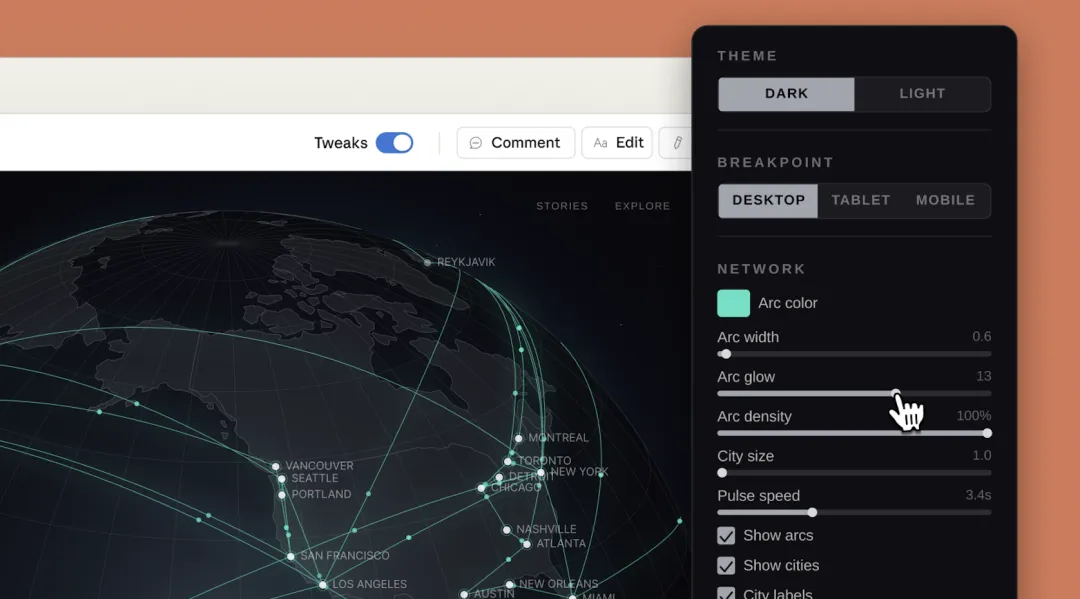
Claude Design Page | Image Source: Anthropic
This also means that Canva and Figma are not without recourse. Figma has accumulated years of moat in collaboration features, meticulous design system management, and the workflow of professional designers; Canva's strength lies in its template ecosystem and the user-friendliness for non-professional users. In the short term, production-level content still requires manual fine-tuning.
But the term "short term" is becoming shorter and shorter in the field of AI.
Anthropic's true ambition this time may not be to directly replace Figma, but to redefine "who is Figma's target user." When an independent developer, a small team's product manager, or an entrepreneur who needs to quickly create a demo can use Claude Design to build a "good enough" prototype in minutes and seamlessly hand it over to Claude Code for implementation, do they still need to take the time to learn Figma?
This may be the real reason Figma's stock price dropped by 7%.
04 From Selling Shovels to Mining
There is a long-standing metaphor in Silicon Valley that during a gold rush, the ones who make the most money are not the gold miners, but the ones who sell shovels. In the early days of the AI wave, OpenAI and Anthropic played the role of the "shovel sellers"—providing APIs for developers and businesses to build applications.
However, now Anthropic has started mining itself.
Claude Code, Claude Design—these are two shovels, as well as two entry points that capture users' time. As Anthropic directly ventures into developer tools and design tools, its relationship with ecosystem companies that once built products based on its API has shifted from "partners" to "competitors."
This path has been trodden by Microsoft, Google, and most decisively, Apple. The difference is that those companies first had a platform before applications, while Anthropic initially gained trust through model performance and then used this trust to permeate the upstream application layer.
Mike Krieger turned Instagram into a platform years ago, only to witness Facebook later use this platform to suppress competitors. Two years ago, he joined Anthropic to start working on products.
History does not merely repeat itself, but sometimes, participants do.
Anthropic's IPO could potentially land as early as October this year. Before that, it will probably "release" a few more times to make it clear to the capital market what this company really aims to be.
Original Article Link
You may also like

Stolen: $290 million, Three Parties Refusing to Acknowledge, Who Should Foot the Bill for the KelpDAO Incident Resolution?

ASTEROID Pumped 10,000x in Three Days, Is Meme Season Back on Ethereum?

ChainCatcher Hong Kong Themed Forum Highlights: Decoding the Growth Engine Under the Integration of Crypto Assets and Smart Economy

Why can this institution still grow by 150% when the scale of leading crypto VCs has shrunk significantly?

Anthropic's $1 trillion, compared to DeepSeek's $100 billion

Geopolitical Risk Persists, Is Bitcoin Becoming a Key Barometer?

Annualized 11.5%, Wall Street Buzzing: Is MicroStrategy's STRC Bitcoin's Savior or Destroyer?

An Obscure Open Source AI Tool Alerted on Kelp DAO's $292 million Bug 12 Days Ago

Mixin has launched USTD-margined perpetual contracts, bringing derivative trading into the chat scene.
The privacy-focused crypto wallet Mixin announced today the launch of its U-based perpetual contract (a derivative priced in USDT). Unlike traditional exchanges, Mixin has taken a new approach by "liberating" derivative trading from isolated matching engines and embedding it into the instant messaging environment.
Users can directly open positions within the app with leverage of up to 200x, while sharing positions, discussing strategies, and copy trading within private communities. Trading, social interaction, and asset management are integrated into the same interface.
Based on its non-custodial architecture, Mixin has eliminated friction from the traditional onboarding process, allowing users to participate in perpetual contract trading without identity verification.
The trading process has been streamlined into five steps:
· Choose the trading asset
· Select long or short
· Input position size and leverage
· Confirm order details
· Confirm and open the position
The interface provides real-time visualization of price, position, and profit and loss (PnL), allowing users to complete trades without switching between multiple modules.
Mixin has directly integrated social features into the derivative trading environment. Users can create private trading communities and interact around real-time positions:
· End-to-end encrypted private groups supporting up to 1024 members
· End-to-end encrypted voice communication
· One-click position sharing
· One-click trade copying
On the execution side, Mixin aggregates liquidity from multiple sources and accesses decentralized protocol and external market liquidity through a unified trading interface.
By combining social interaction with trade execution, Mixin enables users to collaborate, share, and execute trading strategies instantly within the same environment.
Mixin has also introduced a referral incentive system based on trading behavior:
· Users can join with an invite code
· Up to 60% of trading fees as referral rewards
· Incentive mechanism designed for long-term, sustainable earnings
This model aims to drive user-driven network expansion and organic growth.
Mixin's derivative transactions are built on top of its existing self-custody wallet infrastructure, with core features including:
· Separation of transaction account and asset storage
· User full control over assets
· Platform does not custody user funds
· Built-in privacy mechanisms to reduce data exposure
The system aims to strike a balance between transaction efficiency, asset security, and privacy protection.
Against the background of perpetual contracts becoming a mainstream trading tool, Mixin is exploring a different development direction by lowering barriers, enhancing social and privacy attributes.
The platform does not only view transactions as execution actions but positions them as a networked activity: transactions have social attributes, strategies can be shared, and relationships between individuals also become part of the financial system.
Mixin's design is based on a user-initiated, user-controlled model. The platform neither custodies assets nor executes transactions on behalf of users.
This model aligns with a statement issued by the U.S. Securities and Exchange Commission (SEC) on April 13, 2026, titled "Staff Statement on Whether Partial User Interface Used in Preparing Cryptocurrency Securities Transactions May Require Broker-Dealer Registration."
The statement indicates that, under the premise where transactions are entirely initiated and controlled by users, non-custodial service providers that offer neutral interfaces may not need to register as broker-dealers or exchanges.
Mixin is a decentralized, self-custodial privacy wallet designed to provide secure and efficient digital asset management services.
Its core capabilities include:
· Aggregation: integrating multi-chain assets and routing between different transaction paths to simplify user operations
· High liquidity access: connecting to various liquidity sources, including decentralized protocols and external markets
· Decentralization: achieving full user control over assets without relying on custodial intermediaries
· Privacy protection: safeguarding assets and data through MPC, CryptoNote, and end-to-end encrypted communication
Mixin has been in operation for over 8 years, supporting over 40 blockchains and more than 10,000 assets, with a global user base exceeding 10 million and an on-chain self-custodied asset scale of over $1 billion.

$600 million stolen in 20 days, ushering in the era of AI hackers in the crypto world
Vitalik's 2026 Hong Kong Web3 Summit Speech: Ethereum's Ultimate Vision as the "World Computer" and Future Roadmap
On the same day Aave introduced rsETH, why did Spark decide to exit?
Full Post-Mortem of the KelpDAO Incident: Why Did Aave, Which Was Not Compromised, End Up in Crisis Situation?

After a $290 million DeFi liquidation, is the security promise still there?
ZachXBT's post ignites RAVE nearing zero, what is the truth behind the insider control?

Vitalik 2026 Hong Kong Web3 Carnival Speech Transcript: We do not compete on speed; security and decentralization are the core
In-depth Analysis of RAVE Events: Short Squeeze, Crash, and Quantitative Financial Models of Liquidity Manipulation




 App
App