
Deep Dive into BTC On-chain Analysis: Where is the Short-Term Bottom?


Original Author: Murphy, On-chain Data Analyst
Chip Structure Determines the Lower Limit of BTC Price Pullback
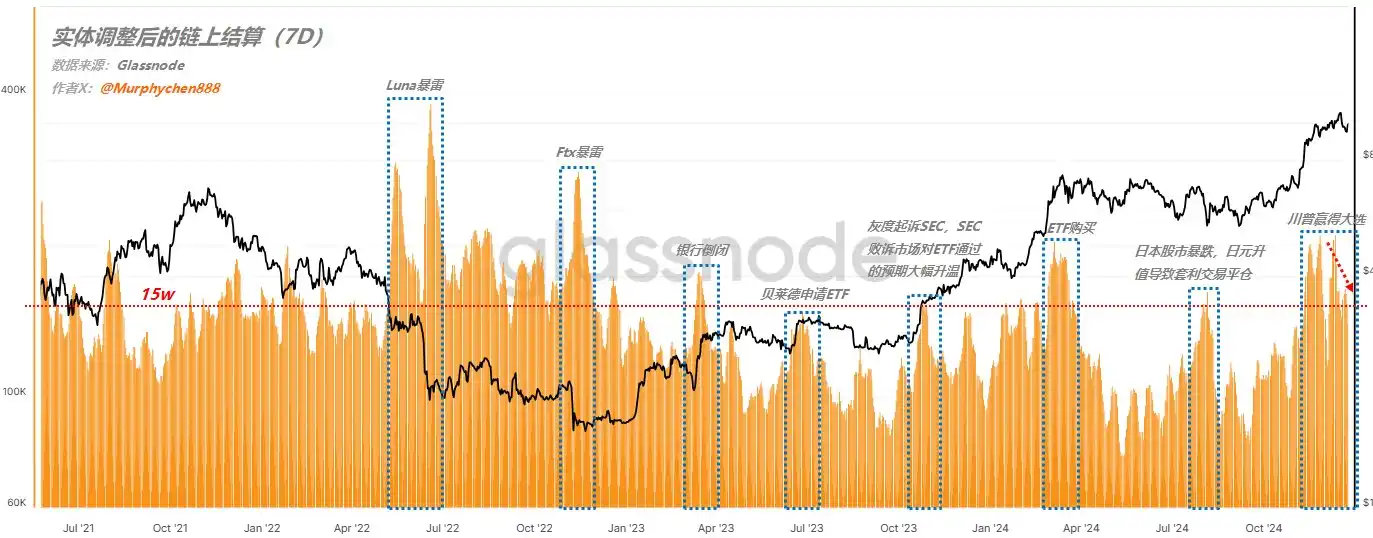
Every event that drives market sentiment change is accompanied by a sudden surge in on-chain transaction volume. After data filtering to exclude transfers within the same entity address cluster, the daily on-chain actual transaction volume is usually around 100k BTC (7-day average), with more on weekdays and less on weekends; if it exceeds 150k BTC, it is considered an "abnormal" data point.
For example, the Luna flash crash in May 2022, the FTX flash crash in November 2022, and the collapse of U.S. banks such as Silicon Valley Bank and Signature Bank from March to April 2023 all brought extreme panic and anxiety to the market, with on-chain transaction volume peaking at over 300k BTC (see Figure 1).
(Figure 1)
From this perspective, we should no longer doubt whether on-chain data can truly reflect "transaction" behavior. It can even be considered that BTC's on-chain settlement is the barometer of the entire crypto market's activity level and a quantified form of macro sentiment.
We can see that after November, as Trump won the presidential election, market sentiment reached a climax, with daily settlement volume reaching 200k. In this round of the cycle, a similar level was only seen in March of this year, indicating a large influx of capital in the short term. However, after December 17, the sentiment began to noticeably cool down, with the average daily settlement volume dropping to around 120k by the 25th. Historically, after experiencing a peak period, the ebb of activity also means that the market enters a period of calm, which is also the most vulnerable time for a pullback to occur.
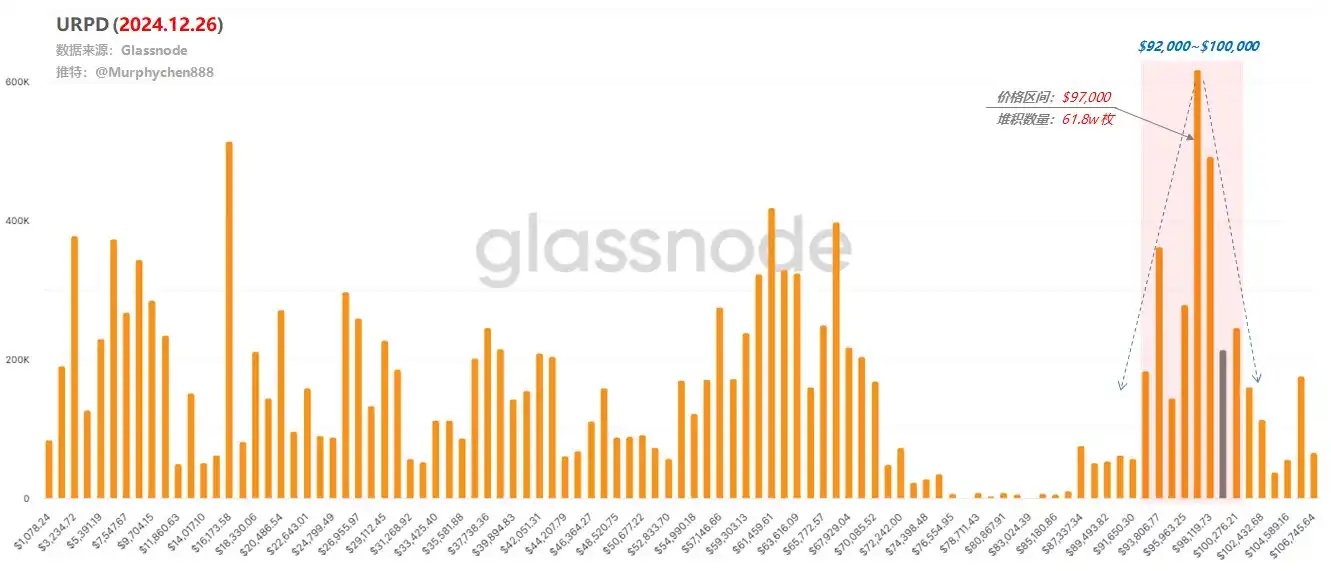
By tracking UTXOs and differentiating on-chain transactions based on different realized prices, we can derive a highly intuitive set of chip structure distribution data, known as URPD (see Figure 2).
(Figure 2)
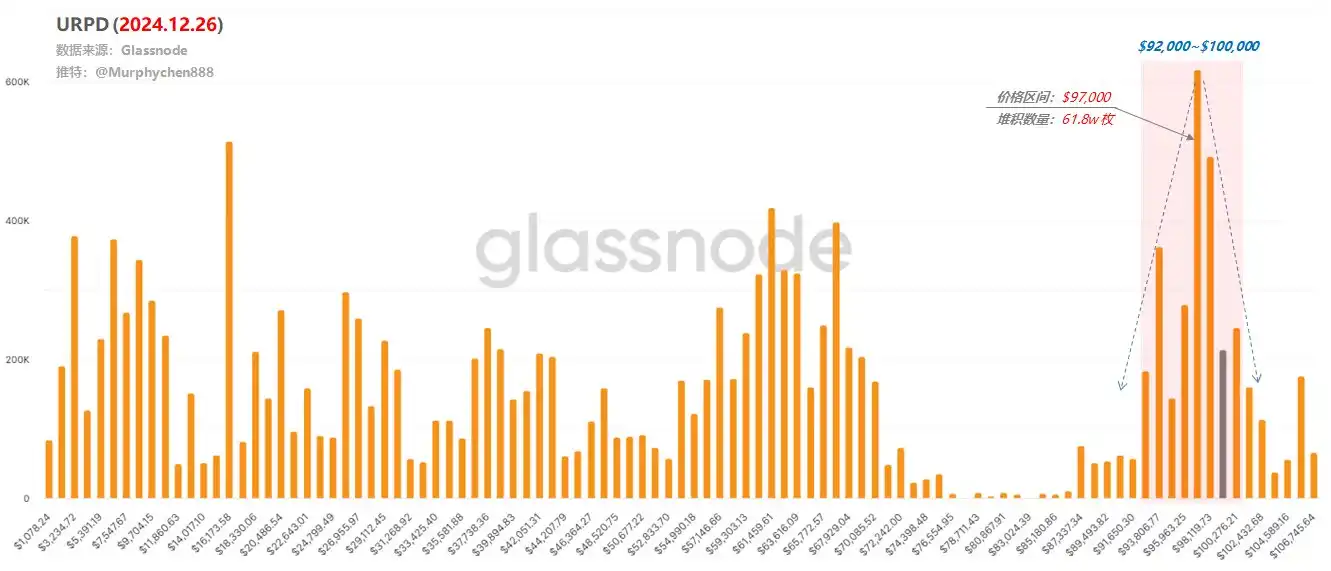
From the current data, the on-chain structure is gradually forming a chip accumulation zone in the $92,000 to $100,000 range, with a massive 600k BTC volume column at $97,000 as the peak, decreasing on both sides.
The Appearance of a Massive Volume Candle Indicates 2 Points:
1. The high likelihood that this is not the absolute top price of the bull market cycle.
2. The price range has experienced intense long and short positioning battles, with a large amount of turnover leading to chip stacking.
Where there are sellers, there are buyers. This indicates that some people here believe the price will continue to drop and want to hedge, while others believe the price at this level presents a good buying opportunity. It is precisely because of the significant buying behavior that the $92,000 to $100,000 range has established a strong support effect. This is why we say that the chip stacking zone has a "damping effect" on the price, meaning that the price will face resistance when trying to break through (difficult to penetrate), and there will be gravitational forces pulling the price back when it moves away.
If it is a major cycle top, there usually won't be much dissent, only "consensus." When the majority of participants reach a consensus that the price is "too high," naturally, there will be more selling than buying, and the market will naturally "peak." Therefore, dissent is not necessarily a bad thing; it is a necessary process for the market to self-correct.
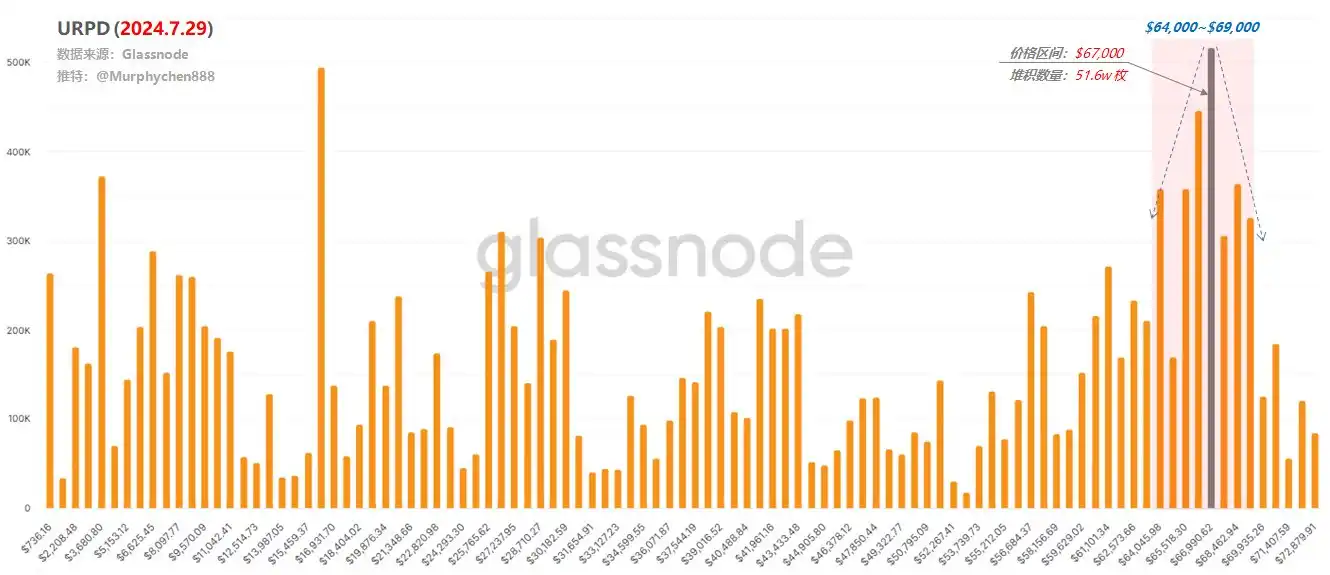
If we must provide an example, a similar chip structure also emerged in July-August 2024 (as shown in Figure 3).
(Figure 3)
At that time, a chip stacking zone was formed in the $64,000 to $69,000 range, with a massive volume candle of 52k BTC created at $67,000 as the peak, gradually decreasing towards both sides, forming a regional price support. I believe everyone still remembers that for a long time after this, the price of BTC did not fall below this price range. Even when it started moving away from this range on August 5 and September 7, the chip structure in this range remained intact. After some time, the price of BTC will return to this range (experiencing gravitational pull).
If we compare the current structure with the horizontal structure in July, the patterns are very similar, but the current one is not as robust yet. Nevertheless, it has already shown a clear support role. Over time, as the turnover becomes more extensive here, the support effect will be stronger. Of course, if the price continues to break upwards, unless it surges quickly away from this price range, it will also be constrained by "gravity" (short-term high-level chips will create massive selling pressure).
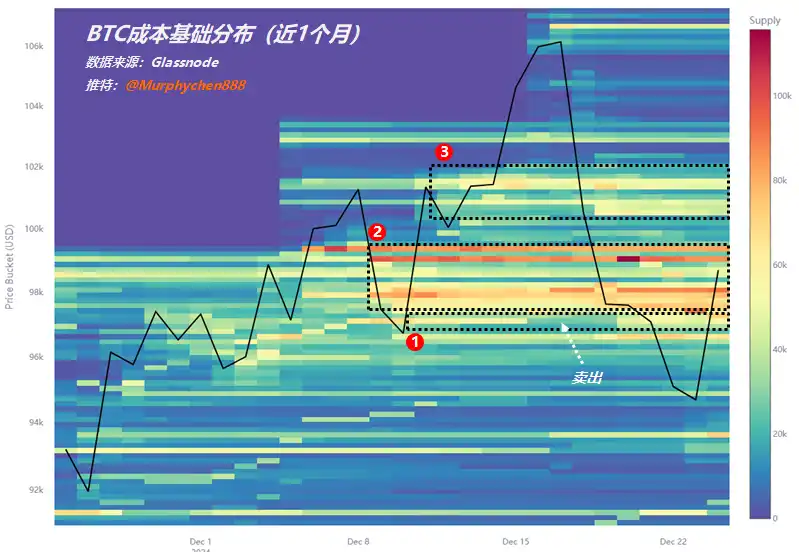
We can also observe similar conclusions from CBD data from another perspective (as shown in Figure 4).
(Figure 4)
Unlike the URPD, which tracks the analysis of the original UTXO, the CBD (BTC Cost Basis Distribution) conducts data calculations per address. It better represents the overall behavior of network participants and can clearly display the trend of cost basis changes over time.
From Figure 4, we can see that as the BTC price retraced to below $100,000 on 12/8, the color changed from green to red, indicating an increase in the money supply (see Point 2). This suggests that a significant amount of bottom-fishing behavior occurred at that time. The chips bought during this period did not show a significant decrease even after the rebound on 12/16 and the subsequent fall on 12/23, with the cost basis remaining around $97,000-$100,000, forming effective support.
Additionally, the chips bought at the low point of $96,000 during the retracement on 12/10 were sold when the price rebounded to $105,000 on 12/16, causing the color to change from red to green (see Point 1). However, when the price retraced again to around $96,000 on 12/21, funds started to buy in. This group is likely engaged in short-term swing trading and represents the main group of on-chain turnover in recent days (STH).
The remaining chips trapped at high prices between $100,000 and $102,000 also account for a significant portion, but they are relatively firm in their positions. Currently, there is no significant decrease in their numbers.
In conclusion, the current market sentiment is gradually calming down, and liquidity is decreasing. However, the chip structure remains "healthy," with the price support formed in the $92,000-$100,000 range proving to be effective. As time passes and turnover increases, the support will strengthen (determining the lower limit). Whether we can see a new all-time high or reverse the trend decline will depend on the market's expectations of macro policies after entering January of the 25th year.
This content is for communication and research purposes only and should not be considered investment advice.
You may also like

The other side of Musk's trillion-dollar fortune: 85% cannot be sold

The U.S. government prohibits foreigners from using Fable 5, Anthropic issues a rebuttal

Citibank releases "2030 Asset Tokenization Market Outlook": 6 major trends may create a $8.2 trillion market

The trillion-dollar valuation test: Are the three major super IPOs a celebration for tech stocks or a nightmare for the crypto market?

Morning Report | Digital Asset completes $355 million financing led by a16z Crypto; Meta completes operational separation from Manus

a16z Crypto Partner: Cash flow is the moat

Cryptocurrency market makers collectively seek change as it becomes increasingly difficult to make money

How TradeXYZ, xStocks, and Alpaca break down the SpaceX IPO into three different strategies
$75 billion in risk asset redistribution: How will SpaceX's IPO affect U.S. stocks and Bitcoin?

Why Is BlackRock Investing $5 Billion in the SpaceX IPO?
Morning News | CME Group launches Nasdaq Cryptocurrency Index futures; Asset management giant Janus Henderson strategically invests in Ethena

Bitcoin Layer 2 Network Botanix: Why Did We Choose to Dissolve?

Why did Oracle deliver the strongest financial report in history, yet its stock price fell?
When the P2P illicit funds from ten years ago turned into 60,000 bitcoins
Dialogue with OmenX Founder: Why does the prediction market need an evolution from "spot" to "derivatives"?
Galaxy in-depth report: Is Solana still worth paying attention to?
Young people in South Korea make a "final effort" in the epic bull market
The pricing controversy of Trade.xyz exposes the fatal weakness of Pre-IPO perpetual contracts
The other side of Musk's trillion-dollar fortune: 85% cannot be sold
The U.S. government prohibits foreigners from using Fable 5, Anthropic issues a rebuttal
Citibank releases "2030 Asset Tokenization Market Outlook": 6 major trends may create a $8.2 trillion market
The trillion-dollar valuation test: Are the three major super IPOs a celebration for tech stocks or a nightmare for the crypto market?
Morning Report | Digital Asset completes $355 million financing led by a16z Crypto; Meta completes operational separation from Manus
a16z Crypto Partner: Cash flow is the moat


