
 Buy Crypto
- Markets
 Futures
- Spot
- Copy Trade
- Earn
- More
Cyber Capital Founder: Ripple is Fully Centralized, Please Remain Vigilant

Original Author: Justin Bons, Founder of Cyber Capital
Original Translator: Luffy, Foresight News
Ripple (XRP) is a centralized and permissioned network, contrary to statements made by its executives. XRP misleads investors by falsely claiming its decentralized nature when, in fact, the network is fully controlled by the foundation.
The XRP consensus is based on a Unique Node List (UNL), where trusted nodes are determined by a centralized entity (including the foundation). The XRP consensus is not based on PoS or PoW but on PoA (Proof of Authority), yet they claim to be more decentralized than Bitcoin and Ethereum...
All of this is supported by Ripple's own documentation, and it's hard to find any researchers outside of XRP who would classify this design as "decentralized"; however, they are deceiving the public.
However, users can modify their UNL and choose whom to trust. The language used here is very subtle. A truly decentralized cryptocurrency is "trustless" because it requires no "trust" at all, and choosing whom to trust is entirely different from being trustless!
XRP is not trustless at all, and what's worse is: if your UNL does not overlap sufficiently with the rest of the network, you are at risk. According to Ripple's documentation: a 90% UNL overlap is required to prevent forks.
This means that in practice, you need direct permission from the XRP foundation to participate in the consensus, which is almost centralization in terms of blockchain design... Let's take a deeper look at these UNLs below.
We have established that the UNL is the trusted third party chosen by the XRP foundation, and as we delve deeper into these UNLs, this point is further confirmed: for a long time, there was only one UNL, the dUNL managed by the XRP foundation.
However, this list is not static but dynamic. The XRP foundation can, in a completely centralized manner, change the list of validators without any notice, kicking out anyone who violates authority.
Over time, now there are two UNLs, namely the dUNL and XRPLF, both directly funded by the XRP foundation. This adds another layer of de facto control over the network; let me explain:
Blockchain allows mutually untrusting parties to coordinate, all thanks to the underlying incentive mechanism (PoS or PoW). However, XRP lacks block rewards and incentives; it is purely based on trust. So, how do different Unique Node Lists (UNLs) coordinate with each other?
XRP's premise is based on the idea that different parties can spontaneously organize around a new UNL without the need for the aforementioned incentive mechanism. This notion is clearly fallacious because this is precisely the problem blockchain aims to solve: a new UNL cannot achieve coordination.
If a new UNL cannot coordinate, it means the foundation holds de facto control. Control over validators equals control over the network, resembling a permissioned blockchain.
In all other blockchains, you cannot choose validators as they are trustless and permissionless. This is why validators can be anonymous—secured by cryptoeconomic game theory, not trust. This is the fundamental difference of XRP.
XRP is fundamentally not a cryptocurrency. Since it is neither PoS nor PoW, it is a PoA. What else could it be? A consensus algorithm requires a validation mechanism, with trust as the system’s foundation, thus: XRP is a PoA!
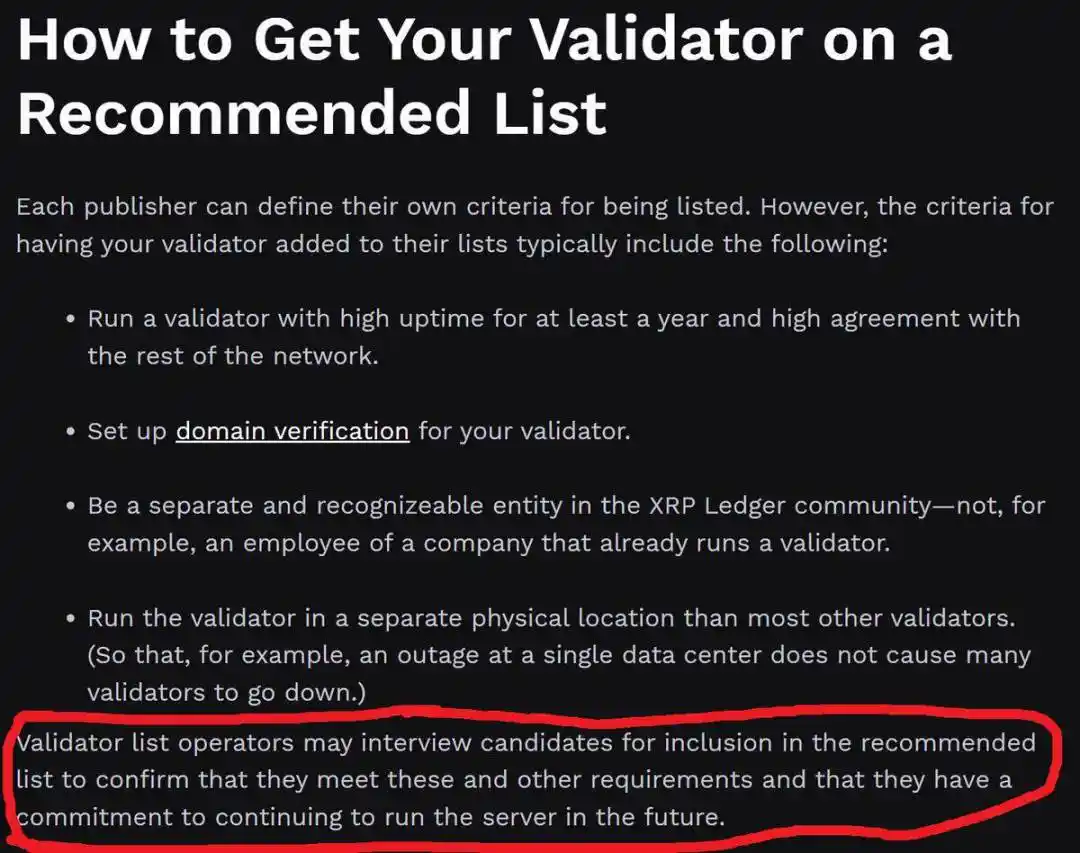
A PoA system always has a central authority to appoint validators. So, what about the fact that there are currently two "official" UNLs? This fact contradicts my assertion that different UNLs cannot coordinate. This is where things truly start to get crazy:
Upon careful inspection, I discovered that all UNLs are, in fact, identical, using the same set of validators, further proving that the foundation effectively controls the XRP network!
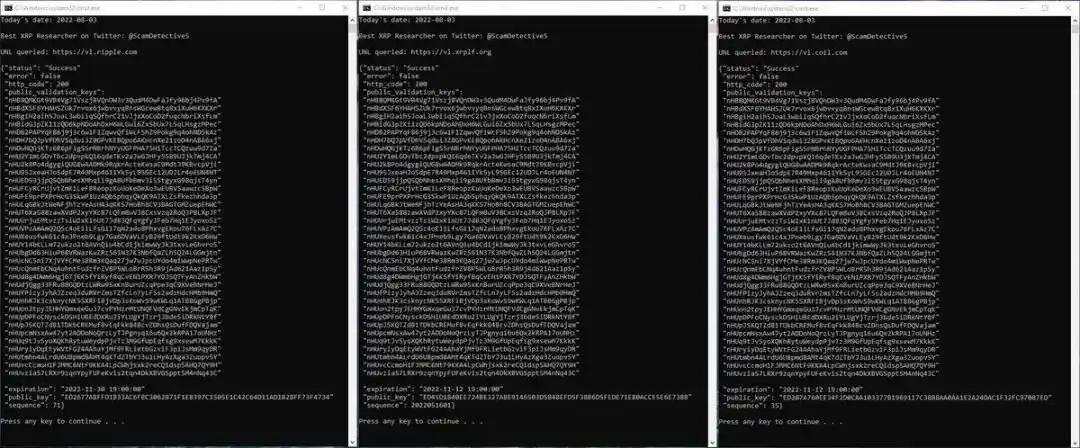
This screenshot is from 2 years ago, but I confirm the situation remains the same today, demonstrating that new UNLs cannot coordinate. Thus, the foundation's list becomes the de facto list since all UNLs must comply, or there is a risk of fork.
This also allows the foundation to conduct audits if compelled, given their high level of control. This operates drastically differently from cryptocurrencies and explains why halting the network only requires 20% of validators...
Running trusted validators also has no incentives. Unlike PoW or PoS, where the cost of attack reflects the block reward to miners/stakers, the decentralized standard heavily relies on block rewards. On XRP, this decentralization measure stands at zero.
I have been researching XRP since the early days, and I vividly remember when people recognized the trade-off of decentralization. As the community and leadership's stance became more extreme, this situation gradually changed. I say this not to disparage investors but to empower them.
Help break the XRP echo chamber and stop being someone else's liquidity out. XRP's pre-mining rate of 99.8% makes it one of the most unfairly distributed cryptocurrencies in history. As no new XRP was created, all newly circulating XRP was purchased from the founders.
I have always been intrigued by the early discussions about Ripple's decentralization, pretending that XRP is permissionless is not the right answer. The real solution is to use PoS to replace the UNL list, transforming XRP into a more traditionally decentralized blockchain.
They could also openly admit that facts are facts, and I will not dispute that. However, using lies to attract ignorant retail investors is wrong. This is where we as an industry need to draw the line and self-regulate!
XRP may currently be able to bribe or deceive the SEC, but they cannot deceive us, the cryptocurrency natives. Regardless of how complex and in-depth the rebuttals may be, it will not change some simple facts: XRP is now fully permissioned and centralized.
If you truly care about XRP, take it seriously. Because within this critical post exists a path that can help XRP succeed: owning up to its centralization or transitioning to decentralization. The truth sets us free, either walk away from XRP or exert pressure for change; nothing is irredeemable.
You may also like

a16z: 5 Ways Blockchain Helps AI Agent Infrastructure

Morning News | The Hong Kong Securities and Futures Commission announced the regulatory framework for secondary market trading of tokenized investment products; Strategy increased its holdings by 34,164 bitcoins last week; KAIO completed a strategic fi...

What Is an XRP Wallet? The Best Wallets to Store XRP (2026 Updated)
An XRP wallet lets you safely store, send, and receive XRP on the XRP Ledger. Learn what wallets support XRP and discover the best XRP wallets for beginners and long-term holders in 2026.

What are the Top AI Crypto Coins? Render vs. Akash: 5 Gems Solving the 2026 GPU Crisis
What are the best AI crypto coins for the 2026 cycle? Beyond the hype, we analyze top tokens like RNDR, AKT, and FET that provide real-world solutions to the global GPU shortage and the rise of autonomous agents.

What Is a Token in AI? What Is an AI Token + 3 Gems You Can't Miss in 2026
The era of AI hype has transitioned into an era of utility. As we move through Q2 2026, the market is no longer rewarding "narrative-only" projects. At WEEX Research, we are seeing a massive capital rotation into Decentralized Compute (DePIN) and Autonomous Agent coordination layers. This guide analyzes which AI tokens are capturing institutional liquidity and how to spot high-conviction setups in a maturing market.

Consumer-grade Crypto Global Survey: Users, Revenue, and Track Distribution

Prediction Markets Under Bias

Stolen: $290 million, Three Parties Refusing to Acknowledge, Who Should Foot the Bill for the KelpDAO Incident Resolution?

ASTEROID Pumped 10,000x in Three Days, Is Meme Season Back on Ethereum?

ChainCatcher Hong Kong Themed Forum Highlights: Decoding the Growth Engine Under the Integration of Crypto Assets and Smart Economy

Why can this institution still grow by 150% when the scale of leading crypto VCs has shrunk significantly?

Anthropic's $1 trillion, compared to DeepSeek's $100 billion

Geopolitical Risk Persists, Is Bitcoin Becoming a Key Barometer?
Annualized 11.5%, Wall Street Buzzing: Is MicroStrategy's STRC Bitcoin's Savior or Destroyer?
An Obscure Open Source AI Tool Alerted on Kelp DAO's $292 million Bug 12 Days Ago

Mixin has launched USTD-margined perpetual contracts, bringing derivative trading into the chat scene.
The privacy-focused crypto wallet Mixin announced today the launch of its U-based perpetual contract (a derivative priced in USDT). Unlike traditional exchanges, Mixin has taken a new approach by "liberating" derivative trading from isolated matching engines and embedding it into the instant messaging environment.
Users can directly open positions within the app with leverage of up to 200x, while sharing positions, discussing strategies, and copy trading within private communities. Trading, social interaction, and asset management are integrated into the same interface.
Based on its non-custodial architecture, Mixin has eliminated friction from the traditional onboarding process, allowing users to participate in perpetual contract trading without identity verification.
The trading process has been streamlined into five steps:
· Choose the trading asset
· Select long or short
· Input position size and leverage
· Confirm order details
· Confirm and open the position
The interface provides real-time visualization of price, position, and profit and loss (PnL), allowing users to complete trades without switching between multiple modules.
Mixin has directly integrated social features into the derivative trading environment. Users can create private trading communities and interact around real-time positions:
· End-to-end encrypted private groups supporting up to 1024 members
· End-to-end encrypted voice communication
· One-click position sharing
· One-click trade copying
On the execution side, Mixin aggregates liquidity from multiple sources and accesses decentralized protocol and external market liquidity through a unified trading interface.
By combining social interaction with trade execution, Mixin enables users to collaborate, share, and execute trading strategies instantly within the same environment.
Mixin has also introduced a referral incentive system based on trading behavior:
· Users can join with an invite code
· Up to 60% of trading fees as referral rewards
· Incentive mechanism designed for long-term, sustainable earnings
This model aims to drive user-driven network expansion and organic growth.
Mixin's derivative transactions are built on top of its existing self-custody wallet infrastructure, with core features including:
· Separation of transaction account and asset storage
· User full control over assets
· Platform does not custody user funds
· Built-in privacy mechanisms to reduce data exposure
The system aims to strike a balance between transaction efficiency, asset security, and privacy protection.
Against the background of perpetual contracts becoming a mainstream trading tool, Mixin is exploring a different development direction by lowering barriers, enhancing social and privacy attributes.
The platform does not only view transactions as execution actions but positions them as a networked activity: transactions have social attributes, strategies can be shared, and relationships between individuals also become part of the financial system.
Mixin's design is based on a user-initiated, user-controlled model. The platform neither custodies assets nor executes transactions on behalf of users.
This model aligns with a statement issued by the U.S. Securities and Exchange Commission (SEC) on April 13, 2026, titled "Staff Statement on Whether Partial User Interface Used in Preparing Cryptocurrency Securities Transactions May Require Broker-Dealer Registration."
The statement indicates that, under the premise where transactions are entirely initiated and controlled by users, non-custodial service providers that offer neutral interfaces may not need to register as broker-dealers or exchanges.
Mixin is a decentralized, self-custodial privacy wallet designed to provide secure and efficient digital asset management services.
Its core capabilities include:
· Aggregation: integrating multi-chain assets and routing between different transaction paths to simplify user operations
· High liquidity access: connecting to various liquidity sources, including decentralized protocols and external markets
· Decentralization: achieving full user control over assets without relying on custodial intermediaries
· Privacy protection: safeguarding assets and data through MPC, CryptoNote, and end-to-end encrypted communication
Mixin has been in operation for over 8 years, supporting over 40 blockchains and more than 10,000 assets, with a global user base exceeding 10 million and an on-chain self-custodied asset scale of over $1 billion.

$600 million stolen in 20 days, ushering in the era of AI hackers in the crypto world
Vitalik's 2026 Hong Kong Web3 Summit Speech: Ethereum's Ultimate Vision as the "World Computer" and Future Roadmap
a16z: 5 Ways Blockchain Helps AI Agent Infrastructure
Morning News | The Hong Kong Securities and Futures Commission announced the regulatory framework for secondary market trading of tokenized investment products; Strategy increased its holdings by 34,164 bitcoins last week; KAIO completed a strategic fi...
What Is an XRP Wallet? The Best Wallets to Store XRP (2026 Updated)
An XRP wallet lets you safely store, send, and receive XRP on the XRP Ledger. Learn what wallets support XRP and discover the best XRP wallets for beginners and long-term holders in 2026.
What are the Top AI Crypto Coins? Render vs. Akash: 5 Gems Solving the 2026 GPU Crisis
What are the best AI crypto coins for the 2026 cycle? Beyond the hype, we analyze top tokens like RNDR, AKT, and FET that provide real-world solutions to the global GPU shortage and the rise of autonomous agents.
What Is a Token in AI? What Is an AI Token + 3 Gems You Can't Miss in 2026
The era of AI hype has transitioned into an era of utility. As we move through Q2 2026, the market is no longer rewarding "narrative-only" projects. At WEEX Research, we are seeing a massive capital rotation into Decentralized Compute (DePIN) and Autonomous Agent coordination layers. This guide analyzes which AI tokens are capturing institutional liquidity and how to spot high-conviction setups in a maturing market.






 App
App