
 Buy Crypto
- Markets
 Futures
- Spot
- Copy Trade
- Earn
- More
「Creator Tokenization」 Narrative Emerges, Will It Be the Next Billion-Dollar Market?

Original Article Title: Liquid Markets for Creators Coins - $100B Market Opportunity
Original Article Author: hitesh.eth, Founder of dyorcryptoapp
Original Article Translation: Ashley, BlockBeats
Editor's Note: This article explores how creator tokenization enables fans, investors, and brands to directly participate in a creator's growth, driving market-based trading and value discovery. With the creator economy surpassing $500 billion, a tokenization model can empower brands to secure early partnership opportunities and allow fans to co-create business decisions through DAO governance. The financialization of the creator economy is becoming an inevitable trend in the Web3 era, potentially reshaping the interaction between social media and financial markets.
The following is the original article content (slightly reorganized for clarity):
Creators are essentially like a startup, but a key difference is that in a startup, investors can invest at different stages and bet on its growth, whereas in the creator space, fans or investors previously couldn't directly participate in their growth. Whether it's a startup or a creator, the core of growth lies in whether consumers are willing to pay for their product or service. A startup's product or service usually revolves around a specific problem to be solved, while a creator's product is their content itself. This content, as a product, is tailored to different interest-driven niche markets, catering to various audience needs.
The Speculative Nature of Startups and Creators
Startups operate in a highly speculative environment, with investors betting on early-stage companies, hoping they will scale rapidly and become profitable. A startup's valuation typically depends on market attractiveness, user growth, and revenue potential. This speculative logic also applies to creators, but there is currently no formalized investment structure that allows fans or traders to participate in a creator's growth. The lack of liquidity in the creator economy signifies an untapped market opportunity—if creators can be tokenized, speculators can bet on their growth potential just like they would on a startup.
Speculating on creators could be a significant opportunity for traders and investors. Just as startups go through hype cycles where their valuation fluctuates with market recognition, creators also experience similar cycles—growing in influence due to viral spread, strategic partnerships, and media exposure. A creator's reputation, engagement rate, and ability to convert traffic into revenue are all quantifiable metrics that can serve as the speculative basis for their tokenized value.
The Creator's 0-1 and 1-10 Journey
The growth journey of a creator is similar to that of a startup, going through the 0-1 and 1-10 stages.
· 0-1 Stage: This means breaking barriers, entering a niche market, building an initial audience, and continuously optimizing content strategy. Many creators stop at this stage, just as many startups fail before finding product-market fit.
· 1-10 Stage: This means scaling up. Creators at this stage start securing brand partnerships, receiving commercial sponsorships, and achieving traffic monetization. At this stage, creators are no longer just content producers but are gradually growing into a full-fledged business entity. This transformation is similar to a startup evolving from a small team into a mature company.
Today, many consumer startups and creators have become part of the same ecosystem, with a similar goal: to sell two products to users— the content itself and brand integrations within the content.
The Scale and Future Potential of the Creator Economy
The creator economy has grown into a multi-billion-dollar industry, with the market size expected to surpass $500 billion in the next decade. Currently, millions of creators produce content daily, and brands are investing significant sums in influencer marketing. In 2023 alone, global spending on influencer marketing exceeded $20 billion, and as brand budgets shift towards digital-native advertising, this number continues to grow.
The tokenization of the creator economy is poised to create an entirely new asset class. Within the next three years, the valuation of the creator token market could easily reach $100 billion as more creators adopt token-based monetization models. Establishing a liquid creator token trading market will provide investors with a new speculative domain, allowing them to bet on emerging influencers and forming a price discovery mechanism based on social influence, audience growth, and brand partnership flow.
Creator Tokens and Brand Partnerships
From a brand perspective, early engagement with creator partnerships is crucial. Brands often seek to establish partnerships at discounted rates before a creator becomes hugely popular. With the tokenization of creators, brands can benefit from purchasing and holding their tokens during their influence growth. This not only provides brands with preferential partnership rights but also ensures that they have access to more valuable ad placement resources once the creator succeeds.
If the value of creator tokens rises with the growth of influence, brands holding these tokens can also benefit from discounted sponsorship costs and capital appreciation. This model makes brands more willing to invest in potentially successful creators for the long term rather than just paying one-time ad fees.
Fans as Brand Managers: Collaborating on DAO Governance
By introducing a DAO governance model, fans can deeply engage in creators' business decisions, fundamentally transforming the way brand collaborations are conducted.
· Fan Voting Decisions: Creator's brand collaborations will be collectively decided by DAO members (i.e., token holders) through voting, rather than unilaterally by the creator. This ensures that brand collaborations align with the creator's audience needs and values.
· Revenue Sharing: The revenue generated from brand collaborations can be distributed to governance token holders through a staking reward mechanism, making them direct beneficiaries of the creator's growth.
As long as the creator remains popular, their influence and traffic will continue to grow, further driving token trading volume and investor interest, thereby increasing the value of the creator's token. The DAO will act as a decentralized brand manager, ensuring transparency and fairness in partnerships, and providing a sustainable profit model for the creator and their community.
The Future of Creator Tokenization
Creator tokenization is not just a conceptual innovation but an inevitable trend in the digital economy. The emergence of Web3, DeFi, and tokenized assets has created the perfect environment for the thriving creator token market. The speculative market built around the creator economy could fundamentally alter the power dynamics of social media, enabling creators, brands, and fans to participate in a whole new financial system.
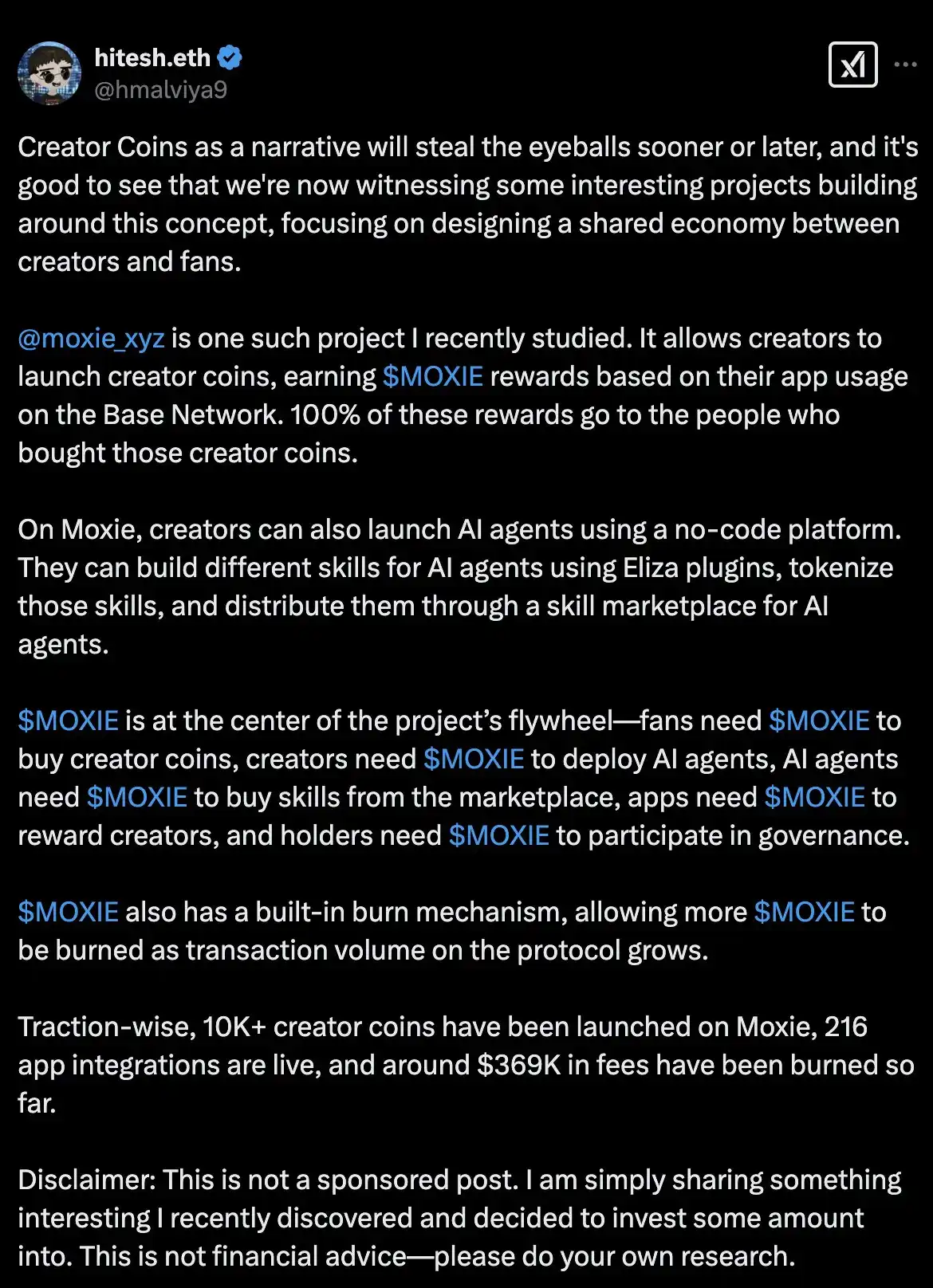
As the creator economy continues to expand, tokenization applications are expected to unlock unprecedented opportunities, bridging the gap between influence and the financial markets. Over the next three years, we may witness the comprehensive liquidity of the creator token market, making the entire creator economy more transparent, tradable, and scalable than ever before.
You may also like

6MV Founder: In 2026, the "landmark turning point" for crypto investment has arrived

Abraxas Capital Mints $2.89 Billion USDT: Liquidity Boost or Just More Stablecoin Arbitrage?
Abraxas Capital just received $2.89 billion in freshly minted USDT from Tether. Is this a bullish liquidity injection for crypto markets, or is it business as usual for a stablecoin arbitrage giant? We analyze the data and the likely impact on Bitcoin, altcoins, and DeFi.
A VC from the Crypto world said AI is too crazy, and they are very conservative
The Evolutionary History of Contract Algorithms: A Decade of Perpetual Contracts, the Curtain Has Yet to Fall

Kicked out by PayPal, Musk aims to make a comeback in the cryptocurrency market

Solana ETF News: What Is a Solana ETF and Why Is Goldman Sachs Betting $108 Million on SOL?
Solana ETF news today shows Goldman Sachs disclosed a $108M position while total SOL ETF inflows reached $1.45B. Analysts now expect up to $6B in institutional demand as Solana trades 71% below its all-time high.

Bitcoin ETF News Today: $2.1B Inflows Signal Strong Institutional Demand for BTC
Bitcoin ETFs news recorded $2.1B inflows over 8 consecutive days, marking one of the strongest recent accumulation streaks. Here’s what the latest Bitcoin ETF news means for BTC price and whether the $80K breakout level is next.
Michael Saylor: Winter is Over – Is He Right? 5 Key Data Points (2026)
Michael Saylor tweeted yesterday “Winter‘s Over.” It is short. It is bold. And it has the crypto world talking.
But is he right? Or is this just another CEO pumping his bags?
Let us look at the data. Let us be neutral. Let us see if the ice has really melted.

WEEX Bubbles App Now Live Visualizes the Crypto Market at a Glance
WEEX Bubbles is a standalone app designed to help users quickly understand complex crypto market movements through an intuitive bubble visualization.

Polygon co-founder Sandeep: Writing after the chain bridge chain explosion

Major Upgrade on Web: 10+ Advanced Chart Styles for Deeper Market Insights
To deliver more powerful and professional analysis tools, WEEX has rolled out a major upgrade to its web trading charts—now supporting up to 14 advanced chart styles.

Morning Report | Aethir secures a $260 million enterprise contract with Axe Compute; New Fire Technology acquires Avenir Group's trading team; Polymarket's trading volume surpassed by Kalshi

Why a Million-Follower Crypto KOL Chooses WEEX VIP?
Discover why top crypto KOL Carl Moon partnered with WEEX. Explore the WEEX VIP ecosystem, 1,000 BTC protection fund, and exclusive rewards for serious traders.

CoinEx Founder: The Crypto Endgame in My Eyes

Spark Coin (SPK): Explodes 73% as Aave Bleeds $15B, A Good Investment Now?
Spark coin (SPK) surged 73% as $15 billion fled Aave after the KelpDAO hack. This article explains what Spark is, why it’s pumping, and whether it is a good investment right now.

As Aave's building collapses, Spark's high-rise is rising

RootData: Q1 2026 Cryptocurrency Exchange Transparency Research Report

What Is Memecoin Trading? A Beginner's Guide to How It Works, the Risks, and 2026's Hottest Tokens
Memecoins surged 30%+ at the start of 2026 while Bitcoin was flat. RAVE spiked 4,500% then crashed 90% in days. MAGA jumped 350% overnight. This guide explains exactly how memecoin trading works — and how to not blow up your account doing it.
6MV Founder: In 2026, the "landmark turning point" for crypto investment has arrived
Abraxas Capital Mints $2.89 Billion USDT: Liquidity Boost or Just More Stablecoin Arbitrage?
Abraxas Capital just received $2.89 billion in freshly minted USDT from Tether. Is this a bullish liquidity injection for crypto markets, or is it business as usual for a stablecoin arbitrage giant? We analyze the data and the likely impact on Bitcoin, altcoins, and DeFi.
A VC from the Crypto world said AI is too crazy, and they are very conservative
The Evolutionary History of Contract Algorithms: A Decade of Perpetual Contracts, the Curtain Has Yet to Fall
Kicked out by PayPal, Musk aims to make a comeback in the cryptocurrency market
Solana ETF News: What Is a Solana ETF and Why Is Goldman Sachs Betting $108 Million on SOL?
Solana ETF news today shows Goldman Sachs disclosed a $108M position while total SOL ETF inflows reached $1.45B. Analysts now expect up to $6B in institutional demand as Solana trades 71% below its all-time high.


 App
App