
 Buy Crypto
- Markets
 Futures
- Spot
- Copy Trade
- Earn
- More
BlackRock Leads $5 Million Investment in Perpetual Protocol DEX, How Does Vest Fight Against the "Crypto Scythe"?

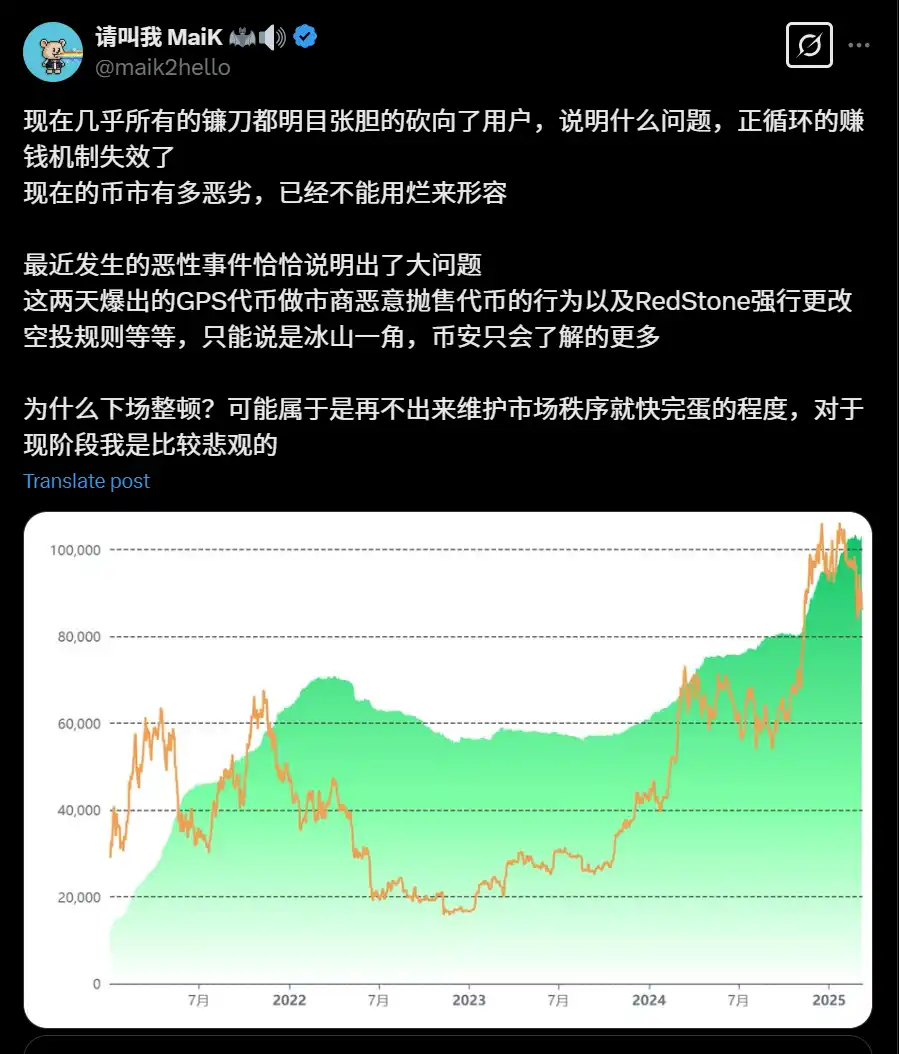
Recently, the cryptocurrency community was once again thrown into chaos, with the emergence of allegations of malicious selling by a GPS token market maker, causing a sharp drop in the token's price and instant substantial losses for investors. The RedStone project was also accused of last-minute changes to its airdrop rules, leaving numerous long-awaited community members empty-handed.
These events inevitably bring to mind the chronic issues of the cryptocurrency world: asymmetric information, whimsical rule changes, and the strong preying on the weak. As Twitter user @maik2hello lamented in a post, "The current coin market is beyond 'messy'."
The traditional financial markets have long had precedents of chaos: market makers manipulating prices, rampant insider trading. In the unregulated crypto market, these problems are exacerbated, and retail investors have almost nowhere to escape.
It is against this backdrop that the Vest project emerged, carrying a clear mission to reshape fairness through technology and mechanisms.
Seeing Injustice Amidst a Market Collapse, Vest's Mission
Vest is a quantitative research company dedicated to building real-time, universal risk pricing financial infrastructure. Its core product, Vest Exchange, is a decentralized perpetual contract trading platform.
Vest's Core Product—Vest Exchange
Unlike traditional CEXs or some DEXs that rely on order books and market makers, Vest Exchange ensures the transparency and fairness of transaction pricing through state-of-the-art cryptographic technology. It is like fitting a "firewall" to the crypto market, precisely combating common liquidity issues and market manipulation seen in traditional markets.
In traditional order book exchanges, traders are often squeezed by institutional and high-frequency traders' "predatory strategies"—such as front-running or price manipulation. At Vest Exchange, each transaction directly matches with a unified liquidity pool and is dynamically priced by the zkRisk engine, eliminating unfair competition.
zkRisk: A Transparent Risk Pricing Engine, Vest's "Brain"
zkRisk is the core pricing mechanism of Vest Exchange, serving as the platform's "super-intelligent steward." It dynamically monitors individual positions, account risk exposure, and overall system risk, adjusting pricing based on market dynamics with the goal of minimizing risk rather than maximizing profit.
Through zkRisk, Vest has established a "fair playing field": no one can "front-run" through unfair means, the impact of market fluctuations on trades is minimized, and liquidity remains stable.
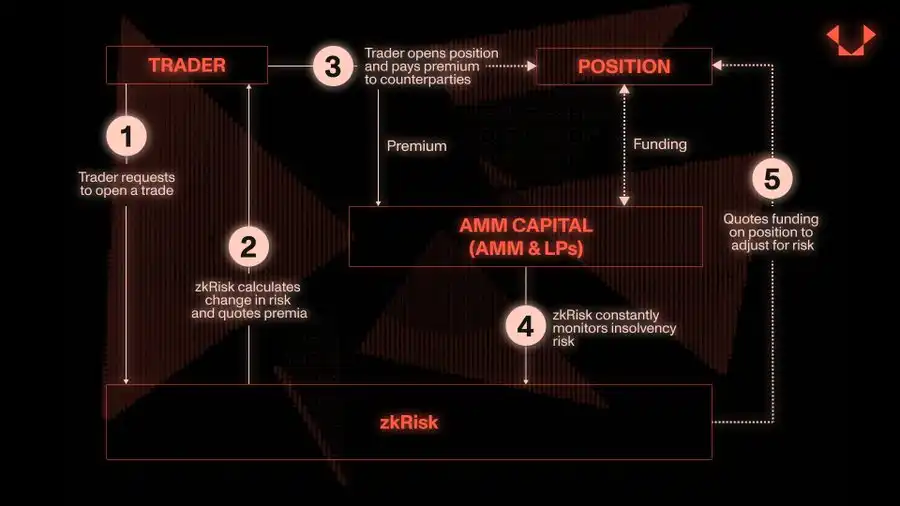
More importantly, zkRisk makes transaction fees fully transparent. Fees are directly tied to the introduced risk, eliminating the opaque and confusing costs present in traditional markets. This design not only protects users but also ensures privacy and security through zero-knowledge proof technology, avoiding common issues like Miner Extractable Value (MEV).
Vest's technology is like the "supercar" of the blockchain world—fast, efficient, and smart enough to navigate complex market environments.
Funding Details and Backers
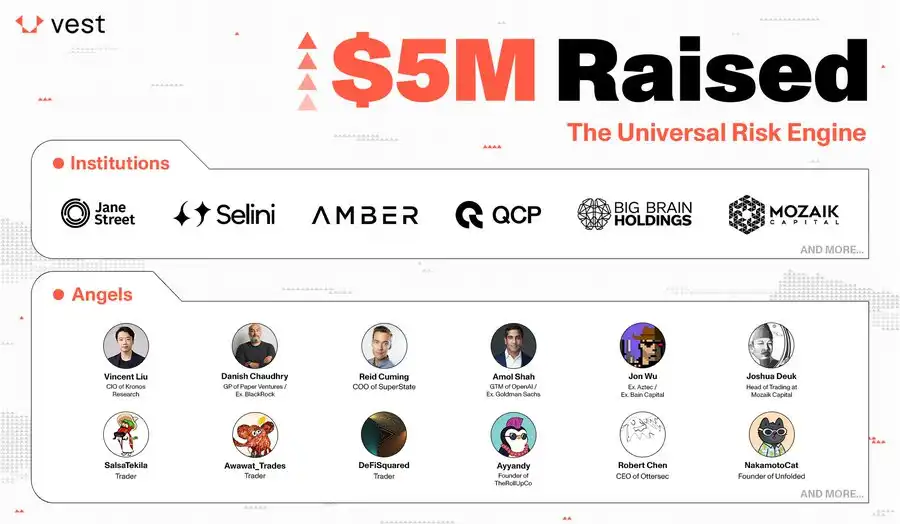
According to BlockBeats news, on March 12, trading protocol Vest announced a $5 million funding round, with participation from BlackRock, Jane Street Group, Selini Capital, Amber Group, QCQ Group, and Big Brain VC, among others. This investor lineup demonstrates Vest's bridging role between traditional finance and the crypto ecosystem.
Although the specific identities of the Vest team have not been disclosed, receiving the approval of BlackRock and Jane Street indicates that the team likely comprises top talent from both blockchain development and the traditional financial sector.
The support of these heavyweight institutions not only provides Vest with financial backing but may also bring strategic guidance and market credibility. Additionally, the involvement of crypto-native entities like Amber Group offers practical support for Vest's product implementation and ecosystem expansion.
From Ondo to Vest: BlackRock's On-Chain Maneuver
As the world's largest asset management company, BlackRock has been making frequent moves recently, and its ambitions in on-chain infrastructure are evident from tokenized funds to RWA. In March 2024, its tokenized fund BUIDL (tokenizing traditional financial assets primarily cash, U.S. Treasury Bills, and repurchase agreements) launched on Ethereum, quickly attracting $5.2 billion in assets, capturing nearly a third of the tokenized corporate bond market.
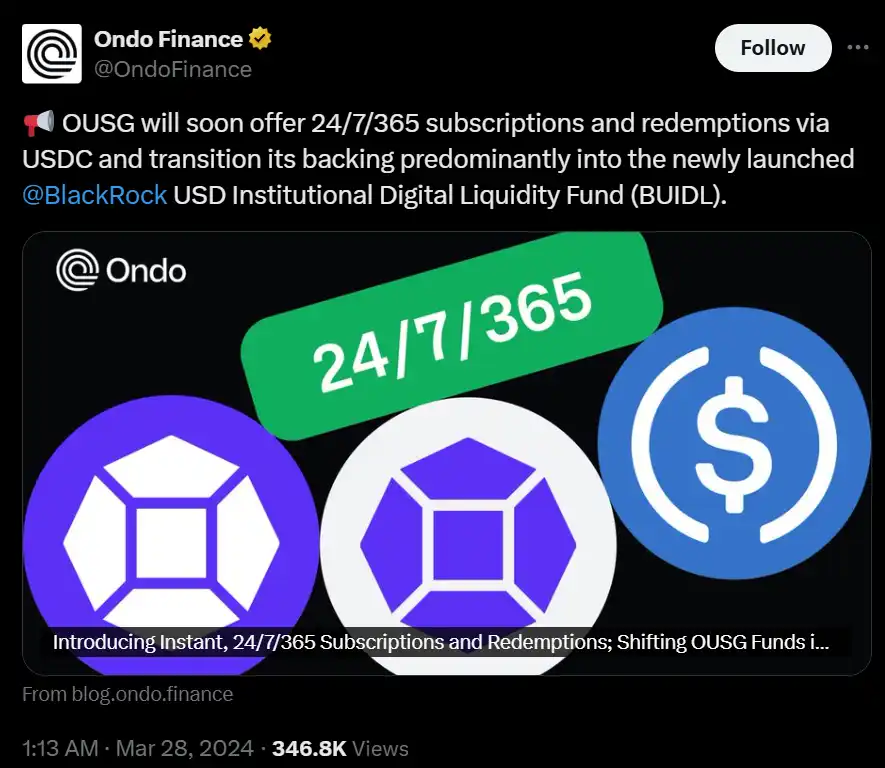
Subsequently, BlackRock, through partnerships with institutions like Securitize, has driven the RWA market from $100 million in 2023 to over $13 billion. Looking at another aspect of the chessboard, Ondo Finance, with its OUSG token directly pegged to BUIDL, provides retail investors with a channel for investing in tokenized corporate bonds, while Vest's entry completes BlackRock's positioning in the on-chain derivatives market.
The prosperity of the RWA market will undoubtedly bring greater liquidity to the Perp DEX market. Vest Exchange, with its zkRisk engine and zkps, is committed to building a fair and efficient Perp DEX, aligning with BlackRock's goal of transparency and liquidity.
It can be foreseen that if Vest can combine a Hyperliquid-style high-performance architecture (zero gas fees + on-chain order book), it may become the next breakthrough in BlackRock's on-chain strategy. From Ondo's asset tokenization to Vest's trading innovation, BlackRock is using technology as a pawn, laying out a grand chessboard of deep integration between traditional finance and crypto.
As BlackRock's CEO Larry Fink said: Tokenized securities are the "next generation of the market."
You may also like

How to balance risk and return in DeFi yields?

Tom Lee's Ethereum Thesis: Why the Man Who Called the Last Cycle Is Doubling Down on Bitmine
Tom Lee is emerging as one of Ethereum’s most influential supporters. From Fundstrat to Bitmine, his Ethereum thesis combines staking yield, treasury accumulation, and long-term network value. Here is why “Tom Lee Ethereum” has become one of crypto’s most watched narratives.
Naval personally takes the stage: The historic collision between ordinary people and venture capital

a16z Crypto: 9 Charts to Understand the Evolution Trends of Stablecoins

Refutation of Yang Haipo's "The End of Cryptocurrency"

Can a hairdryer earn $34,000? Interpreting the reflexivity paradox of prediction markets

6MV Founder: In 2026, the "landmark turning point" for crypto investment has arrived

Abraxas Capital Mints $2.89 Billion USDT: Liquidity Boost or Just More Stablecoin Arbitrage?
Abraxas Capital just received $2.89 billion in freshly minted USDT from Tether. Is this a bullish liquidity injection for crypto markets, or is it business as usual for a stablecoin arbitrage giant? We analyze the data and the likely impact on Bitcoin, altcoins, and DeFi.
A VC from the Crypto world said AI is too crazy, and they are very conservative
The Evolutionary History of Contract Algorithms: A Decade of Perpetual Contracts, the Curtain Has Yet to Fall

Kicked out by PayPal, Musk aims to make a comeback in the cryptocurrency market

Solana ETF News: What Is a Solana ETF and Why Is Goldman Sachs Betting $108 Million on SOL?
Solana ETF news today shows Goldman Sachs disclosed a $108M position while total SOL ETF inflows reached $1.45B. Analysts now expect up to $6B in institutional demand as Solana trades 71% below its all-time high.

Bitcoin ETF News Today: $2.1B Inflows Signal Strong Institutional Demand for BTC
Bitcoin ETFs news recorded $2.1B inflows over 8 consecutive days, marking one of the strongest recent accumulation streaks. Here’s what the latest Bitcoin ETF news means for BTC price and whether the $80K breakout level is next.
Michael Saylor: Winter is Over – Is He Right? 5 Key Data Points (2026)
Michael Saylor tweeted yesterday “Winter‘s Over.” It is short. It is bold. And it has the crypto world talking.
But is he right? Or is this just another CEO pumping his bags?
Let us look at the data. Let us be neutral. Let us see if the ice has really melted.

WEEX Bubbles App Now Live Visualizes the Crypto Market at a Glance
WEEX Bubbles is a standalone app designed to help users quickly understand complex crypto market movements through an intuitive bubble visualization.

Polygon co-founder Sandeep: Writing after the chain bridge chain explosion

Major Upgrade on Web: 10+ Advanced Chart Styles for Deeper Market Insights
To deliver more powerful and professional analysis tools, WEEX has rolled out a major upgrade to its web trading charts—now supporting up to 14 advanced chart styles.
Morning Report | Aethir secures a $260 million enterprise contract with Axe Compute; New Fire Technology acquires Avenir Group's trading team; Polymarket's trading volume surpassed by Kalshi
How to balance risk and return in DeFi yields?
Tom Lee's Ethereum Thesis: Why the Man Who Called the Last Cycle Is Doubling Down on Bitmine
Tom Lee is emerging as one of Ethereum’s most influential supporters. From Fundstrat to Bitmine, his Ethereum thesis combines staking yield, treasury accumulation, and long-term network value. Here is why “Tom Lee Ethereum” has become one of crypto’s most watched narratives.


 App
App