
AI in the Crypto Market: How Artificial Intelligence is Changing Trading Strategies


Crypto markets move fast — sometimes so fast it feels like the price has a mind of its own. One moment you’re holding a position — whether in Bitcoin or Ethereum — the next, a sudden swing wipes out gains or triggers your stop-loss. For years, traders relied on news, rumors, or human emotions — but today, AI has emerged as a major force shaping trading behavior.
AI is no longer just a tool; it is now a central driver of volatility, liquidity, and the rhythm of trading. Understanding how algorithm influences price movements is essential for anyone who wants to navigate crypto successfully.
AI and Market Behavior
High-frequency AI-powered trading systems operate at millisecond speeds, making decisions far faster than humans can. When multiple algorithms respond to the same signals at the same time, emergent behaviors appear. Prices swing sharply, liquidity can vanish, and flash events occur — often without any direct human intervention.
For example, during the so-called “flash crashes” in crypto, prices can drop or spike dramatically within seconds due to algorithmic reactions to order book imbalances. These events illustrate that volatility in AI-driven markets behaves differently from traditional markets: minor imbalances can trigger outsized moves, and sudden reversals form clusters that defy conventional technical analysis.
Liquidity, too, can be deceptive. AI market makers often create deep order books and tight spreads under normal conditions, but when market conditions shift, that liquidity can evaporate instantly, leaving traders unexpectedly exposed.
Challenges for Traders
These AI-driven dynamics introduce new risks for retail traders. Stop-losses are triggered more easily during micro-fluctuations, rapid reversals can turn winning trades into losses, and apparent breakouts may be false signals caused by algorithmic responses rather than market fundamentals. Traditional strategies based on charts or news can lag behind AI responses.
Success now requires a different mindset: instead of trying to predict price direction, traders must learn to read patterns created by algorithms — liquidity shifts, volatility clusters, and cross-exchange discrepancies. These patterns define how the market moves in real time.
How AI Drives Market Dynamics
Modern AI-driven trading algorithms act on signals invisible to most retail traders. They monitor order book imbalances, trading velocity, funding rate changes, and liquidity gaps across exchanges. Many systems use reinforcement learning: observing outcomes, adjusting strategies, and repeating actions that generate profit.
When multiple AI systems operate with similar objectives, their collective actions can amplify volatility. A particularly striking effect is the “self-fulfilling prediction”: an AI may act on a forecast, and when others act similarly, the market behaves as predicted, even without human coordination. This feedback loop can create sudden swings and short-lived price spikes.
Trading Strategies for an AI Market
Navigating an AI-driven market requires observation, patience, and flexibility:
- Watch liquidity, not just price. Understanding the depth of the order book and the flow of trades across exchanges gives insight into real market strength. Avoid heavy positions during low-liquidity periods.
- Adjust stop-losses. Narrow stop-losses are vulnerable to AI micro-movements. Using wider ranges or staggered exits can reduce unnecessary liquidations.
- Recognize volatility patterns. Volatility clusters and flash events often precede false breakouts. Observing these patterns can guide timing and position sizing.
- Exploit short-term opportunities. Temporary liquidity gaps and cross-exchange differences can offer arbitrage potential, turning AI behavior from a challenge into an advantage—if acted upon carefully.
By combining observation with flexible risk management, traders can reduce losses and even capitalize on algorithm-driven opportunities.
Trading in the AI Era
AI has transformed crypto markets from human-driven arenas into ecosystems dominated by algorithmic behavior. Price swings, flash events, and liquidity vacuums are not anomalies — they are emergent properties of interacting AI systems.
Understanding AI market behavior is now as important as mastering charts or news analysis. Traders who can read algorithmic patterns, adjust strategies, and act on fleeting opportunities will be better equipped for the AI-powered future of crypto trading. Continuous learning, observation, and adaptability are no longer optional — they are essential skills for thriving in the modern market.
Watching AI Trading in Action

As AI-driven trading reshapes the crypto market, WEEX brings these strategies to life through the AI Wars: Alpha Awakens Hackathon — a global showdown where top teams trade real assets and make split-second decisions in live markets.
Watching the Hackathon puts you front row to AI trading in action: how algorithms react to volatility, liquidity shifts, and cross-exchange opportunities, all while teams battle on a live leaderboard for a share of the $1880,000 prize pool — including a Bentley for the champion.
Forked Entry closes on January 18. Watch elite teams deploy AI strategies in live markets — or register now and join the battle: https://www.weex.com/events/ai-trading
About WEEX
Founded in 2018, WEEX has developed into a global crypto exchange with over 6.2 million users across more than 150 countries. The platform emphasizes security, liquidity, and usability, providing over 1,200 spot trading pairs and offering up to 400x leverage in crypto futures trading. In addition to traditional spot and derivatives markets, WEEX is expanding rapidly in the AI era — delivering real-time AI news, empowering users with AI trading tools, and exploring innovative trade-to-earn models that make intelligent trading more accessible to everyone. Its 1,000 BTC Protection Fund further strengthens asset safety and transparency, while features such as copy trading and advanced trading tools allow users to follow professional traders and experience a more efficient, intelligent trading journey.
You may also like

AI Crypto Trading in 2026: How AI Agents Use Stablecoins for Capital Management and Settlement
Learn how AI agents use stablecoins for crypto trading in 2026 — managing capital, settling transactions, and operating across exchanges and DeFi protocols.
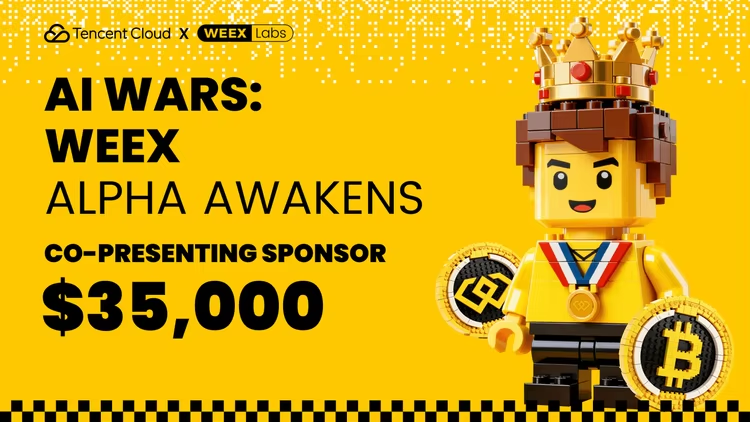
AI Trading's Ultimate Test: Empower Your AI Strategy with Tencent Cloud to Win $1.88M & a Bentley
AI traders! Win $1.88M & a Bentley by crushing WEEX's live-market challenge. Tencent Cloud powers your AI Trading bot - can it survive the Feb 9 finals?

How a Risk-Controlled AI Crypto Trading Bot Protects Capital in Real Markets
Ritmex demonstrates how disciplined risk control and structured signals can make an AI crypto trading bot more stable and reliable on WEEX, highlighting the importance of combining execution discipline with scalable AI trading systems.

How a Structured AI Crypto Trading Bot Won at the WEEX Hackathon
Crypto_Trade shows how structured inputs and controlled adaptability can build a more stable and reliable AI crypto trading bot within the WEEX AI Trading Hackathon, highlighting a practical path toward scalable AI trading systems.

How a Fully Automated AI Trading Bot Won at WEEX Hackathon (From 0 to AI Agent)
Nick’s journey on WEEX shows that successful AI Trading isn’t just about strategy ideas—but about structured AI agents, disciplined execution, and continuous adaptation in real market conditions.

Best AI Crypto Trading Bot? Inside the AI Trading System That Ranked Top 3 on WEEX
Discover the best AI crypto trading bot on WEEX. Learn how AI trading works, how to trade automatically, and why this system stands out among top AI trading apps.

OpenClaw and AI Bots: From AI Trading to BTC Liquidations in the Crypto Gold Rush
AI crypto trading bots like OpenClaw and AI trading apps are reshaping digital markets. From BTC liquidations to crypto bubble charts, automated trading is expanding alongside free crypto airdrops, affiliate programs, LALIGA partnerships, and tokenized gold markets.

From Human Strategy to AI Trading Bot: How Shadow Trading AI Won 2nd Place in the WEEX Hackathon
Ivan’s Shadow Trading AI secured second place in the WEEX AI Trading Hackathon, demonstrating how AI trading systems built on real market expertise can perform under live market conditions.

Who Will Control AI? Why Decentralized AI May Be the Only Alternative to Government and Big Tech
AI has become critical infrastructure, and governments and corporations are competing to control it. Centralized development and regulation are entrenching existing power structures. The Web3 community is building a decentralized alternative — distributed compute, token incentives, and community governance — before that window closes.

WEEX AI Hackathon: How Did This AI Trading Winner Succeed?
A self-taught AI trading enthusiast achieved top-10 results at the WEEX AI Hackathon. Learn about the mindset, AI tools, and lessons behind this impressive performance.

Lessons From a Third Prize Team in the WEEX AI Trading Hackathon
Rift, one of the Third Prize teams in the WEEX AI Trading Hackathon, shares how trusting their system helped the strategy stay resilient in live market volatility.

Champion Crowned at WEEX AI Hackathon: Revealing Strategy That Won $600K
A trader with only 6 months of AI trading experience won $600,000 at the WEEX AI Hackathon. Discover the strategy, tools, and lessons behind this breakthrough victory.

4 AI Trading Strategy Lessons from WEEX Hackathon Finalist
Finalist Bambi shares how AI tools helped turn real trading experience into an automated strategy, why survival-first risk control shaped the system’s design, and how the approach will evolve ahead of WEEX AI Trading Hackathon Season 2.

What Is OpenClaw? How The AI Agent Could Automate Crypto Trading Through APIs
OpenClaw is a rapidly growing AI agent on GitHub that can automate tasks and even execute crypto trades through exchange APIs. Learn how OpenClaw works, how it connects to exchanges, and the risks traders should understand before using AI trading agents.

WEEX AI Hackathon Champions Crowned, Revealing Future of AI Trading
The first-ever WEEX AI Hackathon has concluded, with 10 winners emerging from over 200 global teams. Beyond its $1.8 million prize pool, the event marked a milestone—proving that the future of AI trading belongs to accessible, AI-powered innovation.

Lessons From a Top 10 AI Trading Strategy in the WEEX AI Hackathon
A Top 10 finalist in the WEEX AI Hackathon shares how a market-neutral AI trading system competed against high-leverage strategies in live crypto markets.

From 27th to 4th: The AI Trading "Survivor Strategy" Behind a WEEX Hackathon Comeback
After a logic failure dropped him to 27th place, ClubW_9Kid rebuilt his AI trading framework and finished 4th in the WEEX AI Hackathon. In this interview, he explains the lessons behind disciplined AI execution, risk control, and why survival beats complexity in algorithmic trading.
What Is Vibe Coding? How AI Is Changing Web3 & Crypto Development
What is vibe coding? Learn how AI coding tools are lowering the barrier to Web3 development and enabling anyone to build crypto applications.
AI Crypto Trading in 2026: How AI Agents Use Stablecoins for Capital Management and Settlement
Learn how AI agents use stablecoins for crypto trading in 2026 — managing capital, settling transactions, and operating across exchanges and DeFi protocols.
AI Trading's Ultimate Test: Empower Your AI Strategy with Tencent Cloud to Win $1.88M & a Bentley
AI traders! Win $1.88M & a Bentley by crushing WEEX's live-market challenge. Tencent Cloud powers your AI Trading bot - can it survive the Feb 9 finals?
How a Risk-Controlled AI Crypto Trading Bot Protects Capital in Real Markets
Ritmex demonstrates how disciplined risk control and structured signals can make an AI crypto trading bot more stable and reliable on WEEX, highlighting the importance of combining execution discipline with scalable AI trading systems.
How a Structured AI Crypto Trading Bot Won at the WEEX Hackathon
Crypto_Trade shows how structured inputs and controlled adaptability can build a more stable and reliable AI crypto trading bot within the WEEX AI Trading Hackathon, highlighting a practical path toward scalable AI trading systems.
How a Fully Automated AI Trading Bot Won at WEEX Hackathon (From 0 to AI Agent)
Nick’s journey on WEEX shows that successful AI Trading isn’t just about strategy ideas—but about structured AI agents, disciplined execution, and continuous adaptation in real market conditions.
Best AI Crypto Trading Bot? Inside the AI Trading System That Ranked Top 3 on WEEX
Discover the best AI crypto trading bot on WEEX. Learn how AI trading works, how to trade automatically, and why this system stands out among top AI trading apps.


