
AI Agents Are Replacing Crypto Research? How Autonomous AI Is Reshaping Crypto Trading


Main Takeaways
- AI is moving from assisting traders to automating the entire research-to-execution process in crypto markets.
- The edge has shifted from human insight to data pipelines, speed, and execution-ready AI systems, making delays in AI integration a competitive disadvantage.

For years, artificial intelligence in trading was framed as an assistant: a faster calculator, a better signal generator, a tool to optimize backtests or scan charts. Human researchers still sat at the center of the decision-making process, translating macro views, on-chain insights, and market narratives into trades.
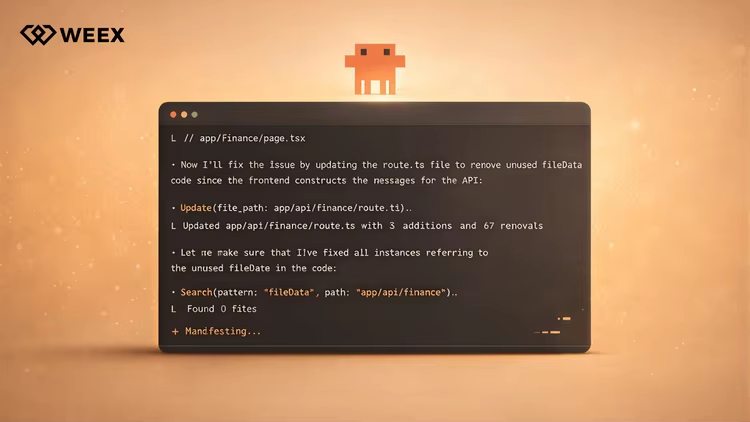
That assumption is now being challenged. Recent demonstrations of autonomous AI research agents, such as Abacus AI’s DeepAgent, point to a structural shift: AI systems are no longer just supporting research teams — they are beginning to replace the entire research-to-execution pipeline.
In crypto markets especially, this transition may arrive faster than most participants expect.
The Structural Limits of Traditional Crypto Research
Crypto research faces structural constraints. Markets run 24/7, data is fragmented across on-chain activity, derivatives, sentiment, and global macro signals, and alpha often decays within hours.
A traditional research workflow looks like this:
- Collect data from multiple sources
- Analyze macro, on-chain, and technical signals
- Form a qualitative view
- Translate that view into a trade
- Execute and manage risk
Even in well-resourced teams, this process can take days or weeks. In a fast-moving market like crypto, that delay is often fatal. More importantly, there is a persistent gap between insight and execution. Saying “the market is risk-off” does not explain how much to trade, when to enter, or how risk should be managed.
AI Agents Collapse the Research Timeline
What systems like DeepAgent demonstrate is not just faster analysis, but a compressed research-to-execution loop. Instead of producing high-level commentary, AI agents:
- Ingest real-time on-chain activity, including large wallet movements
- Monitor macro correlations across assets and markets
- Analyze sentiment at scale, across thousands of sources
- Identify technical patterns based on data and likelihood, rather than trader intuition or fixed rules
Once a market regime is identified, the system moves beyond interpretation and outputs execution-ready decisions, including trade direction, position sizing, portfolio impact, and risk parameters. Work that once required multiple specialists and weeks of coordination can now be completed in seconds. This is not intelligence as opinion, but intelligence designed for action.
Why Crypto Is the First Market to Be Fully AI-Driven
Crypto markets are unusually well-suited to this transformation.
First, crypto data is machine-native. On-chain transactions are transparent, structured, and accessible via APIs. Unlike traditional finance, there are no delayed filings or opaque balance sheets.
Second, market structure amplifies AI’s advantages. Volatility is high, noise is constant, and human emotions frequently dominate short-term price action. Consistency, discipline, and speed — areas where machines outperform humans — matter more than narrative storytelling.
Finally, crypto trading infrastructure is already automated. APIs, algorithmic execution, and real-time risk management are standard. The missing piece was not execution, but decision automation. That gap is now closing.
The Impact on Funds and Trading Organizations
For quantitative funds and hedge funds, the implications are uncomfortable but clear.
The traditional division between “research” and “trading” is eroding. Small teams equipped with strong AI systems can increasingly compete with larger organizations built around human-driven workflows.
The new competitive edge is no longer who has the smartest analyst, but who has:
- The best data pipelines
- The fastest feedback loops
- The most robust risk and execution infrastructure
In this environment, delaying AI integration is not a neutral choice. It is a strategic disadvantage.
The Next Phase of AI Trading
The next evolution of AI trading is not about marginally better predictions. It is about completeness.
Modern systems are beginning to:
- Generate strategies
- Allocate capital dynamically
- Manage portfolio-level risk
- Review performance and adapt autonomously
Trading systems are becoming self-updating decision engines, not static models.
Conclusion
The significance of AI agents replacing research teams is not that humans become irrelevant. It is that human judgment is no longer fast enough to sit at the center of crypto trading.
In highly competitive, always-on markets, the edge belongs to those who can turn information into action with minimal friction. For builders, quants, and traders exploring this shift, WEEX AI Trading Hackathon reflects where the industry is heading — towards live markets, real capital, and AI systems judged not by theory, but by performance.
The future of crypto trading is not about predicting markets better. It is about building systems that can act faster than markets can react.
About WEEX
Founded in 2018, WEEX has developed into a global crypto exchange with over 6.2 million users across more than 150 countries. The platform emphasizes security, liquidity, and usability, providing over 1,200+ spot trading pairs and offering up to 400x leverage in crypto futures trading. In addition to traditional spot and derivatives markets, WEEX is expanding rapidly in the AI era — delivering real-time AI news, empowering users with AI trading tools, and exploring innovative trade-to-earn models that make intelligent trading more accessible to everyone. Its 1,000 BTC Protection Fund further strengthens asset safety and transparency, while features such as copy trading and advanced trading tools allow users to follow professional traders and experience a more efficient, intelligent trading journey.
Follow WEEX on social media
X: @WEEX_Official
Telegram: WeexGlobal Group
YouTube: @WEEX_Global
TikTok: @weex_global
Instagram: @WEEX Exchange
Discord: WEEX Community
You may also like

AI Crypto Trading in 2026: How AI Agents Use Stablecoins for Capital Management and Settlement
Learn how AI agents use stablecoins for crypto trading in 2026 — managing capital, settling transactions, and operating across exchanges and DeFi protocols.

AI Trading's Ultimate Test: Empower Your AI Strategy with Tencent Cloud to Win $1.88M & a Bentley
AI traders! Win $1.88M & a Bentley by crushing WEEX's live-market challenge. Tencent Cloud powers your AI Trading bot - can it survive the Feb 9 finals?

How a Risk-Controlled AI Crypto Trading Bot Protects Capital in Real Markets
Ritmex demonstrates how disciplined risk control and structured signals can make an AI crypto trading bot more stable and reliable on WEEX, highlighting the importance of combining execution discipline with scalable AI trading systems.

How a Structured AI Crypto Trading Bot Won at the WEEX Hackathon
Crypto_Trade shows how structured inputs and controlled adaptability can build a more stable and reliable AI crypto trading bot within the WEEX AI Trading Hackathon, highlighting a practical path toward scalable AI trading systems.

How a Fully Automated AI Trading Bot Won at WEEX Hackathon (From 0 to AI Agent)
Nick’s journey on WEEX shows that successful AI Trading isn’t just about strategy ideas—but about structured AI agents, disciplined execution, and continuous adaptation in real market conditions.

Best AI Crypto Trading Bot? Inside the AI Trading System That Ranked Top 3 on WEEX
Discover the best AI crypto trading bot on WEEX. Learn how AI trading works, how to trade automatically, and why this system stands out among top AI trading apps.

OpenClaw and AI Bots: From AI Trading to BTC Liquidations in the Crypto Gold Rush
AI crypto trading bots like OpenClaw and AI trading apps are reshaping digital markets. From BTC liquidations to crypto bubble charts, automated trading is expanding alongside free crypto airdrops, affiliate programs, LALIGA partnerships, and tokenized gold markets.

From Human Strategy to AI Trading Bot: How Shadow Trading AI Won 2nd Place in the WEEX Hackathon
Ivan’s Shadow Trading AI secured second place in the WEEX AI Trading Hackathon, demonstrating how AI trading systems built on real market expertise can perform under live market conditions.

Who Will Control AI? Why Decentralized AI May Be the Only Alternative to Government and Big Tech
AI has become critical infrastructure, and governments and corporations are competing to control it. Centralized development and regulation are entrenching existing power structures. The Web3 community is building a decentralized alternative — distributed compute, token incentives, and community governance — before that window closes.

WEEX AI Hackathon: How Did This AI Trading Winner Succeed?
A self-taught AI trading enthusiast achieved top-10 results at the WEEX AI Hackathon. Learn about the mindset, AI tools, and lessons behind this impressive performance.

Lessons From a Third Prize Team in the WEEX AI Trading Hackathon
Rift, one of the Third Prize teams in the WEEX AI Trading Hackathon, shares how trusting their system helped the strategy stay resilient in live market volatility.

Champion Crowned at WEEX AI Hackathon: Revealing Strategy That Won $600K
A trader with only 6 months of AI trading experience won $600,000 at the WEEX AI Hackathon. Discover the strategy, tools, and lessons behind this breakthrough victory.

4 AI Trading Strategy Lessons from WEEX Hackathon Finalist
Finalist Bambi shares how AI tools helped turn real trading experience into an automated strategy, why survival-first risk control shaped the system’s design, and how the approach will evolve ahead of WEEX AI Trading Hackathon Season 2.

What Is OpenClaw? How The AI Agent Could Automate Crypto Trading Through APIs
OpenClaw is a rapidly growing AI agent on GitHub that can automate tasks and even execute crypto trades through exchange APIs. Learn how OpenClaw works, how it connects to exchanges, and the risks traders should understand before using AI trading agents.

WEEX AI Hackathon Champions Crowned, Revealing Future of AI Trading
The first-ever WEEX AI Hackathon has concluded, with 10 winners emerging from over 200 global teams. Beyond its $1.8 million prize pool, the event marked a milestone—proving that the future of AI trading belongs to accessible, AI-powered innovation.

Lessons From a Top 10 AI Trading Strategy in the WEEX AI Hackathon
A Top 10 finalist in the WEEX AI Hackathon shares how a market-neutral AI trading system competed against high-leverage strategies in live crypto markets.

From 27th to 4th: The AI Trading "Survivor Strategy" Behind a WEEX Hackathon Comeback
After a logic failure dropped him to 27th place, ClubW_9Kid rebuilt his AI trading framework and finished 4th in the WEEX AI Hackathon. In this interview, he explains the lessons behind disciplined AI execution, risk control, and why survival beats complexity in algorithmic trading.
What Is Vibe Coding? How AI Is Changing Web3 & Crypto Development
What is vibe coding? Learn how AI coding tools are lowering the barrier to Web3 development and enabling anyone to build crypto applications.
AI Crypto Trading in 2026: How AI Agents Use Stablecoins for Capital Management and Settlement
Learn how AI agents use stablecoins for crypto trading in 2026 — managing capital, settling transactions, and operating across exchanges and DeFi protocols.
AI Trading's Ultimate Test: Empower Your AI Strategy with Tencent Cloud to Win $1.88M & a Bentley
AI traders! Win $1.88M & a Bentley by crushing WEEX's live-market challenge. Tencent Cloud powers your AI Trading bot - can it survive the Feb 9 finals?
How a Risk-Controlled AI Crypto Trading Bot Protects Capital in Real Markets
Ritmex demonstrates how disciplined risk control and structured signals can make an AI crypto trading bot more stable and reliable on WEEX, highlighting the importance of combining execution discipline with scalable AI trading systems.
How a Structured AI Crypto Trading Bot Won at the WEEX Hackathon
Crypto_Trade shows how structured inputs and controlled adaptability can build a more stable and reliable AI crypto trading bot within the WEEX AI Trading Hackathon, highlighting a practical path toward scalable AI trading systems.
How a Fully Automated AI Trading Bot Won at WEEX Hackathon (From 0 to AI Agent)
Nick’s journey on WEEX shows that successful AI Trading isn’t just about strategy ideas—but about structured AI agents, disciplined execution, and continuous adaptation in real market conditions.
Best AI Crypto Trading Bot? Inside the AI Trading System That Ranked Top 3 on WEEX
Discover the best AI crypto trading bot on WEEX. Learn how AI trading works, how to trade automatically, and why this system stands out among top AI trading apps.


