
 Buy Crypto
- Markets
 Futures
- Spot
- Copy Trade
- Earn
- More
3-Day 500% Surge, $28,500 Airdrop per Person: What Makes Hyperliquid Go Wild in the Market?

Original Article Title: "Largest Airdrop of the Year? Hyperliquid Airdrops $2.85k Per Capita, HYPE Fever Sparks New Gold Rush"
Original Article Author: Frank, PANews
The long-awaited moment has finally arrived. On November 29, decentralized derivatives exchange Hyperliquid announced the genesis event of its native token, HYPE. Following the token's launch, the price of HYPE surged significantly, starting at $2 on November 29 and peaking at $9.8 on December 1, nearly quintupling in less than 3 days.
Compared to other major airdrop projects this year, HYPE's market performance has been truly impressive. In this airdrop, Hyperliquid distributed a total of 310 million tokens, meaning that even at the $2 opening price, the airdrop's value reached $620 million. Among this year's airdrops, it can certainly be considered one of the largest.
However, strangely, prior to Hyperliquid's airdrop announcement, there was little discussion among Chinese KOLs on social media, and there were not many Chinese bloggers sharing their experiences afterwards. It seems that those focused on other activities missed out on this truly big opportunity.
Airdrop Sent to 94k Addresses, Highest Airdrop Nearly $10M
According to ASXN Data, the actual airdrop amount by Hyperliquid was around 274 million tokens (some users missed out on claiming due to not signing the Genesis Event terms). A total of 94,000 addresses received the airdrop, with an average of 2,915 HYPE tokens per address. Based on the $9.8 price on December 1, this is equivalent to $2.85k. From this perspective, Hyperliquid is indeed one of the largest airdrops of the year.
However, behind the average of 2,915 tokens is the Pareto Principle, with whales pulling up the average, and the median airdrop being only 64.53 tokens. Looking at the overall distribution, around 38.7% of users received between 10 and 100 tokens, while 17.9% received less than 10 tokens. Therefore, about 56.6% of users received less than 100 tokens. The percentage of accounts receiving fewer than 1,000 tokens is 83.9%. In this light, most people did not reach the average of 2,915 tokens, but even with a few hundred dollars, Hyperliquid's airdrop could still buy you an Apple iPhone.
On a single address, the highest amount claimed is 970,000 tokens, calculated at a price of $9.8, making the airdrop on this address worth $9.56 million. This should be the address with the highest claimed value in the 2024 airdrop projects (Starknet's highest claimed value address is $360,000, Jupiter's highest claimed value address is $130,000).
Airdrop Brings 10,000 New Users in 2 Days
Despite limited promotion on social media, the results of the lavish airdrop brought in many new users to Hyperliquid. Historical data shows that prior to the airdrop, Hyperliquid's daily new users were mostly below 500, often around 150 new users. However, on November 29th and 30th, there were 10,993 new users in two days, even surpassing the number of new users in the past month. On November 30th, the total number of transactions even exceeded 3.44 million, growing over 10 times compared to pre-airdrop levels.

However, the surge in user activity does not seem to have brought a significant change in transaction volume. The total transaction volume from November 29th to November 30th was approximately $18 billion and $19 billion, showing no substantial increase. Nevertheless, compared to the sharp decline in user numbers after the airdrop in other projects, Hyperliquid's performance is indeed unique.
The growth trend of Hyperliquid has long been established. According to data from defillama, Hyperliquid Perp ranks second among all derivative protocols, slightly below Jupiter Perpetual. On November 17th, Hyperliquid briefly surpassed Jupiter to become number one. Back in July of this year, Hyperliquid was ranked fourth, following GMX and DYDX. As a rising star in decentralized derivative exchanges, Hyperliquid's ascent has long begun.
Hyperliquid Ecosystem Tokens Experience Collective Surge
As of December 1st, the market cap of HYPE exceeded $3.3 billion, ranking around 44th among all tokens, on par with OKB. ARB's market cap is currently around $4 billion. If HYPE's price continues to rise, it may directly surpass ARB.
For those who received the airdrop, the significant surge in HYPE is undoubtedly the best morale booster. On social media, many Key Opinion Leaders (KOL) have expressed that Hyperliquid, compared to those airdrops with complex rules and user gamification but received a large amount of funding, is simply a beacon of integrity for this year. However, some individual users have also pointed out that currently, HYPE is just a standalone coin that can only be traded on Hyperliquid.
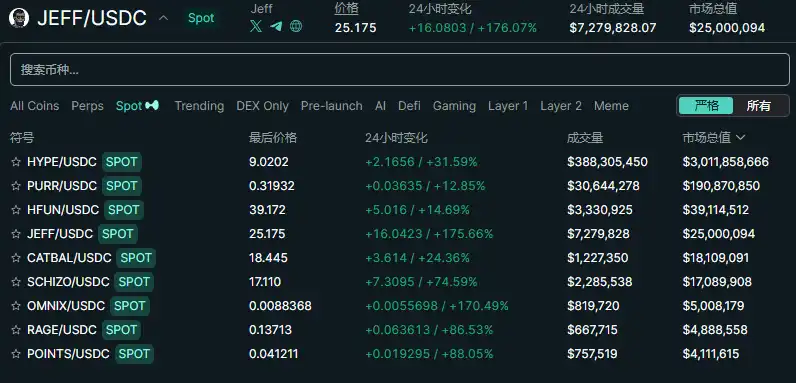
With the hype surrounding HYPE, Hyperliquid seems to have become a new gold rush territory. Apart from HYPE, other tokens on Hyperliquid have also experienced rapid price surges in this wave of excitement. From November 29 to December 1, native tokens on Hyperliquid such as PURR, JEFF, HFUN, etc., saw significant price increases. Particularly, JEFF (a MEME coin themed after Hyperliquid's founder Jeff) saw an almost 10x increase in price within three days. OMNIX has also seen exponential growth in recent days.
However, it remains unknown how long this strong uptrend can be sustained.
So far, on-chain deposits and withdrawals to Hyperliquid still need to be bridged through Arbitrum. Over 60% of USDC tokens on Arbitrum's chain belong to Hyperliquid addresses. This seems to be a mutually beneficial process where Hyperliquid brings ample active addresses and funds to Arbitrum, while Arbitrum provides stable and cost-effective infrastructure to Hyperliquid before its mainnet launch.
Up to now, Hyperliquid has not accepted any investments. In the announcement of its Genesis event, the Hyperliquid Foundation stated regarding token distribution: "There is no allocation for private investors, centralized exchanges, or market makers." Previously, PANews conducted an in-depth study on Hyperliquid's development philosophy and other related topics. (Related reading: Head MEME Coins Worth Billions, Will Hyperliquid, an L1 public chain focusing on derivative trading, become the new MEME gold rush territory?)
According to official information from Hyperliquid, the Hyperliquid EVM is currently live on the testnet, but integration with other L1 chains is not yet complete. In the short term, it seems that asset transfers through cross-chain bridges like other L1 chains cannot be performed. Furthermore, as an L1 chain, Hyperliquid's ecosystem is not yet robust, with everything from browsers to DEX being in a Hyperliquid self-operated model. This approach has its pros and cons: the benefit is that all technological innovations and development efforts are focused on improving the performance of a decentralized derivative trading platform, aiming to create a decentralized Binance. The downside is that it may be challenging to expand brand influence through ecosystem expansion.
From the official social media management of Hyperliquid, it can be seen that apart from announcements, almost no other content is posted. This is a kind of persistent simplicity, which is indeed unique in the enthusiastic but hype-driven crypto field.
However, Hyperliquid's recent surge once again confirms the idea that any marketing gimmick is insignificant in the face of price gains.
You may also like

What Is an XRP Wallet? The Best Wallets to Store XRP (2026 Updated)
An XRP wallet lets you safely store, send, and receive XRP on the XRP Ledger. Learn what wallets support XRP and discover the best XRP wallets for beginners and long-term holders in 2026.

What are the Top AI Crypto Coins? Render vs. Akash: 5 Gems Solving the 2026 GPU Crisis
What are the best AI crypto coins for the 2026 cycle? Beyond the hype, we analyze top tokens like RNDR, AKT, and FET that provide real-world solutions to the global GPU shortage and the rise of autonomous agents.

What Is a Token in AI? What Is an AI Token + 3 Gems You Can't Miss in 2026
The era of AI hype has transitioned into an era of utility. As we move through Q2 2026, the market is no longer rewarding "narrative-only" projects. At WEEX Research, we are seeing a massive capital rotation into Decentralized Compute (DePIN) and Autonomous Agent coordination layers. This guide analyzes which AI tokens are capturing institutional liquidity and how to spot high-conviction setups in a maturing market.

Consumer-grade Crypto Global Survey: Users, Revenue, and Track Distribution

Prediction Markets Under Bias

Stolen: $290 million, Three Parties Refusing to Acknowledge, Who Should Foot the Bill for the KelpDAO Incident Resolution?

ASTEROID Pumped 10,000x in Three Days, Is Meme Season Back on Ethereum?

ChainCatcher Hong Kong Themed Forum Highlights: Decoding the Growth Engine Under the Integration of Crypto Assets and Smart Economy

Why can this institution still grow by 150% when the scale of leading crypto VCs has shrunk significantly?

Anthropic's $1 trillion, compared to DeepSeek's $100 billion

Geopolitical Risk Persists, Is Bitcoin Becoming a Key Barometer?

Annualized 11.5%, Wall Street Buzzing: Is MicroStrategy's STRC Bitcoin's Savior or Destroyer?
An Obscure Open Source AI Tool Alerted on Kelp DAO's $292 million Bug 12 Days Ago

Mixin has launched USTD-margined perpetual contracts, bringing derivative trading into the chat scene.
The privacy-focused crypto wallet Mixin announced today the launch of its U-based perpetual contract (a derivative priced in USDT). Unlike traditional exchanges, Mixin has taken a new approach by "liberating" derivative trading from isolated matching engines and embedding it into the instant messaging environment.
Users can directly open positions within the app with leverage of up to 200x, while sharing positions, discussing strategies, and copy trading within private communities. Trading, social interaction, and asset management are integrated into the same interface.
Based on its non-custodial architecture, Mixin has eliminated friction from the traditional onboarding process, allowing users to participate in perpetual contract trading without identity verification.
The trading process has been streamlined into five steps:
· Choose the trading asset
· Select long or short
· Input position size and leverage
· Confirm order details
· Confirm and open the position
The interface provides real-time visualization of price, position, and profit and loss (PnL), allowing users to complete trades without switching between multiple modules.
Mixin has directly integrated social features into the derivative trading environment. Users can create private trading communities and interact around real-time positions:
· End-to-end encrypted private groups supporting up to 1024 members
· End-to-end encrypted voice communication
· One-click position sharing
· One-click trade copying
On the execution side, Mixin aggregates liquidity from multiple sources and accesses decentralized protocol and external market liquidity through a unified trading interface.
By combining social interaction with trade execution, Mixin enables users to collaborate, share, and execute trading strategies instantly within the same environment.
Mixin has also introduced a referral incentive system based on trading behavior:
· Users can join with an invite code
· Up to 60% of trading fees as referral rewards
· Incentive mechanism designed for long-term, sustainable earnings
This model aims to drive user-driven network expansion and organic growth.
Mixin's derivative transactions are built on top of its existing self-custody wallet infrastructure, with core features including:
· Separation of transaction account and asset storage
· User full control over assets
· Platform does not custody user funds
· Built-in privacy mechanisms to reduce data exposure
The system aims to strike a balance between transaction efficiency, asset security, and privacy protection.
Against the background of perpetual contracts becoming a mainstream trading tool, Mixin is exploring a different development direction by lowering barriers, enhancing social and privacy attributes.
The platform does not only view transactions as execution actions but positions them as a networked activity: transactions have social attributes, strategies can be shared, and relationships between individuals also become part of the financial system.
Mixin's design is based on a user-initiated, user-controlled model. The platform neither custodies assets nor executes transactions on behalf of users.
This model aligns with a statement issued by the U.S. Securities and Exchange Commission (SEC) on April 13, 2026, titled "Staff Statement on Whether Partial User Interface Used in Preparing Cryptocurrency Securities Transactions May Require Broker-Dealer Registration."
The statement indicates that, under the premise where transactions are entirely initiated and controlled by users, non-custodial service providers that offer neutral interfaces may not need to register as broker-dealers or exchanges.
Mixin is a decentralized, self-custodial privacy wallet designed to provide secure and efficient digital asset management services.
Its core capabilities include:
· Aggregation: integrating multi-chain assets and routing between different transaction paths to simplify user operations
· High liquidity access: connecting to various liquidity sources, including decentralized protocols and external markets
· Decentralization: achieving full user control over assets without relying on custodial intermediaries
· Privacy protection: safeguarding assets and data through MPC, CryptoNote, and end-to-end encrypted communication
Mixin has been in operation for over 8 years, supporting over 40 blockchains and more than 10,000 assets, with a global user base exceeding 10 million and an on-chain self-custodied asset scale of over $1 billion.

$600 million stolen in 20 days, ushering in the era of AI hackers in the crypto world
Vitalik's 2026 Hong Kong Web3 Summit Speech: Ethereum's Ultimate Vision as the "World Computer" and Future Roadmap
On the same day Aave introduced rsETH, why did Spark decide to exit?
Full Post-Mortem of the KelpDAO Incident: Why Did Aave, Which Was Not Compromised, End Up in Crisis Situation?
What Is an XRP Wallet? The Best Wallets to Store XRP (2026 Updated)
An XRP wallet lets you safely store, send, and receive XRP on the XRP Ledger. Learn what wallets support XRP and discover the best XRP wallets for beginners and long-term holders in 2026.
What are the Top AI Crypto Coins? Render vs. Akash: 5 Gems Solving the 2026 GPU Crisis
What are the best AI crypto coins for the 2026 cycle? Beyond the hype, we analyze top tokens like RNDR, AKT, and FET that provide real-world solutions to the global GPU shortage and the rise of autonomous agents.
What Is a Token in AI? What Is an AI Token + 3 Gems You Can't Miss in 2026
The era of AI hype has transitioned into an era of utility. As we move through Q2 2026, the market is no longer rewarding "narrative-only" projects. At WEEX Research, we are seeing a massive capital rotation into Decentralized Compute (DePIN) and Autonomous Agent coordination layers. This guide analyzes which AI tokens are capturing institutional liquidity and how to spot high-conviction setups in a maturing market.



 App
App