
0G Ecosystem Report: Enabling Decentralized AI as a Core Driver of Web3

Source: 0G Ecosystem
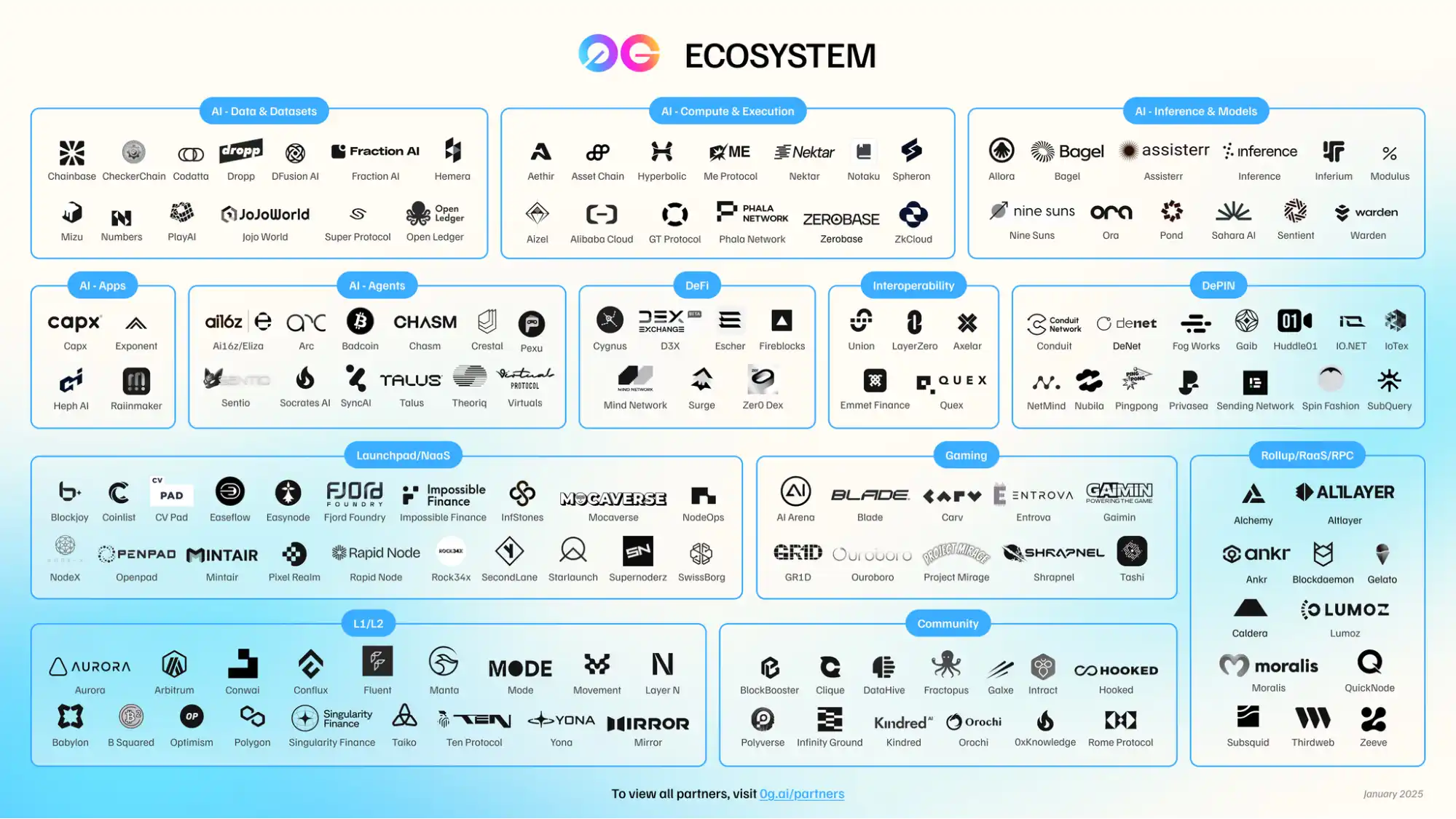
Although still in a relatively early stage of development, 0G has rapidly become a core player in the Web3 space. By 2024, we have partnered with leading projects in the Web3 space and achieved integration, continuously pushing the boundaries of decentralized AI infrastructure.
Since the release of our inaugural ecosystem report, our ecosystem has seen rapid growth. We have not only expanded our partner network but also entered new tracks within the Web3 space. For instance, on the demand side, we have partnered with DePIN, cross-chain infrastructure, and AI-driven gaming projects, showcasing the diversity and adaptability of our technology.
This report provides a comprehensive overview of the 0G ecosystem, highlighting our extensive integration capabilities and the innovative solutions we support.
This report is divided into two parts:
· Why Achieve Exponential Growth? It delves into how 0G has transformed into the world's first decentralized AI operating system (deAIOS), focusing on its unique modular infrastructure and decentralized solutions that have driven its widespread adoption in the Web3 space.
· Projects Empowered by 0G: It outlines various projects leveraging 0G's deAIOS to provide services such as storage, data availability, AI resources, covering various verticals within Web3.
· Core Pillars of the 0G Ecosystem: The foundational technologies that support 0G's success, including GPUs, indexing tools, oracles, zero-knowledge (ZK) technology, interoperability infrastructure, and more.
Deciphering 0G's Strong Momentum: Key to Success
The current AI infrastructure is highly centralized, leading to issues such as data ownership, transparency, mismatched profit models, and incentive mechanisms. Historically, decentralized AI has been considered challenging to achieve due to limitations in scalability, latency, and coordination of distributed systems under high-performance workloads.
As the foundational layer of decentralized AI, 0G has redefined this possibility, providing users not only full control over data but also enabling a transparent decision-making process and fair profit distribution. At the core of this transformation is our ability to coordinate distributed hardware resources like storage, computational power, and data availability through a decentralized AI operating system (deAIOS), unlocking the true potential of decentralized AI.
By integrating modular systems and advanced technology, the 0G AI infrastructure can seamlessly integrate with any project or workflow, ultimately bringing decentralized AI onto the chain.
This includes several architecture components designed to support various aspects of AI workflows:
· 0G Storage: a decentralized network designed to efficiently and securely handle massive data loads.
· 0G DA (Data Availability): an infinitely scalable and programmable data availability layer that provides end users with seamless data access and validation.
· 0G Service Marketplace: an AI service marketplace platform for inferencing, expected to add more services such as AI models and datasets by 2025.
· 0G Compute: an AI service marketplace tailored for computing resources like GPUs, supported by partners such as Aethir and Akash Network.
Any project looking to achieve on-chain data storage, fast and low-cost data availability, access to various computing resources, etc., can consider 0G as an all-in-one solution. This comprehensive capability is in high demand in the industry, leading to partnerships with numerous partners from various verticals.
For example, 0G enables gaming projects to run entirely on-chain without sacrificing performance or cost efficiency. The DePIN project relies on 0G to achieve secure metadata storage and rapid data retrieval, enabling seamless communication between decentralized systems.
In this report, we will explore how various projects in AI, gaming, and other fields actively leverage 0G's decentralized AI Operating System (dAIOS) to showcase the adaptability and impact of our technology.
Projects Using 0G
AI Projects
One of the main challenges facing current AI projects is the difficulty of fully storing data on-chain and retrieving it quickly. Even with existing on-chain databases, these databases are often disjointed from AI systems, leading to interoperability issues and processing delays.
0G provides an integrated AI solution that enables any AI project to not only leverage 0G to store its massive datasets but also access other datasets, while incorporating highly scalable data availability and the ability to on-demand access GPU computing resources.
0G-supported AI projects can be divided into several different areas:
· Inference & Modeling: Providing real-time on-chain AI inference capabilities and access to pre-trained AI models for efficient deployment. For example, Pond is creating a community-generated AI model hub, while Assisterr focuses on bringing small language models (SLMs) on-chain for specific use cases.
· Training & Fine-Tuning: Leveraging decentralized storage and computing resources to help developers securely train and fine-tune AI models. For example, Bagel orchestrates data storage for AI model fine-tuning, allowing developers to efficiently manage and retrieve datasets.
· Applications: Supporting a variety of AI-driven applications, including analytics tools, recommendation systems, and more. For instance, Capx will utilize 0G Storage to serve its vector database needs.
· Agents: Facilitating the creation and deployment of autonomous AI agents, ensuring secure access to on-chain datasets and computing resources, such as Talus and Theoriq.
Many projects also leverage 0G DA and the 0G Service Marketplace, for example, Talus, accessing and querying data in the network via 0G DA.
Gaming
Gaming has long faced many challenges when running on-chain, such as scalability issues, high transaction costs, and the complexity of real-time management of decentralized data. These limitations have made it difficult for developers to create games with Web2 performance, let alone integrate AI-driven features that require large-scale computation and data availability.
By leveraging 0G, game projects can now overcome these challenges, utilizing 0G Storage for secure and decentralized game data storage, leveraging 0G DA to provide scalable data availability, and integrating AI-driven game mechanics through 0G Compute. This infrastructure enables games to run with real-time responsiveness, verifiable outcomes, and lower development costs while providing players with true asset ownership and transparency.
For example, Blade Games uses 0G to store game state on-chain, including storing ZK proofs that are verifiable by anyone and task IDs (unique identifiers for in-game actions).
Likewise, Neon Machine (founded by Shrapnel) will integrate 0G Storage to ensure the integrity of in-game assets in a shooter game. Meanwhile, Gaimin leverages 0G DA to distribute rewards to players in real-time and stores metadata through 0G DA, such as players' ownership of in-game assets.
Zero-Knowledge Proofs
Zero-Knowledge Proofs (ZK Proofs), as a transformative technology in Web3, enable trustless verification without revealing sensitive information. However, due to the computational intensity of proof generation, the complexity of managing secure environments, and the challenges of efficiently integrating with decentralized systems, many projects still face hurdles when scaling the application of ZK technology.
Projects like Gevulot and Orochi Network rely on 0G to support the generation of ZK proofs and the construction of secure computing environments. For example, Orochi stores its zkDatabase data on 0G and optimizes the deployment of its zkMemory AI models through 0G DA.
Cross-Chain and Web3 Infrastructure
Existing AI infrastructure solutions suffer from fragmentation, only running on certain networks (such as some Layer 2 networks). In contrast, the 0G network itself is compatible with other networks, and 0G DA can ensure security when transferring assets and information across networks.
Because of this, 0G is supporting RAAS (Rollups-as-a-Service) projects like AltLayer, Caldera, and Rome Protocol.
Seamless interoperability is crucial for expanding Web3. 0G is collaborating with infrastructure projects like Rome Protocol and AltLayer to provide scalable data solutions for application chains and cross-chain services. Platforms such as Hemera and Redstone enhance data indexing and oracle capabilities, while industry leaders like Galxe are integrating 0G into applications such as AI, storage, and marketing.
L1, L2, and Rollups-as-a-Service
Web3 will focus on developing application chains (App-Chains) tailored to different needs. However, to achieve this goal, robust data availability and secure interoperability are needed to support efficient operation. 0G can not only provide this support but also offer native access to other products and services, including 0G Storage and 0G Service Marketplace, enabling anyone to access GPU and other AI resources.
This means that any Layer 1, Layer 2, or Rollup-as-a-Service can automatically provide developers on their network access to AI resources and tools.
This is particularly crucial as it offers developers a competitive advantage in choosing a development platform while providing them with an all-in-one solution without having to integrate multiple disparate components (such as standalone storage solutions and data availability solutions) and piece them together.
Well-known RAAS providers like AltLayer, Caldera, and Rome Protocol are leveraging 0G to offer high-performance, scalable, and decentralized infrastructure for their application chains. Additionally, leading Layer 1 and Layer 2 networks, including Arbitrum and Optimism, are using 0G to enhance their scalability, interoperability, and access to AI resources.
DePIN
The Decentralized Physical Infrastructure Network (DePIN) faces many challenges when connecting real-world data with on-chain applications, including secure and efficient data collection, the high cost of required scalability, and the complexity of maintaining decentralized communication infrastructure. Furthermore, many DePIN projects still encounter bottlenecks in acquiring affordable and scalable computing resources for real-time applications.
0G directly addresses these issues by providing robust foundational support for the DePIN network. For example:
· IoTeX and Mizu: Utilize 0G to achieve secure, decentralized data collection and communication between devices, ensuring reliable integration between physical systems and on-chain systems.
· Hyperbolic: Democratizes GPU computing power through 0G, providing a more equitable and efficient computing infrastructure to empower DePIN projects.
· Huddle01 and NetMind: Leverage 0G to offer decentralized storage and communication infrastructure to support real-time applications.
By providing the tools and infrastructure needed to address these challenges, 0G is helping the DePIN network build a new generation of interconnected decentralized systems.
Other Projects
0G serves a wide range of projects, demonstrating the versatility of its infrastructure across almost every domain.
For example, 0G supports the Decentralized Identity (DID) project Humanity Protocol. This project utilizes 0G Storage to store metadata and performs quick queries and verification of this data through 0G DA.
Simultaneously, Galxe is a highly anticipated decentralized super app in the industry, relying on 0G Serving, DA, and Storage to provide scalable and secure operational support.
0G Collaborative Projects
0G has also collaborated with key projects to advance its own technology.
For example, 0G utilizes GPU-accelerated erasure coding (used by 0G Storage to split data into multiple data blocks for dispersed storage). To achieve this, 0G has leveraged the computational power of projects such as Aethir, Spheron, and Zeeve.
0G also needs to provide data feeds for projects built on 0G, making collaboration with leading oracle service providers such as Hemera and Quex crucial. This collaboration allows projects built on 0G to customize their data sources, expand the range and diversity of available data points, and enhance fault tolerance.
Furthermore, we have partnered with EigenLayer and Babylon to provide robust staking solutions to enhance network security. These solutions are not only available for partners to use, but we also plan to integrate them into future products.
2025 Outlook
As we enter 2025, 0G will further deepen its collaborations with leading projects in the Web3 space, solidifying its position as a decentralized AI innovation powerhouse.
Building on this foundation, we will expand our product portfolio, including the newly launched Compute Network, a decentralized AI services marketplace offering inference, RAG (Retrieval-Augmented Generation), and model hosting services.
Additionally, we have more products set to be released soon, with details to be announced in the near future.
「Original Article Link」
You may also like

In the name of charity, for the benefit of the family: How the Trump family turned charity into profit?

Will Gold Break $4,500 After Tonight's Fed Decision? What XAUT and PAXG Traders Need to Know

Cursor, why did you get on Musk's spaceship?

Morning Report | DeepSeek completes over $7 billion in financing, with a valuation exceeding $50 billion; Musk's personal wealth has surpassed the total market value of Bitcoin

SharpLink CEO: How to understand that Ethereum developers have just surpassed 1 million?

Morning Report | MiCA grace period expires on July 1; Kalshi's trading volume in the first week of the World Cup breaks $5.1 billion, setting a record

The foundation of SpaceX's trillion-dollar valuation: Who is dividing Musk's annual capital expenditure of tens of billions?

How to exit after asset tokenization?

The stablecoin positioning battle escalates: When compliance is just a ticket to entry, will USD1 become the biggest winner?

A16Z: The sun bears witness, SpaceX is worth 7.5 trillion
Mergers and acquisitions in the cryptocurrency market are exceptionally active

Concerns Behind the Binance Customer Service Controversy

SpaceX Stock Prediction After the IPO: Can SPCX Reach $200 Before QQQ Inclusion?

Congratulations to Carl Moon on His Historic Ferrari Challenge Le Mans Podium Triumph
Crypto influencer and racing enthusiast Carl Moon finished third in the Ferrari Challenge Le Mans Coppa Shell class, marking his best result of the year. As his racing partner and sponsor, WEEX celebrates this remarkable achievement and continues to lead crypto’s journey beyond boundaries, uniting the innovation of digital assets with the passion of motorsport.
Can the CLARITY Act Become Law by July 4? Everything You Need to Know About the Final Battle

France vs Senegal World Cup 2026: Mbappe’s New Era Begins Against a Historic Rival
What is the connection between Huang Zheng of Pinduoduo and blockchain?

Morning Report | Prediction market platforms like Kalshi and Polymarket jointly sue Kentucky over 14.25% trading tax; Bridgewater founder discusses decision-making in the AI era: principled thinking should run parallel to AI, human insight remains irre...
In the name of charity, for the benefit of the family: How the Trump family turned charity into profit?
Will Gold Break $4,500 After Tonight's Fed Decision? What XAUT and PAXG Traders Need to Know
Cursor, why did you get on Musk's spaceship?
Morning Report | DeepSeek completes over $7 billion in financing, with a valuation exceeding $50 billion; Musk's personal wealth has surpassed the total market value of Bitcoin
SharpLink CEO: How to understand that Ethereum developers have just surpassed 1 million?
Morning Report | MiCA grace period expires on July 1; Kalshi's trading volume in the first week of the World Cup breaks $5.1 billion, setting a record


